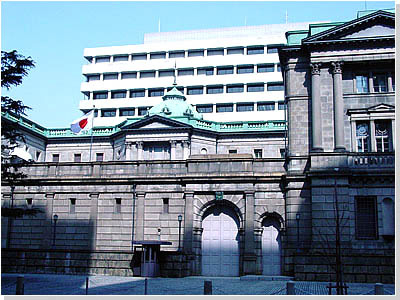
The Bank of Japan Head Office consists of the Old Building (including the Main Building and Buildings 2 and 3), the New Building, and the Annex Building.
The Main Building, the oldest of the Bank's current buildings, was completed in 1896. Besides the Akasaka Palace, the State Guest House (Geihinkan) in Tokyo, it is said to be one of the best examples of Western-style architecture of the Meiji period (1868-1912) and is designated an important cultural property by the Japanese government.
BOJ Deputy Governor Advocates Holistic Approach on Global Monetary System
TOKYO — In a major address outlining the future of international finance, Bank of Japan (BOJ) Deputy Governor Ryozo Himino called for a "holistic approach" to designing the global monetary system. Speaking at the spring annual meeting of the Japan Society of Monetary Economics, Himino argued that the global community must look beyond a narrow debate centered solely on Central Bank Digital Currencies (CBDCs) and stablecoins.
Beyond CBDCs and Stablecoins
Himino highlighted the diverging paths currently being taken by major global economies. While the United States has restricted the issuance of CBDCs in favor of promoting private stablecoins to reinforce the global dominance of the dollar, Europe is aggressively pushing forward with the digital euro to counteract payment system fragmentation across the region.
However, Himino emphasized that the future financial architecture should not be limited to these two options. He urged policymakers to consider a broader spectrum of innovations, including:
Tokenized Bank Deposits: Utilizing commercial bank money in digital asset formats.
Blockchain-Based Central Bank Reserves: Integrating distributed ledger technology (DLT) directly into the interbank layer.
"Options for the future monetary system are not limited to CBDCs and stablecoins," Himino stated, emphasizing the need for a comprehensive framework that prioritizes "singleness of money" alongside technological efficiency.
Japan’s "Two-Path" Strategy
Positioning Japan as a proactive bridge in the global landscape, Himino noted that the country is actively preparing for multiple scenarios. Japan has already enacted pioneering stablecoin legislation while concurrently advancing its retail CBDC pilot program.
To push boundaries further, the BOJ has launched a "sandbox project" to test the feasibility of tokenizing central bank reserves. Analysts note that running interbank settlements on a blockchain network could enable instantaneous, 24/7 clearing and significantly reduce the risk of settlement "gridlocks" during periods of financial stress.
Navigating Structural Vulnerabilities
The Deputy Governor's remarks come at a time when the post-Bretton Woods monetary system is facing heightened pressure. Recent geopolitical conflicts and shipping disruptions in vital trade routes like the Strait of Hormuz have strained global dollar liquidity, exposing architectural weaknesses. Himino identified key focus areas that a holistic redesign must address:
Exchange Rate Volatility: Buffering economies against sudden market swings.
Funding Strains: Managing dollar liquidity shortages in emerging markets.
Payment System Fragmentation: Improving cross-border retail and wholesale payment interoperability.
Ultimately, Himino stressed that any successful evolution of the global monetary infrastructure must carefully balance five core pillars: technical feasibility, social costs, user convenience, financial stability, and monetary policy effectiveness.$JTO $JOE $BTC