
The internet has always depended on invisible labor. Not the kind people usually talk about, but the quiet human activity happening every second behind screens. Someone answers a question in a forum. Someone tags an image. Someone leaves a review after a bad meal. Someone spends years building niche knowledge online without expecting payment for it. Individually, these actions feel meaningless. Together, they became the foundation of artificial intelligence.
What makes the current AI era uncomfortable for many people is not simply the speed of innovation. It is the realization that modern AI systems were built from millions of scattered human contributions that were never treated as labor in the first place. The internet trained people to think of participation as free expression while large systems quietly transformed that participation into economic value.
For years, most users accepted this arrangement because the exchange seemed fair enough. Platforms offered convenience, entertainment, and communication tools in return for attention and data. But artificial intelligence changed the scale of extraction. AI does not just observe human behavior anymore. It absorbs patterns, language, decision-making styles, emotions, and creativity itself.
That shift created a difficult question the technology industry still struggles to answer honestly: if human knowledge powers AI systems, what exactly do contributors receive after their information becomes part of those systems?
Traditional technology companies solved this problem through ownership. They controlled the servers, the models, the datasets, and the distribution channels. Users remained participants, but not stakeholders. Even many AI startups today operate under the same structure. Data enters privately owned systems, value accumulates centrally, and the people contributing indirectly remain disconnected from the outcome.
Blockchain projects attempted to challenge this imbalance before, but many misunderstood the deeper issue. They focused heavily on token mechanics while ignoring the reality that most people do not want to become full-time managers of digital assets. Some decentralized data marketplaces looked impressive conceptually but struggled to create ecosystems where ordinary contributors actually benefited in practical ways.
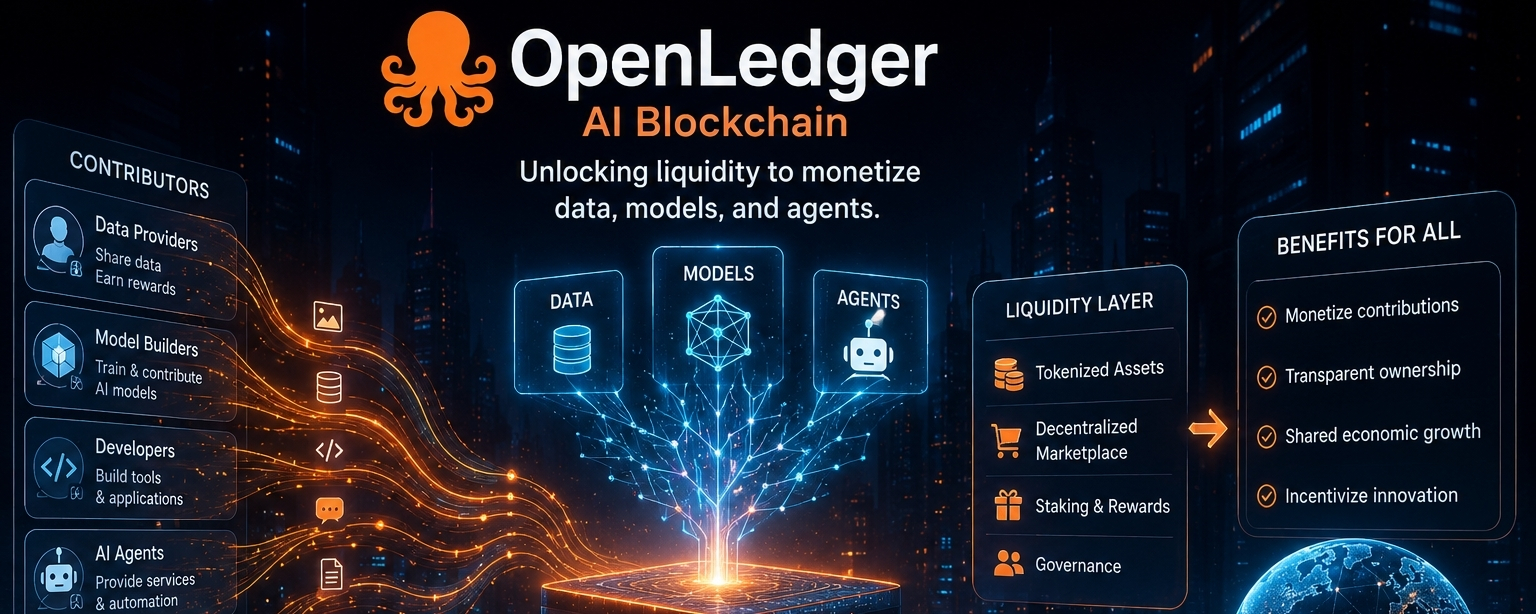
This is where enters the conversation from a slightly different direction. The project does not appear to frame AI as a product alone. Instead, it treats AI as an economy made up of multiple layers of contribution — data providers, model creators, developers, autonomous agents, and users interacting inside the same network.
The interesting part is not simply the use of blockchain technology. Many projects use blockchain. The more important idea is the attempt to make intelligence itself economically traceable. OpenLedger seems to explore whether the creation of AI can become a process where value moves through contributors more visibly rather than disappearing into centralized systems.
In simple terms, the project appears interested in turning AI resources into assets that can circulate openly. Data, models, and intelligent agents are treated less like hidden infrastructure and more like components inside a shared marketplace. That may sound technical, but the underlying social idea is actually straightforward: if many people help create intelligence, perhaps more people should participate in its economic outcomes.
Still, this approach raises difficult trade-offs that deserve attention.
One concern is whether monetizing human contribution changes the nature of online participation itself. The internet historically produced valuable information partly because people shared knowledge freely, emotionally, and sometimes irrationally. Once financial incentives enter the process directly, behavior may shift toward optimization. People could begin producing information not because it is meaningful or truthful, but because it generates rewards.
That risk becomes even larger in AI ecosystems where scale matters. Networks may become flooded with synthetic content, recycled information, or low-quality contributions designed to exploit incentive systems. Building an open marketplace for intelligence sounds appealing, but maintaining trust inside that marketplace may prove far more difficult than creating it.
There is also a deeper structural issue. Open systems often promise decentralization while gradually concentrating influence among technically sophisticated participants. The people with stronger infrastructure, computational resources, and access to quality datasets may still dominate outcomes over time. In that scenario, smaller contributors participate symbolically while larger actors capture most of the economic value.
Privacy creates another uncomfortable contradiction. Projects discussing ownership and monetization of data frequently emphasize empowerment, but economic pressure can encourage people to share more information than they otherwise would. Turning personal data into an asset may offer opportunities, yet it also risks normalizing a world where human experience itself becomes increasingly transactional.
Even the idea of autonomous AI agents participating economically deserves skepticism. Intelligent agents coordinating resources independently may improve efficiency, but automation often removes visibility from decision-making processes. When systems become too complex for ordinary users to understand, transparency alone may no longer create meaningful accountability.
Despite these uncertainties, projects like OpenLedger reveal something important about the direction technology is heading. The debate around AI is slowly moving away from raw capability and toward ownership, participation, and economic structure. The real tension may not be about whether AI becomes powerful. That already seems inevitable. The harder question is who remains connected to the value created by that power once intelligence itself becomes part of global digital infrastructure.
Perhaps the most uncomfortable possibility is that the future internet will no longer distinguish clearly between users, workers, and data sources. If that happens, projects like OpenLedger may matter less for the technology they build and more for the question they force people to confront: when human knowledge becomes programmable capital, does participation online still feel voluntary — or does it quietly become another form of invisible labor?
