
The modern internet has created a strange kind of loneliness. Billions of people are constantly contributing knowledge, emotions, opinions, corrections, conversations, and creativity online, yet almost none of them feel ownership over the digital systems growing from their participation.
Artificial intelligence made this contradiction impossible to ignore.
Every AI model depends on human traces. Not just official datasets or research libraries, but ordinary behavior. The way people speak. The mistakes they make. The sarcasm hidden inside comments. The patterns behind decisions. AI systems are not learning from machines alone. They are learning from collective human existence.
But there is an uncomfortable reality beneath this process: the crowd creates the intelligence, while a small number of institutions often control the outcome.
That imbalance is quietly becoming one of the most important discussions in technology, and projects like are emerging directly from that tension.
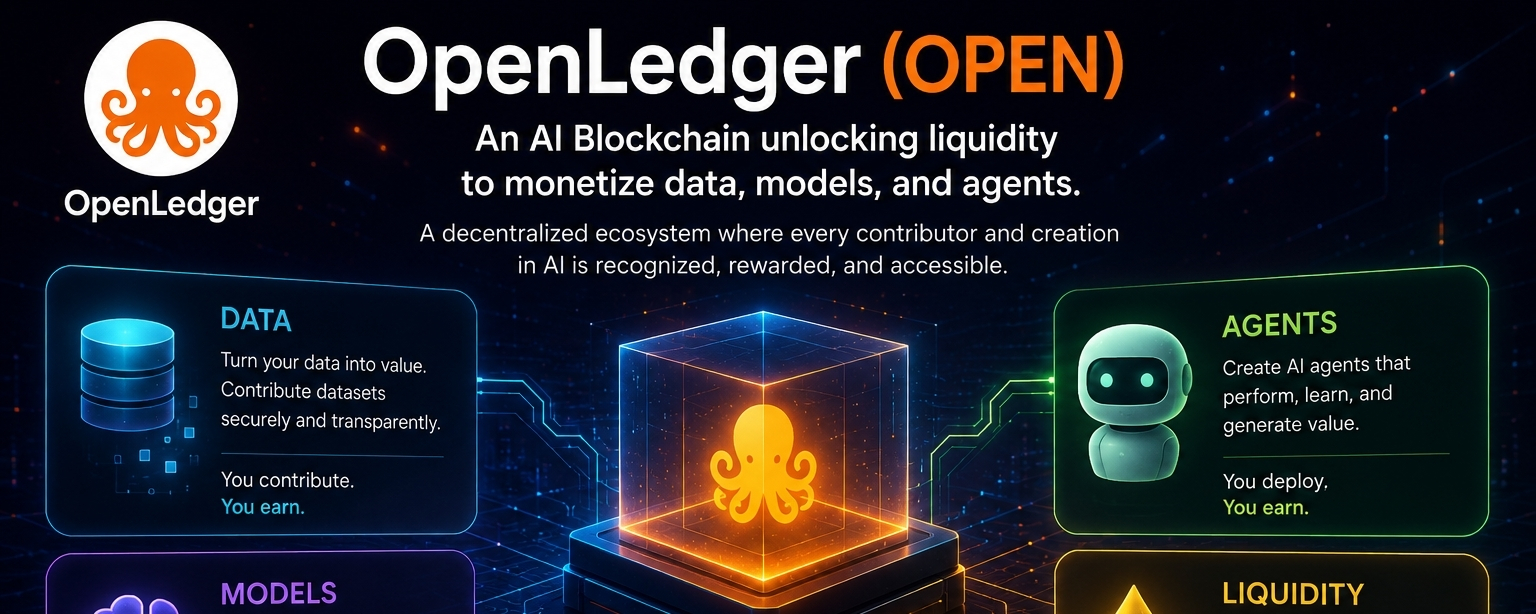
Unlike many blockchain projects that focus only on finance or infrastructure, OpenLedger approaches AI from a different angle. It treats artificial intelligence less like software and more like an economy of participation. The project attempts to create a blockchain environment where data, AI models, and autonomous agents can interact as measurable digital assets rather than invisible background processes.
At first glance, this may sound similar to older crypto narratives about decentralization. But the deeper idea here feels slightly different. OpenLedger is not simply asking how AI can become decentralized. It is asking whether intelligence itself can become economically shared.
That distinction matters because the internet’s current AI structure remains heavily centralized. Large technology firms possess the storage, computing power, engineering talent, and massive datasets required to train advanced models. Smaller developers often depend on systems they cannot fully inspect or influence. Ordinary users contribute data continuously while remaining disconnected from the value created around it.
Previous attempts to solve this problem usually failed because they approached the issue from narrow technical directions. Some projects tried building decentralized data markets, assuming raw information alone carried value. Others focused only on computational infrastructure or token incentives. But AI ecosystems are more complicated than isolated tools. Intelligence emerges from relationships between data, models, feedback loops, and real-world usage.
OpenLedger appears to recognize this interconnected structure. The project’s design revolves around the idea that contributors across the AI pipeline — whether supplying data, refining models, or operating AI agents — should exist inside the same economic framework.
In simple terms, it is attempting to build an accounting layer for artificial intelligence.
That concept introduces both possibility and uncertainty.
On one hand, blockchain technology offers transparency that traditional AI systems often lack. Most people currently have little visibility into how their data is collected, where it travels, or how models evolve from it. A decentralized ledger could theoretically create clearer records around contribution and attribution.
But transparency is not the same thing as fairness.
One of the hardest problems inside AI economies is determining value itself. Human knowledge is uneven, contextual, and difficult to measure. A scientist uploading specialized research data contributes differently from a casual user interacting with an AI chatbot. A small correction inside a dataset could become more valuable than thousands of generic inputs. Translating human contribution into programmable economic logic may be far messier than blockchain systems expect.
There is also a philosophical question hidden underneath projects like OpenLedger: should every form of human interaction eventually become monetized?
The internet already transformed attention into currency. Social media converted emotion into engagement metrics. Streaming platforms turned creativity into algorithmic performance. If AI networks begin assigning financial value to conversations, behaviors, and knowledge contributions, society may move even deeper into a world where human experience is constantly measured economically.
Some people may view that as empowerment. Others may see it as another layer of extraction wrapped in decentralization language.
Another challenge involves accessibility. Blockchain systems often assume users are comfortable navigating wallets, tokens, governance structures, and digital identity tools. But many people generating valuable AI data are not crypto-native participants. If systems become too technically complex, the benefits may still concentrate among specialized communities while ordinary contributors remain peripheral.
There is also the reality of power concentration. Decentralized infrastructure does not automatically prevent inequality. AI development still depends heavily on computing resources, network scale, and capital access. Large actors may continue dominating decentralized ecosystems simply because they possess stronger operational advantages.
Even so, projects like OpenLedger reveal something meaningful about the direction of technological anxiety today.
For years, conversations around AI focused almost entirely on capability. How intelligent can machines become? How quickly can automation scale? Which models outperform others?
Now the discussion is slowly changing.
People are beginning to ask who owns the intelligence being created, who benefits from automated systems, and whether the people feeding AI networks deserve more than passive participation.
That shift may ultimately matter more than any single blockchain project.
Because beneath the technical architecture, token systems, and infrastructure debates sits a far more human question:
If artificial intelligence is increasingly built from the behaviors, language, and knowledge of billions of ordinary people, can the future of AI really belong to only a handful of institutions?
