
Most of the value in AI does not begin with the final answer we see on a screen. It begins much earlier. It begins with the data someone collected, the model someone trained, the small improvement someone made, the agent someone deployed, or the narrow piece of knowledge that helped a system become more useful.
But you can usually tell that this value is hard to trace.
A model gives an output. A user sees the result. Maybe the result is useful. Maybe it helps write code, answer a question, sort information, or make a decision. But behind that moment, there may be thousands or millions of pieces that shaped what happened. The people who created those pieces often disappear into the background. The data becomes invisible. The model becomes the only thing people notice.
That’s where things get interesting with OpenLedger.
It is trying to make AI assets feel less like locked boxes and more like things that can be tracked, used, and rewarded. Data, models, and agents are not just passive inputs in this view. They become assets with a history. They can have ownership, usage, attribution, and, maybe most importantly, a path toward earning value when they are actually useful.
The word “liquidity” can sound cold at first. It feels like something from trading screens and financial markets. But in this case, the idea is a little more practical. Liquidity means that something which was stuck can begin to move. A dataset that only sat on someone’s drive can become part of a larger system. A model that was trained for one narrow task can be shared or used by others. An agent that performs a useful action can become part of a network instead of living alone inside one app.
The question changes from “Who owns the AI?” to “Who contributed to what the AI can do?”
That is a different kind of question.
A lot of AI today feels powerful but unclear. You can use it, but you do not always know where its knowledge came from. You can benefit from it, but you cannot easily see who helped make it better. And for people who create useful data or train useful models, that can feel strange after a while. Their work may improve systems, but the value often travels somewhere else.
@OpenLedger seems to be looking at that gap.
It does not treat AI as one giant model sitting at the center of everything. It looks more like a network of smaller parts. Some people bring data. Some build models. Some create agents. Some use them. Some improve them. The chain, in theory, becomes the place where these actions leave a record.
That record matters because attribution matters.
Attribution is not just about giving credit in a nice way. It is also about knowing what actually shaped an outcome. If a piece of data helps improve a model, that should mean something. If a model is used by an agent, that should be visible. If an agent creates value through repeated use, that value should not be completely separated from the people and resources that made it possible.
This is not a small problem. It becomes obvious after a while that AI has a memory problem, not in the technical sense, but in the social and economic sense. It remembers patterns, but it often forgets contributors.
Blockchain, in this context, is not interesting because it sounds futuristic. It is interesting only if it helps keep track of these relationships in a way that cannot be quietly rewritten or ignored. That is the calmer way to look at it. Not as a magic layer. More like a shared notebook that records who added what, who used what, and what happened after.
$OPEN , as the token connected to OpenLedger, sits inside that system. It is not the whole story by itself. Tokens often get too much attention because they are easy to measure. Price moves. Charts move. People react. But the more important question is slower: does the network create real reasons for data, models, and agents to be used and valued?
That part takes time.
For OpenLedger to matter, it would need more than a strong idea. It would need useful data. It would need builders who want to create models there. It would need agents that people actually use. It would need attribution that feels fair enough for contributors and simple enough for users. Those are not easy things.
Still, the direction is worth noticing.
AI is moving toward a world where many small, specialized systems may matter as much as the large general ones. Not every problem needs one huge model. Some problems need very specific knowledge, clean data, and clear ownership. In that kind of world, the ability to trace and reward contribution becomes more important.
#OpenLedger is trying to live in that space.
Not just AI as output.
Not just blockchain as speculation.
But the quieter place between them, where people ask how value is created, where it goes, and who gets remembered when the system works.
And maybe that is the part to keep watching. Not the loud claim, but the simple shift underneath it. Data, models, and agents have always carried value. OpenLedger is asking what happens when that value becomes visible enough to move...
@OpenLedger #OpenLedger $OPEN

Άρθρο
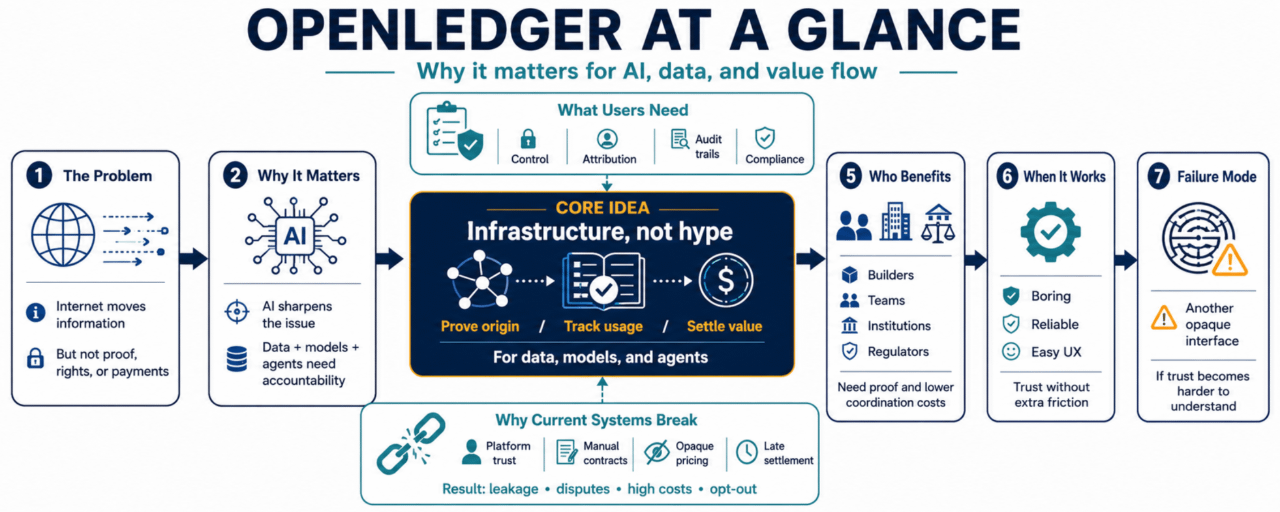
OpenLedger is built around a simple idea, but it takes a little time to sit with it.
Αποποίηση ευθυνών: Περιλαμβάνει γνώμες τρίτων. Δεν είναι οικονομική συμβουλή. Ενδέχεται να περιλαμβάνει χορηγούμενο περιεχόμενο. Δείτε τους Όρους και προϋποθέσεις.