
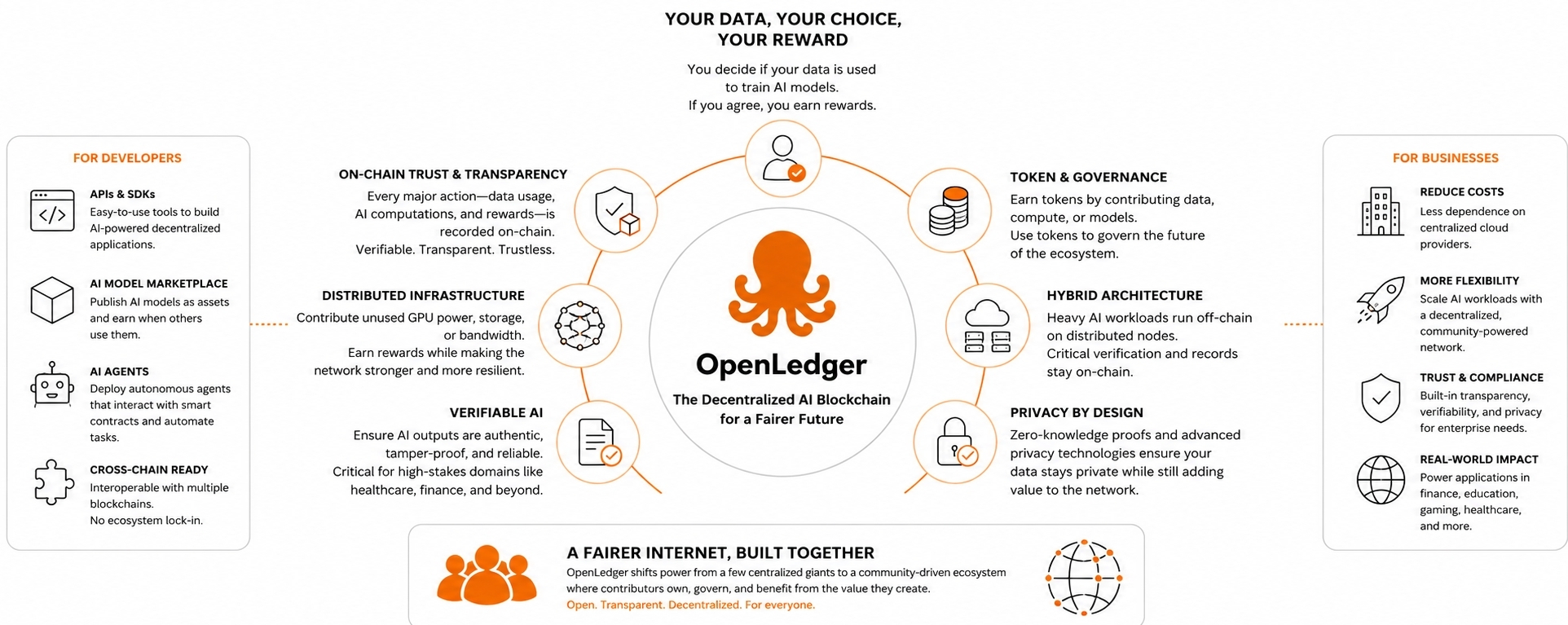
I just went through this whole idea about OpenLedger, and honestly, it’s trying to tackle exactly that problem. So instead of a few big tech giants owning basically everything we do online our photos, searches, messages, even location data it flips the model a bit.
The idea is pretty simple on the surface: your data should actually mean something to you, not just some company sitting on a server farm making money off it. With @OpenLedger you can choose if your data gets used to train AI models, and if you’re cool with it, you actually get rewarded for it. So instead of just handing your data away for free, it’s more like you’re contributing an asset and getting something back.
What really stood out to me is how they use blockchain for trust. I just read through how every major action like data usage, AI computations, and rewards distribution is recorded on-chain. So there’s no “hidden black box” where someone can quietly mess with things. You can literally verify what’s going on.
They also spread the computing side out instead of relying on one big centralized cloud. So people can chip in unused GPU power, storage, or bandwidth, and get paid for it. I kind of like this part because it makes the system feel less fragile like there’s no single point that can just crash everything.$OPEN
Another thing I found interesting is the “verifiable AI” concept. Basically, the system can check whether an AI’s output is legit and hasn’t been tampered with. That’s a big deal if you think about sensitive stuff like healthcare or finance where wrong info could actually cause real damage.
There’s also a token system involved. I see it as both a reward mechanism and a governance tool. If you contribute whether it’s data, computing, or models you earn tokens, and then you can use them to vote on how the system evolves. So it’s not one company making all the decisions; it’s more community-driven.
To keep things efficient, they run heavy AI workloads off-chain across distributed nodes, while the important verification and records stay on-chain. And from what I understand, it can connect with other blockchains too, so it’s not locked into one ecosystem.
Privacy-wise, they’re using stuff like zero knowledge proofs, which basically let the system confirm something is valid without exposing the actual sensitive data. That part feels pretty important because it tries to balance transparency with privacy instead of choosing one or the other.
For developers, it kind of works like a toolkit. I just saw how they provide APIs and SDKs so people can build apps in areas like finance, education, gaming, healthcare pretty much anything. You can even publish AI models as assets that others can pay to use, like a marketplace for intelligence.
And then there are AI agents that can run on their own, interacting with smart contracts and automating tasks without constant human input. For businesses, that could mean less dependence on expensive centralized cloud providers and more flexibility overall.
At the end of the day, the whole thing is trying to shift power a bit from a few companies owning everything to a system where people who actually contribute resources also benefit from them. I just finished going through it, and even if it’s not perfect yet, the direction definitely feels more open and fair than how the internet usually works right now.