
A year ago, I probably would’ve separated AI infrastructure and crypto infrastructure without even thinking about it.
Now I’m not so sure the distinction holds up anymore.
The deeper AI goes, the less it feels like a normal software industry. It feels heavier than that. More industrial. More dependent on physical systems most people never see.
The conversation online still revolves around models and chatbots, but underneath that there’s an entirely different race happening. GPU supply. Energy access. Data ownership. Compute contracts. Entire warehouses running nonstop just to keep these systems alive.
That layer matters more than people admit.
And that’s partly why OpenLedger caught my attention.
Not because “AI + blockchain” suddenly sounds convincing. Honestly, that narrative has been stretched so far that most people instinctively tune it out now. Crypto has attached itself to enough trends already.
But OpenLedger feels like it’s pointing toward something slightly different.
Less about building another AI product.
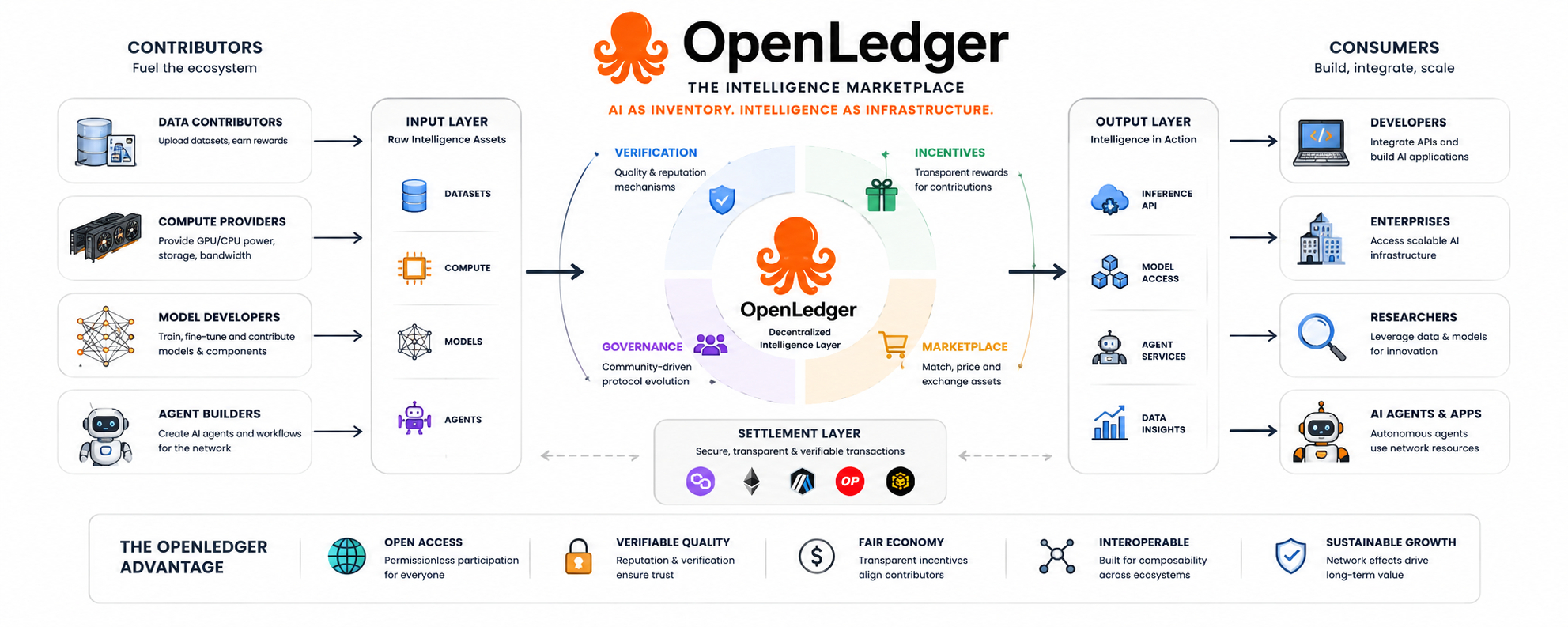
More about turning intelligence itself into something markets can organize and move around.
That idea sounds abstract at first, but crypto has been moving in this direction for years without people fully noticing the pattern. The industry is extremely good at taking things that normally stay static and pushing them into circulation. Capital, ownership, access, even attention eventually become tradable once infrastructure exists around them.
AI now seems to be entering that phase.
Datasets become economic assets instead of private archives. Compute becomes rentable infrastructure instead of something locked inside a single company. Models stop looking like standalone software and start behaving more like network resources people can access, contribute to, or monetize.
Even AI agents are starting to feel less like tools and more like participants inside digital economies.
That shift is fascinating.
It’s also where I start getting skeptical.
Because markets are great at accelerating activity, but not necessarily quality. Crypto already proved that multiple times. The moment incentives appear, people optimize aggressively around them, usually faster than systems can filter bad behavior.
I can already imagine what happens inside networks like this.
Cheap datasets flooding the system because volume pays before accuracy does. Compute power quietly concentrating around whoever secured hardware early enough. Agents optimized for engagement and monetization instead of reliability because markets naturally reward visibility first.
That part feels inevitable.
And none of it really solves the deeper issue underneath AI either: concentration still exists at the physical layer. The hardware is concentrated. The energy is concentrated. The supply chains are concentrated.
No amount of decentralization language fully removes that reality.
Which is why OpenLedger doesn’t feel like some clean break from the current system to me. It feels more like financial infrastructure slowly extending itself deeper into the production of intelligence.
That’s the part I keep coming back to.
Not AI as a futuristic product.
Not crypto as speculation.
But intelligence itself becoming something markets can price, distribute, and circulate.
Maybe that was always going to happen once AI became modular enough.
Still feels strange watching it happen in real time.