
When I first started looking into OpenLedger, I honestly couldn’t decide whether I was looking at a serious infrastructure play or just another AI-themed token wrapped in good branding. The AI + blockchain narrative has become crowded fast. Every cycle creates a new batch of projects promising decentralized intelligence, monetized data, autonomous agents, or “trustless AI,” and most of them eventually turn into liquidity events rather than durable networks.
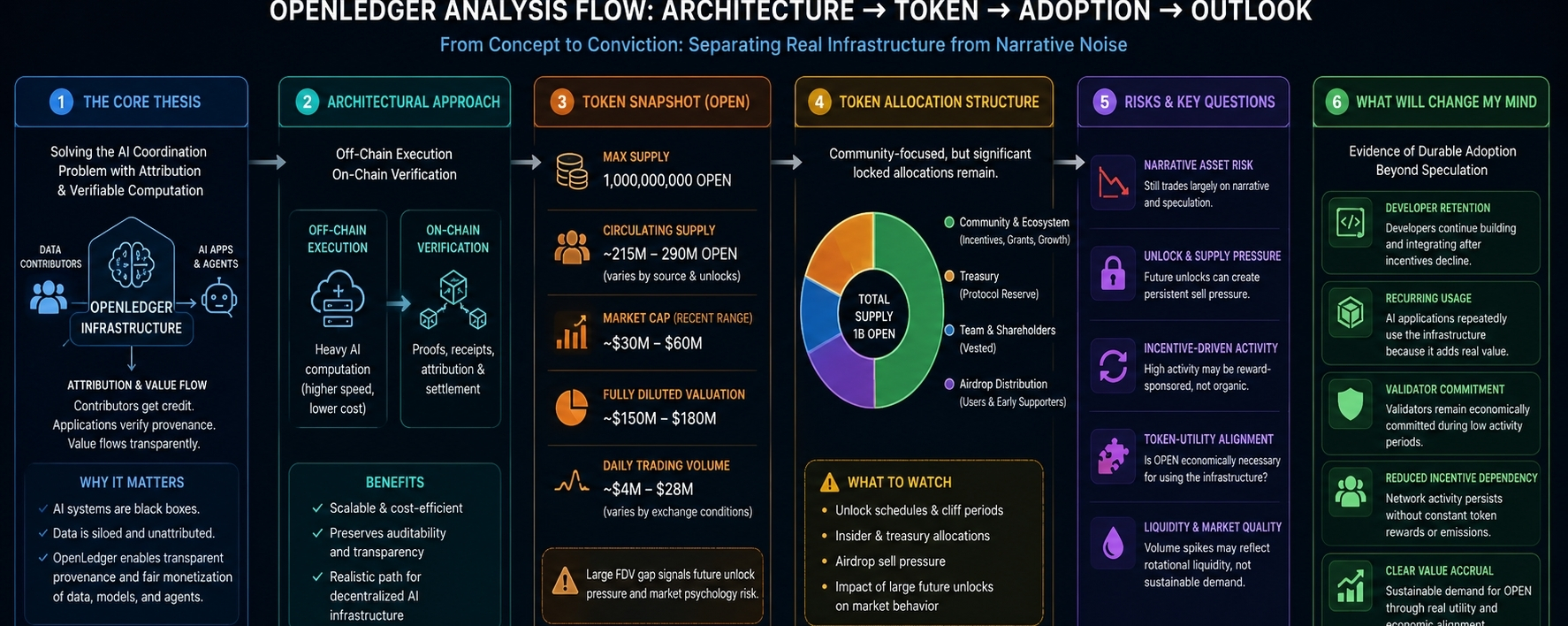
What pulled me toward OpenLedger wasn’t the marketing. It was the architecture discussion around attribution and verifiable AI computation. Most AI systems today are black boxes. Data gets scraped, models are trained behind closed doors, and contributors rarely know where their information ends up or how value flows back to them. OpenLedger is trying to solve that coordination problem by creating infrastructure where datasets, models, and AI agents can be tracked and monetized transparently. The idea is that contributors receive attribution while applications can verify where outputs came from.
Conceptually, that matters more than people realize.
One thing I’ve been thinking about lately is how unsustainable fully on-chain AI computation actually is. Running heavy inference directly on-chain is expensive, slow, and economically irrational at scale. OpenLedger appears to lean toward separating off-chain execution from on-chain verification. In simple terms, the expensive computation happens elsewhere, while the blockchain records proof, attribution, or receipts verifying that the work was completed correctly. That design choice is important because it dramatically lowers operational costs while preserving auditability.
I think this is one of the few realistic paths for decentralized AI infrastructure.
A lot of traders still misunderstand this distinction. They assume “AI blockchain” means the chain itself performs all intelligence. That’s not scalable. The more interesting model is using blockchains as settlement, ownership, attribution, and verification layers while computation remains externalized. If OpenLedger executes that properly, it could become more useful than many of the fully on-chain AI experiments currently attracting speculative attention.
But utility narratives and token performance are not the same thing.
Right now, OPEN still trades largely as a narrative asset.
The current numbers tell an interesting story. The token has a maximum supply of 1 billion OPEN, while circulating supply appears to fluctuate between roughly 215 million and 290 million depending on reporting methodology and unlocked allocations. Market capitalization has recently ranged around $30M–$60M, while fully diluted valuation sits much higher near $150M–$180M. Daily trading volume has also remained relatively active, fluctuating between roughly $4M and $28M depending on exchange conditions and listing activity.
That gap between circulating valuation and FDV is where I immediately become more cautious.
Crypto traders often underestimate how much future unlock pressure matters psychologically. It’s not just about mathematics. It’s about market behavior. A token can have a reasonable current market cap but still trade poorly if participants know large allocations remain scheduled for release. OpenLedger’s token allocation structure includes community incentives, treasury reserves, team/shareholder allocations, and airdrop distribution. CryptoRank data suggests community-related allocations dominate the structure, while substantial portions allocated to insiders and treasury remain locked under vesting schedules.
I pay close attention to this because AI narratives attract speculative momentum extremely fast. Once exchange listings arrive, traders rotate in aggressively, volumes spike, and social engagement explodes. But those same periods often coincide with increased token routing between exchanges, market makers, incentive wallets, and airdrop participants.
I’ve watched this cycle repeat dozens of times.
New listings create temporary demand shocks. Airdrops distribute supply into weak hands. Early contributors take profit. Market makers increase velocity. Wallet activity rises dramatically, but actual user retention often remains shallow underneath the surface. Sometimes what appears to be “network growth” is really just redistribution of speculative inventory.
That’s why I don’t treat raw transaction growth as proof of adoption anymore.
With OpenLedger, I’m trying to separate genuine network usage from incentive-driven activity. Are developers continuing to build after rewards fade? Are validators economically committed to securing the system? Are AI applications repeatedly using the infrastructure because it genuinely reduces cost or improves trust? Or are people interacting only because emissions temporarily subsidize participation?
That distinction becomes everything over time.
One thing that caught my attention is how much the project emphasizes provenance and attribution instead of just throughput metrics. Most AI crypto projects obsess over TPS, inference marketplaces, or agent ecosystems because those are easy narratives to market. OpenLedger’s focus on tracking influence and contribution inside AI systems feels more grounded in an actual economic problem.
The data economy is messy right now. Valuable datasets remain siloed because there’s no efficient way to verify ownership, contribution, or downstream usage. If OpenLedger can genuinely create programmable incentives around data provenance, that could become structurally important for decentralized AI ecosystems.
Still, the market doesn’t reward potential forever.
The trading structure around OPEN already reflects typical post-launch volatility behavior. The token experienced substantial decline from its all-time highs, dropping more than 90% from peak valuation levels according to market tracking data. That doesn’t automatically invalidate the project, but it changes the psychology around future rallies. Once a token experiences severe post-hype drawdowns, future upside depends less on narrative and more on demonstrated traction.
That’s the phase I’m watching now.
I’m also paying attention to exchange concentration and liquidity quality. Volume spikes alone don’t impress me anymore because crypto markets are full of rotational liquidity. One week it’s AI. The next week it’s modular chains. Then gaming. Then memes again. Sustainable markets usually emerge when spot participation stabilizes even during quieter news cycles.
OpenLedger’s challenge is proving that activity persists without constant catalysts.
Another risk I keep thinking about is whether attribution-based AI economies actually create durable token demand. This is where many infrastructure projects fail. They build technically impressive systems, but the token itself becomes economically unnecessary. If enterprises or developers can use the infrastructure without needing meaningful OPEN exposure, long-term value accrual weakens considerably.
That token-utility alignment question still feels unresolved to me.
At the same time, I don’t want to dismiss the project too early. Some of the strongest infrastructure plays initially looked underwhelming because speculation front-ran adoption by years. Markets price stories immediately, while actual ecosystems develop slowly. The fact that OpenLedger is approaching AI from a verification and data coordination angle rather than simply chasing “AI agents” hype gives it a slightly different profile than many competitors.
What I’m watching most closely now is retention.
Not wallets. Not temporary volume. Not influencer attention.
I want to see repeated usage patterns. I want to see whether developers continue integrating the infrastructure after incentives decline. I want evidence that validators remain economically committed during lower activity periods. I want to see whether applications depend on OpenLedger because it meaningfully reduces trust assumptions or operational costs.
That’s where real networks separate themselves from speculative ecosystems.
My current view is cautiously constructive, but far from blindly bullish. I think OpenLedger has a more credible architectural thesis than many AI-chain narratives currently trading in the market. The idea of combining off-chain AI execution with on-chain attribution and verification makes practical sense to me. The project is at least attempting to solve a real coordination problem rather than inventing synthetic demand.
But token structure, unlock dynamics, and post-airdrop retention remain major risks.
I’ve seen too many projects mistake temporary engagement for sustainable adoption. Incentives can manufacture activity for months. Sometimes years. The real test begins when emissions slow down and speculation rotates elsewhere.
If I eventually become significantly more bullish on OpenLedger, it won’t be because of another exchange listing or short-term volume explosion. It’ll be because I start seeing persistent developer activity, recurring AI usage patterns, and evidence that participants remain active without needing constant token rewards.
That’s the evidence that would genuinely change my mind.
