
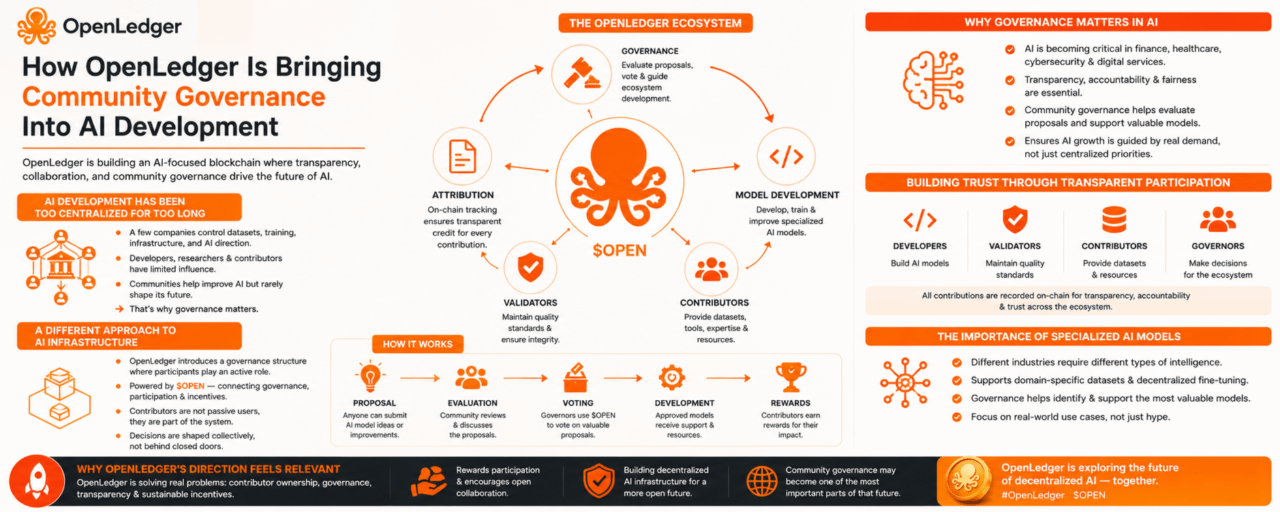
AI Development Has Been Too Centralized for Too Long
One of the biggest concerns in today’s AI industry is that decision-making power is concentrated in the hands of a few companies. These organizations control the datasets, the training process, the deployment infrastructure, and ultimately the direction AI systems take in the future.
For developers, researchers, and contributors outside those ecosystems, participation is usually limited. Even when communities help improve AI products through data, testing, or feedback, they rarely influence how the technology evolves afterward.
That’s why the governance model behind @OpenLedger feels important.
A Different Approach to AI Infrastructure
OpenLedger is building an AI-focused blockchain where transparency and collaboration are integrated directly into the ecosystem. Instead of relying on centralized control, the project introduces a governance structure that allows participants to play an active role in how AI models are proposed, evaluated, and improved.
The ecosystem is powered by $OPEN, which connects governance, participation, and incentives together. Contributors are not treated as passive users. They become part of the system itself.
This creates a more open environment where decisions are shaped collectively rather than behind closed doors.
Why Governance Matters in AI
Artificial intelligence is becoming more influential across industries such as finance, healthcare, cybersecurity, and digital services. As AI systems gain more responsibility, the process behind model development becomes increasingly important.
Questions around transparency, accountability, and fairness are no longer optional.
OpenLedger approaches this challenge by introducing community-driven governance into the AI lifecycle. Participants holding governance power can help evaluate proposals, support valuable models, and guide ecosystem development toward areas with real demand and utility.
Instead of allowing AI growth to depend entirely on centralized priorities, OpenLedger creates a structure where the community can influence long-term direction.
Building Trust Through Transparent Participation
One thing that stands out about OpenLedger is the way governance connects with attribution and contribution tracking.
Because contributions are recorded on-chain, ecosystem participants can interact inside a more transparent environment. Developers build models, validators help maintain quality standards, contributors provide specialized datasets, and governors participate in decision-making processes.
This structure encourages accountability across the ecosystem while reducing the risk of hidden development practices commonly seen in traditional AI platforms.
In my opinion, transparency like this could become essential as decentralized AI continues to grow.
The Importance of Specialized AI Models
Another interesting aspect of OpenLedger is its focus on specialized AI systems instead of depending only on massive general-purpose models.
Different industries require different types of intelligence. A financial AI system, for example, needs different training and validation standards compared to healthcare or legal automation.
OpenLedger supports this transition by creating infrastructure for domain-specific datasets, decentralized fine-tuning, and collaborative model improvement. Governance participants can help identify which models deserve support and development based on community value.
That creates a more efficient ecosystem focused on practical use cases rather than hype alone.
Why OpenLedger’s Direction Feels Relevant
The relationship between AI and blockchain is often discussed in abstract ways, but OpenLedger is focusing on very real problems: contributor ownership, governance, transparency, and sustainable incentives.
As AI adoption continues to expand, ecosystems that reward participation and encourage open collaboration may become far more valuable than closed systems controlled by a few large organizations.
Projects like @OpenLedger are exploring what decentralized AI infrastructure could actually look like in practice and community governance may end up becoming one of the most important parts of that future.