
A strange thing happens when a new technology gets attention.
Everyone looks at the exciting part first.
With AI, that exciting part is easy to see. The model answers. The agent acts. The tool saves time. A task that once felt slow suddenly feels lighter. That is the part people notice, and honestly, it makes sense. It is the part that feels alive.
But underneath all of that, there is a much duller problem.
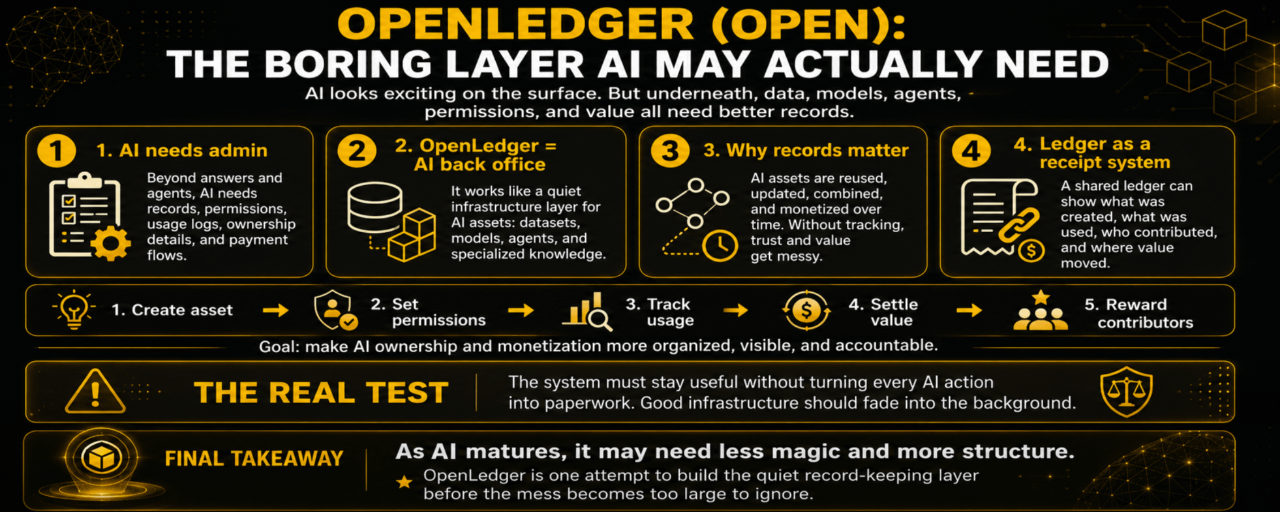
AI needs administration.
Not the kind of administration people like to talk about. Not big ideas or flashy demos. More like records, permissions, usage logs, ownership details, payment flows, and ways to know what belongs to whom. It sounds boring. But after a while, you can usually tell that boring systems are what let useful things last.
That is one way to look at OpenLedger.
Not as the most visible part of AI. Not as the tool people directly touch every day. More like the back office for an AI economy that does not really have one yet.
And that matters.
Right now, AI feels very active on the surface but messy underneath. A dataset can be used in many places. A model can be fine-tuned, copied, improved, connected to agents, or wrapped inside applications. An agent can perform tasks based on several models and many sources of information. A user may never know what actually powered the result.
Everything moves, but the paperwork is missing.
That may not seem important at the beginning. Early markets often run on energy and experimentation. People build quickly. They share things. They test ideas. They move on. But when real value starts to appear, the questions become more serious.
Who has the right to use this data?
Who created this model version?
Which agent used it?
How often was it used?
Who should receive value from that use?
What happens when the asset is updated?
These are not dramatic questions. They are ordinary ones. But ordinary questions become important when money, ownership, and trust are involved.
@OpenLedger seems to be trying to answer those questions for AI assets.
That phrase, “AI assets,” can feel a little abstract. But it becomes clearer when you think about what people are actually building. A dataset is an asset if it helps a model perform better. A model is an asset if others can use it to create something useful. An agent is an asset if it can complete work again and again. Even a small piece of specialized knowledge can become valuable if it makes an AI system more accurate.
The issue is that these assets do not behave like simple files.
They are used.
They are reused.
They are changed.
They are combined with other things.
They may create value long after the original creator stopped paying attention.
That is where normal systems start to feel weak.
A basic marketplace can show what is for sale. A platform can host a model. A database can store information. But AI assets need something more connected than that. They need records of activity. They need a way to follow value as it moves through different layers.
OpenLedger’s blockchain side becomes easier to understand from here.
It is not only about putting AI on-chain because that sounds modern. The useful idea is more practical. A shared ledger can act like a receipt system for AI work. It can show that something was created, that it was used, that it contributed to a process, and that value moved because of it.
Receipts are not exciting.
But they are powerful.
A receipt gives memory to an action. It says this happened. It says this resource was involved. It gives people something to point to later. In a small project, maybe that does not matter much. In a larger AI network, it matters a lot.
Because without records, value often flows toward the most visible layer.
The app gets attention. The platform gets users. The final output gets judged. But the quieter parts underneath can disappear. The cleaned dataset. The narrow model. The agent module. The person who made the system more useful in some small but important way.
#OpenLedger is interesting because it seems to take those quiet parts seriously.
Not by making them glamorous. Just by giving them a place in the system.
That is a different kind of ambition. It is not trying to make AI look more magical. It is trying to make AI more organized. And maybe that is what the space will need as it matures. Less magic, more structure.
Of course, structure can become heavy if it is done badly.
That is one risk. If every AI interaction feels like managing paperwork, people will avoid it. Builders want tools that move quickly. Users want things that work. Contributors want rewards, but they do not want to spend all their time thinking about technical rules. So the hard part is not only building a ledger. The hard part is making the ledger fade into the background.
The best infrastructure usually does that.
It keeps track without making people stare at the tracking. It handles settlement without making the process feel slow. It protects ownership without turning every action into a legal debate.
That may be the real test for OpenLedger.
Can it make AI ownership feel natural?
Can it make monetization happen without making the user experience feel crowded?
Can it help builders connect assets without forcing them into a complicated system?
Those questions are still open.
But the angle is worth noticing because AI is not going to stay simple. More agents will appear. More models will be built for narrow use cases. More data will become valuable because it gives AI better judgment in specific areas. As that happens, the need for records will probably grow quietly in the background.
Not everyone will care about that layer.
Most people will keep looking at the answer on the screen.
But somewhere behind that answer, there will be data, models, agents, permissions, usage, and value moving from one place to another. Someone will need to keep track of it.
OpenLedger is one attempt to build that quiet record-keeping layer before the mess becomes too large to ignore.
@OpenLedger #OpenLedger $OPEN

Άρθρο
OpenLedger (OPEN): The Boring Layer AI Might Actually Need
Αποποίηση ευθυνών: Περιλαμβάνει γνώμες τρίτων. Δεν είναι οικονομική συμβουλή. Ενδέχεται να περιλαμβάνει χορηγούμενο περιεχόμενο. Δείτε τους Όρους και προϋποθέσεις.