
I've been watching OpenLedger for a while now.
On the surface, it's straightforward. AI data infrastructure. Helping models train on better information. Decentralized. Transparent. Efficient. The kind of project that makes sense in a world where AI is eating everything.
But the more I looked, the more I realized something was hiding underneath. Not a scam. Not a rug pull. Something stranger.
OpenLedger isn't just about what AI should remember. It's about what AI should forget. And it might be the mechanism that prices forgetting. Deciding which data dies. Which memories fade. Which parts of the past stop influencing the future.
That's not infrastructure. That's something else entirely.
The problem with AI memory
AI models remember everything they're trained on.
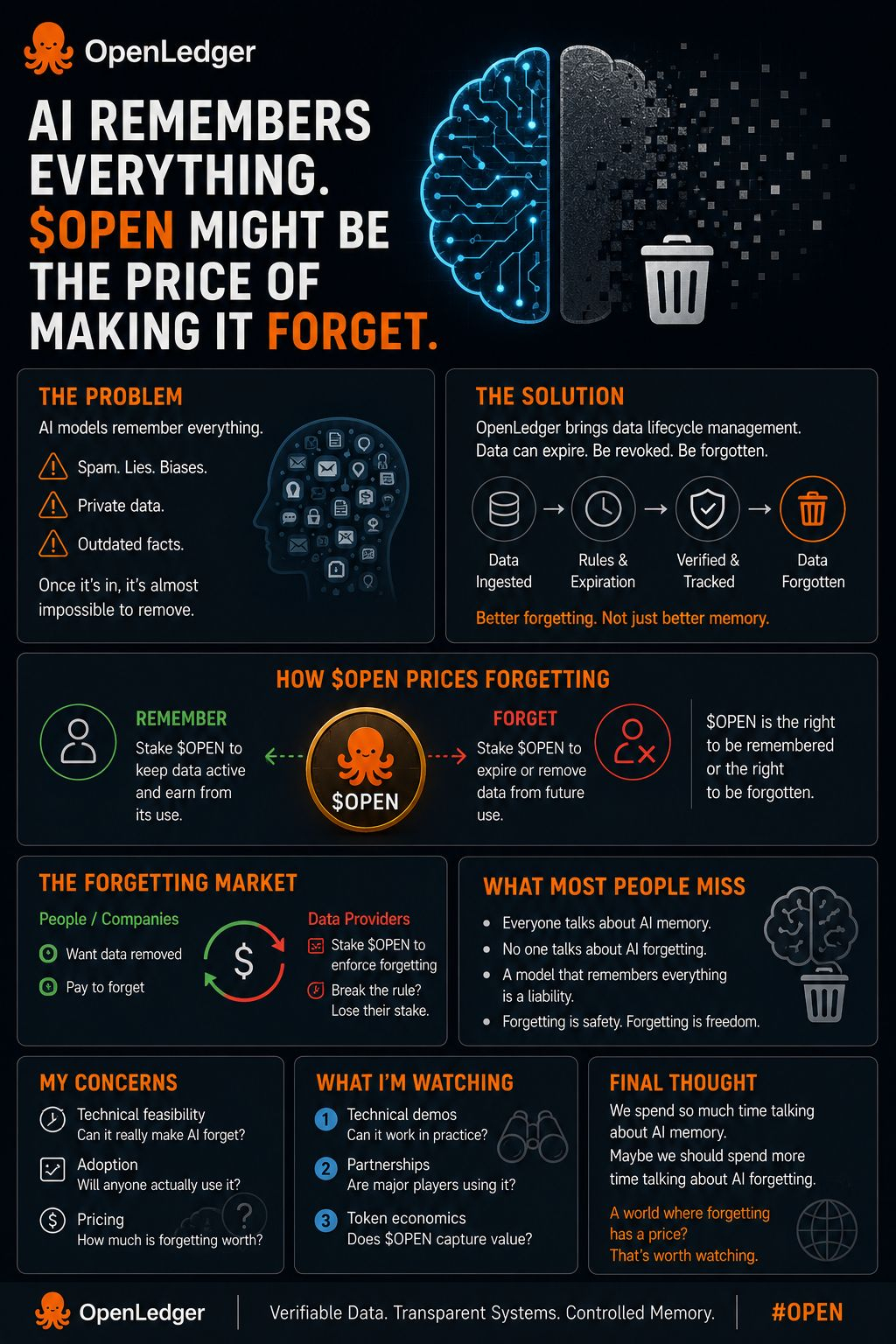
That sounds good. But it's not. Models remember spam. Remember lies. Remember biases. Remember private information that shouldn't be there. Remember outdated facts that are no longer true.
Once something is in the training data, it's almost impossible to remove. You can't just hit delete. The model's weights have already been adjusted. The memory is baked in.
This is a huge problem. Companies are getting sued because their AI remembers copyrighted material. Governments are worried because AI remembers sensitive data. Users are creeped out because AI remembers conversations they thought were private.
Everyone wants AI to forget. But no one knows how.
What OpenLedger is actually doing
The public story is about data sourcing. Better data in, better AI out.
But the private story, the one you have to dig for, is about data expiration. Data that has a shelf life. Data that can be revoked. Data that the AI is allowed to forget.
OpenLedger isn't just gathering information. It's attaching rules to that information. Timestamps. Permissions. Expiration dates. When data expires, the system signals that it should no longer be used. The AI doesn't have to forget instantly. But it gets a notice. A reminder that this information is no longer valid.
That's the innovation. Not better memory. Better forgetting.
I didn't see this at first. I thought OpenLedger was just another data marketplace. Then I read their whitepaper closely. Buried in the technical section was a line about "data lifecycle management." That's corporate speak for "making data die."
How OPEN prices forgetting
If forgetting is valuable, someone has to pay for it.
Data providers want their data to be remembered. They get paid when it's used. But data subjects? The people the data is about? They might want it forgotten. They might pay to have it removed.
It is the token that mediates this. You want your data remembered? Stake OPEN. You want it forgotten? Stake it the other direction. The token doesn't just represent value. It represents the right to be remembered or the right to be forgotten.
This is wild when you think about it. We're used to paying for access. Paying for memory. But paying for forgetting? That's new. That's strange. That might be huge.
I've watched similar experiments in other contexts. The right to be forgotten is a legal concept in Europe. But it's clunky. Slow. Expensive. OPEN could make it automated. Programmable. Cheap.
The forgetting market
Imagine a market where forgetting has a price.
Companies pay to make their old, embarrassing data disappear. Individuals pay to have their private information removed from training sets. Governments pay to classify certain information as forgettable.
On the other side, data providers get paid to forget. They stake OPEN as collateral. If they remember something they promised to forget, they lose their stake.
This isn't theoretical. OpenLedger is building this. Slowly. Quietly. But the architecture is there.
The question is whether anyone will use it. Will companies pay for forgetting? Or will they just accept that their old data lives forever in some model's weights?
I think they'll pay. The legal risks are too high not to. The reputational risks are even higher.
What most people miss
Everyone talks about AI memory. Better recall. More context. Longer attention spans.
No one talks about AI forgetting. But forgetting is just as important. Maybe more important.
A model that remembers everything is a liability. It remembers your private conversations. Your embarrassing search history. Your outdated opinions from ten years ago. That's not helpful. That's dangerous.
OpenLedger is one of the first projects to take forgetting seriously. Not as an afterthought. As a first-class feature. Something worth building an entire token economy around.
I don't know if they'll succeed. Forgetting is hard. Technically hard. Socially hard. Legally hard. But someone has to try.
My concerns
I have doubts.
First, technical feasibility. Making AI forget is genuinely difficult. You can't just delete a file. Models are black boxes. Even if the data expires, the model might still behave as if it remembers.
Second, adoption. Will data providers actually stake OPEN to enforce forgetting? Or will they just ignore the problem and hope no one notices?
Third, pricing. How much is forgetting worth? Less than remembering? More? The market hasn't decided yet. OPEN's value is unclear until this resolves.
I'm not invested. Not yet. I'm watching. Learning. Waiting for more evidence.
What I'm watching for
I'm looking for three things.
One. Technical demos. Can OpenLedger actually make a model forget something specific? Not in theory. In practice.
Two. Partnerships. Are any major AI companies using this? If not, why not?
Three. Token economics. Does OPEN actually capture value from forgetting? Or is it just a governance token that does nothing?
Until I see answers, I'm on the sidelines. But I'm paying attention. Because if this works, it changes everything.
Final thought
OpenLedger looks like AI data infrastructure.
Better data. Better training. Better models. That's the surface story.
But underneath, OPEN may be pricing something stranger. What AI should forget. Which data dies. Which memories fade. Which parts of the past stop mattering.
We spend so much time talking about AI memory. Maybe we should spend more time talking about AI forgetting.
Because a world where AI remembers everything isn't a world I want to live in. A world where forgetting has a price? That's interesting. That's worth watching.
I'll keep watching. And maybe, eventually, I'll stop forgetting to check my bag