
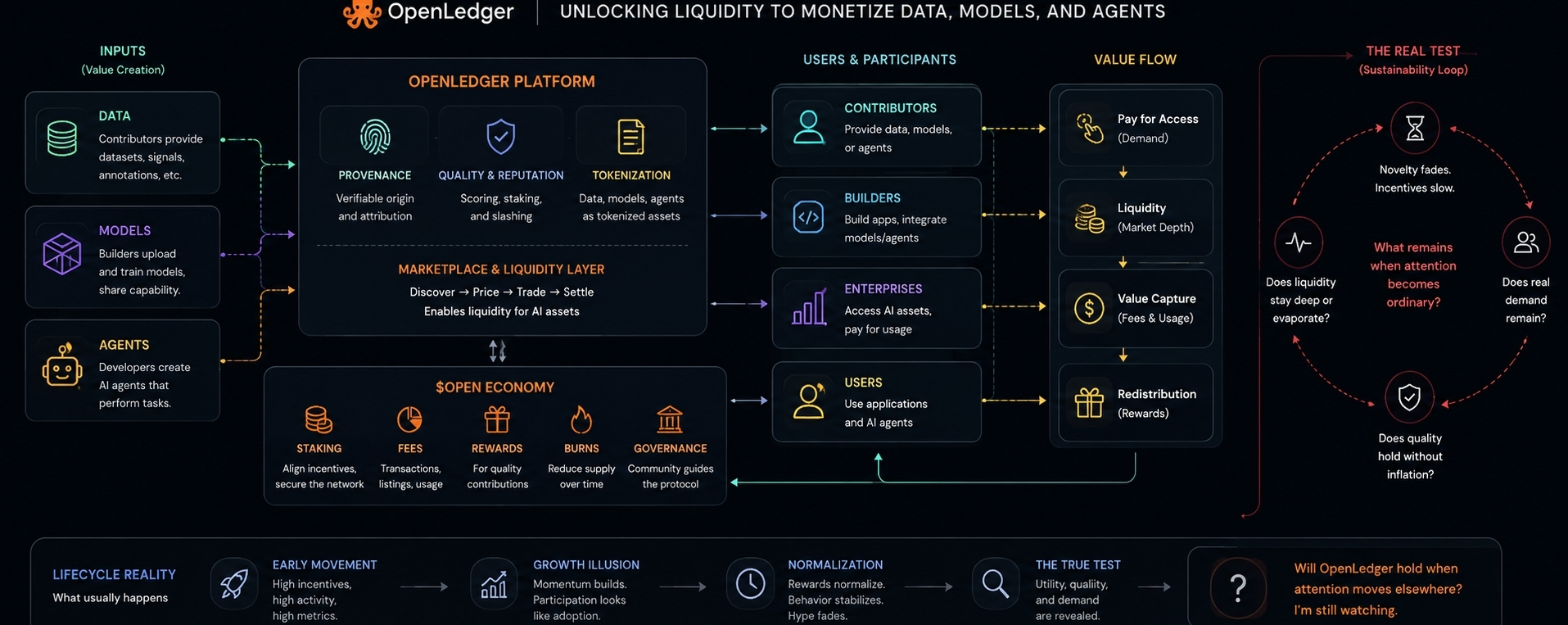
I’m watching I’m waiting I’m looking I’ve been paying attention and I focus on small details because that usually feels more useful than listening to the first layer of language wrapped around a system like this. I keep staring at movement before meaning, at behavior before narrative. OpenLedger keeps pulling my attention toward the spaces between activity and intention. I find myself looking less at what is being said and more at what people are actually doing once they enter the system, because there is usually a difference there. I keep wondering whether participation emerges naturally or whether participation is being carefully pulled into existence through incentives that temporarily make everything appear alive.
The thing that keeps lingering in my mind is the relationship between value and motion. OpenLedger talks around liquidity for data, models, and agents, but I keep returning to the idea that liquidity itself is often mistaken for proof of demand. Movement can create a strange illusion. Assets circulate, users interact, metrics expand, and everything starts producing a rhythm that resembles adoption. But circulation alone does not always explain who truly needs the system beneath it. I think about who enters first and who enters later. I think about who is creating value and who is mainly collecting it. Those patterns usually become visible long before people start discussing them openly.
I keep finding myself staring at users rather than architecture. Systems become interesting when people stop acting like observers and start revealing habits. I watch where attention settles. I watch what gets repeated. I watch what becomes routine. Real behavior eventually strips away presentation and leaves only incentives behind. If rewards appear, users move toward rewards. If attention becomes scarce, behavior shifts. None of this feels surprising, but I think the interesting part sits somewhere underneath that obvious reality.
Because if data becomes an asset, then the questions start multiplying quietly. Who is actually producing meaningful inputs and who is merely generating noise because the system rewards activity itself? When models become part of an economy, what separates contribution from volume? When agents become participants rather than tools, where does utility begin and where does simulation begin? I notice these questions arriving without asking permission.
What stands out to me feels less like a conclusion and more like a small realization appearing at the edge of my attention. Systems built around participation often spend their early stages surrounded by motion, but motion behaves differently from permanence. Early movement can hide weaknesses simply because nobody has stayed still long enough to notice them. I keep wondering what remains once behavior settles and novelty fades into routine.
I keep coming back to the uncomfortable possibility that the strongest test for a system like this arrives quietly. Not during growth. Not during expansion. Not while rewards are circulating quickly and every interaction carries momentum. The interesting moment appears later, when attention becomes ordinary and users stop arriving out of curiosity. Does activity continue because something essential exists beneath it, or because incentives are still carrying its weight?
That question keeps sitting there without moving.
And I think I’m still watching it.
