
@OpenLedger I started following OpenLedger because it felt different from the usual AI and crypto narratives that dominate the market. Most projects talk endlessly about artificial intelligence, automation, or decentralized infrastructure, but after digging deeper into OpenLedger, I realized the team is actually focused on a problem that almost nobody in the industry is solving properly — ownership and attribution inside AI systems. That immediately made the project stand out to me because the current AI economy is heavily imbalanced. Huge models are trained using massive amounts of public and private data, yet the people who contribute data, improve models, or help shape intelligence rarely receive meaningful long-term value from it.
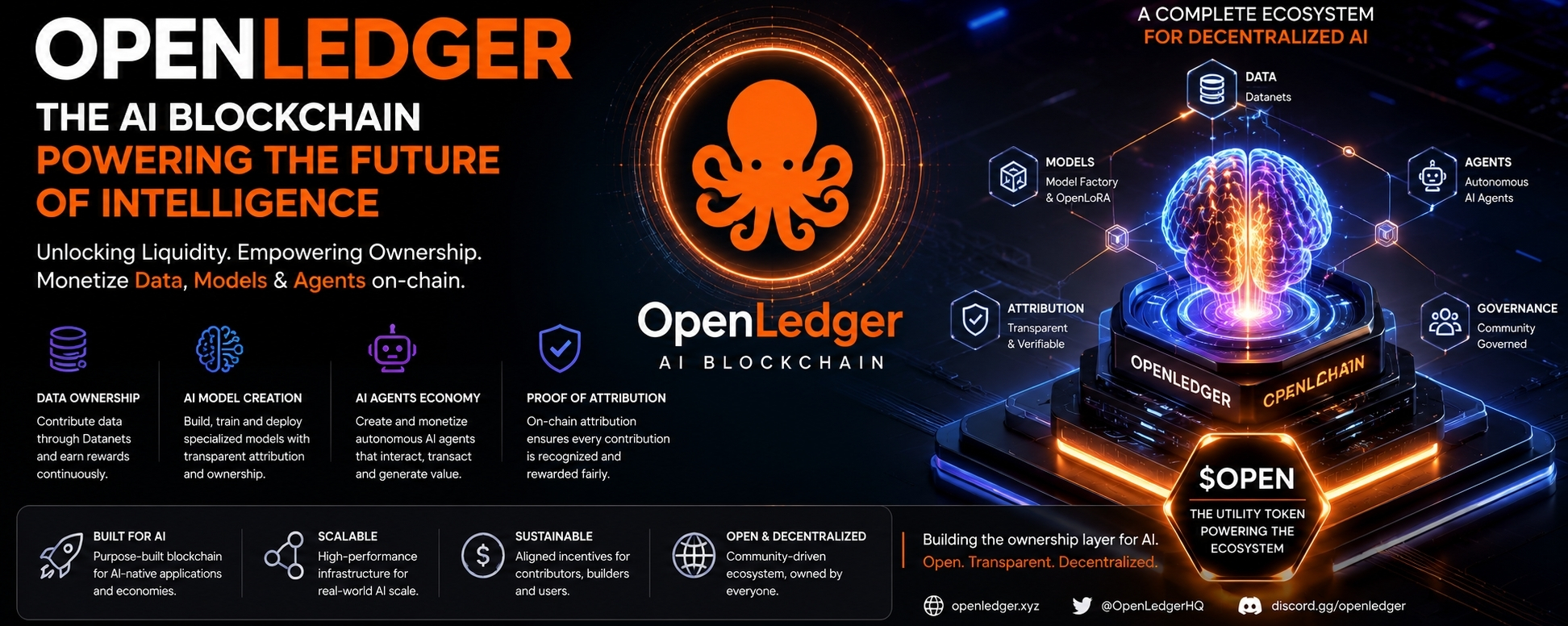
The more I explored OpenLedger, the more I understood that the project is trying to build an entirely different economic structure around AI. Instead of treating data like an invisible resource that gets consumed once and forgotten, OpenLedger is designing a system where datasets, models, and AI agents become productive digital assets. Contributors can potentially earn value continuously as their data powers future inference and model activity. In my opinion, this is one of the most important ideas emerging in decentralized AI right now because data has quietly become one of the world’s most valuable resources, yet most contributors are completely disconnected from the value creation process.
What really pulled me into the ecosystem was the concept behind OpenLedger’s attribution framework. In traditional AI systems, once data is collected and integrated into a model, it becomes almost impossible to trace where value originated. OpenLedger approaches this differently by trying to create transparent attribution mechanisms directly on-chain. That means contributions can potentially remain identifiable and economically connected to future outputs generated by the network. I think this creates a much healthier relationship between builders, data providers, developers, and users because everyone becomes part of the same value cycle instead of operating inside a centralized extraction model.
From my perspective, this matters because AI is entering a stage where trust and transparency are becoming critical. People are already questioning where models get their information, who owns generated outputs, and whether creators deserve compensation when their work trains AI systems. OpenLedger seems to understand that these questions will only become bigger over time. Rather than ignoring them, the project is building infrastructure specifically designed to address them before the problem becomes unmanageable.
One area I personally find very interesting is OpenLedger’s focus on Datanets. I see Datanets as more than simple data marketplaces. They feel closer to decentralized intelligence ecosystems where contributors can organize, structure, and monetize specialized information. Instead of competing to build one massive generic AI model, OpenLedger appears focused on enabling networks of domain-specific intelligence. I think that approach makes far more sense in the long run because different industries require different types of precision, context, and optimization.
For example, healthcare data, financial data, legal information, gaming behavior, and autonomous agent interactions all require unique handling and specialized training environments. Massive generalized AI systems often struggle with depth and efficiency in niche sectors. Smaller specialized models trained on carefully curated datasets could actually outperform larger systems in practical applications. That is one reason I believe OpenLedger’s infrastructure has strong long-term relevance.
Another thing I genuinely appreciate about the project is that it doesn’t rely entirely on marketing hype. In crypto, it’s very easy for projects to generate attention through exaggerated promises, but sustainable ecosystems are built through usable infrastructure. OpenLedger appears to be concentrating on the foundational layers required for decentralized AI economies to function properly. Attribution systems, model deployment frameworks, data coordination, inference infrastructure, and contributor incentives may not always sound exciting on social media, but these are the components that actually determine whether a network can survive long term.
I also think the project’s timing is important. AI adoption is accelerating globally, but most people still underestimate how valuable high-quality data will become over the next decade. Companies are already competing aggressively for proprietary datasets because the quality of data directly influences model performance. OpenLedger’s approach recognizes that data contributors should not be treated as disposable participants. Instead, the ecosystem attempts to transform them into active stakeholders within the AI economy itself.
Personally, I believe this could completely reshape how people think about AI participation. Right now, users generate enormous amounts of valuable information every day through online interactions, workflows, creative output, and digital behavior, but centralized platforms capture most of the economic value from that activity. OpenLedger introduces the possibility of a more balanced system where contributors maintain economic exposure to the intelligence their data helps create. That idea feels much more aligned with the broader philosophy of decentralization.
The project’s emphasis on AI agents also caught my attention early on. I think agent economies are going to become a huge part of the future internet. Autonomous AI systems will eventually interact with applications, execute tasks, analyze information, and coordinate transactions without constant human involvement. But for those agent economies to function properly, they need transparent systems for payments, attribution, access control, and data coordination. OpenLedger seems designed with that future in mind rather than focusing only on current market trends.
Another aspect I respect is the project’s focus on scalable AI infrastructure. Training and deploying AI models can become extremely expensive, especially when relying on traditional centralized systems. OpenLedger’s approach toward more efficient and specialized model deployment could make AI development accessible to a much larger group of builders and contributors. That matters because innovation tends to accelerate when barriers to entry become lower.
I also think OpenLedger understands something that many AI projects overlook: openness alone is not enough. Open-source AI sounds appealing in theory, but without proper economic incentives, ecosystems struggle to sustain high-quality contributions over time. OpenLedger attempts to combine openness with monetization, creating an environment where contributors are rewarded rather than simply expected to participate for free. In my opinion, that balance between decentralization and incentive alignment is critical for long-term adoption.
The $OPEN token also feels integrated into the ecosystem in a more natural way than many AI-related crypto assets I’ve seen. Instead of existing purely as a speculative trading instrument, the token is connected to actual network functionality, including governance, transactions, contributor rewards, and inference-related activity. I usually pay close attention to whether a token has genuine utility inside a project because ecosystems without meaningful token integration often struggle to maintain long-term value creation.
At the same time, I think it’s important to understand that projects like OpenLedger are still building within an extremely early industry. Decentralized AI infrastructure is not fully mature yet, and there are still many technical, regulatory, and adoption-related challenges ahead. But personally, I prefer projects that are building around future infrastructure problems rather than chasing temporary trends. OpenLedger feels like one of the few ecosystems attempting to create foundational systems for how AI economies may operate in the coming years.
What keeps me engaged the most is the broader vision behind the project. AI is evolving rapidly, but conversations around ownership, transparency, attribution, and economic fairness are becoming more urgent every month. Centralized AI systems are powerful, but they also create concentration risks where a small number of entities control massive amounts of intelligence, data, and influence. OpenLedger offers an alternative direction where intelligence can become more decentralized, collaborative, and economically distributed.
I also think the market is still underestimating how important attribution could become in the future. As AI-generated content floods the internet, people will increasingly demand systems that can verify origins, trace contributions, and establish accountability. OpenLedger’s infrastructure seems positioned around exactly those concerns. If decentralized AI continues expanding, transparent attribution layers may eventually become essential rather than optional.
From an investment and ecosystem perspective, I see OpenLedger sitting at the intersection of several major narratives at once — decentralized AI, data monetization, autonomous agents, blockchain infrastructure, and creator ownership. Usually, when multiple emerging sectors begin overlapping, the projects that successfully connect those ecosystems can become extremely influential over time. That’s one reason I continue paying attention to OpenLedger despite how early the space still is.
Another thing I personally value is that the project encourages participation instead of pure speculation. Many crypto ecosystems become entirely price-focused, where community activity revolves only around short-term trading. OpenLedger feels more connected to actual contribution and infrastructure building. Contributors, developers, data providers, and builders all have visible roles inside the network’s growth. That creates a stronger foundation than ecosystems driven purely by market hype.
I honestly think the biggest strength of OpenLedger is that it understands AI is not only about models. The future AI economy will involve data coordination, attribution systems, agent interaction, decentralized computation, transparent governance, and economic distribution mechanisms. Building only the model layer is not enough. Sustainable AI ecosystems require entire infrastructures capable of coordinating all those moving parts together.
As someone who spends a lot of time analyzing emerging blockchain and AI ecosystems, I rarely see projects approaching the space from this angle. Most teams focus heavily on visibility and narrative momentum, but OpenLedger appears much more focused on solving infrastructure-level problems that could become increasingly important over the next several years.
That’s ultimately why I remain interested in OpenLedger. I don’t see it as another short-term AI narrative. I see it as an attempt to redesign how value moves across AI ecosystems. Whether it’s contributors earning from their data, developers deploying specialized models, or autonomous agents interacting inside decentralized networks, OpenLedger is trying to build the coordination layer that connects all of it together.
The project is still evolving, and like every early-stage ecosystem, there are risks and uncertainties ahead. But from everything I’ve explored so far, OpenLedger feels aligned with where decentralized AI is actually heading rather than where temporary hype cycles are pointing. And in a market full of noise, that kind of direction stands out to me more than anything else.