

I still remember scrolling through different AI crypto narratives late at night and thinking something felt slightly off, not in a dramatic way, just a quiet mismatch between how big the story sounded and how little of it I could actually trace back to something concrete. Everyone was talking about AI agents, data economies, liquidity layers for intelligence, but when I tried to ask a simple question like where does the value actually sit, the answers always drifted into abstractions.
That’s probably why OpenLedger (OPEN) caught my attention in a different way. Not because it felt like a breakthrough moment, but because it kept pointing toward something more structural. Still, I’m not fully sure if the market is ready to even price that kind of structure yet.
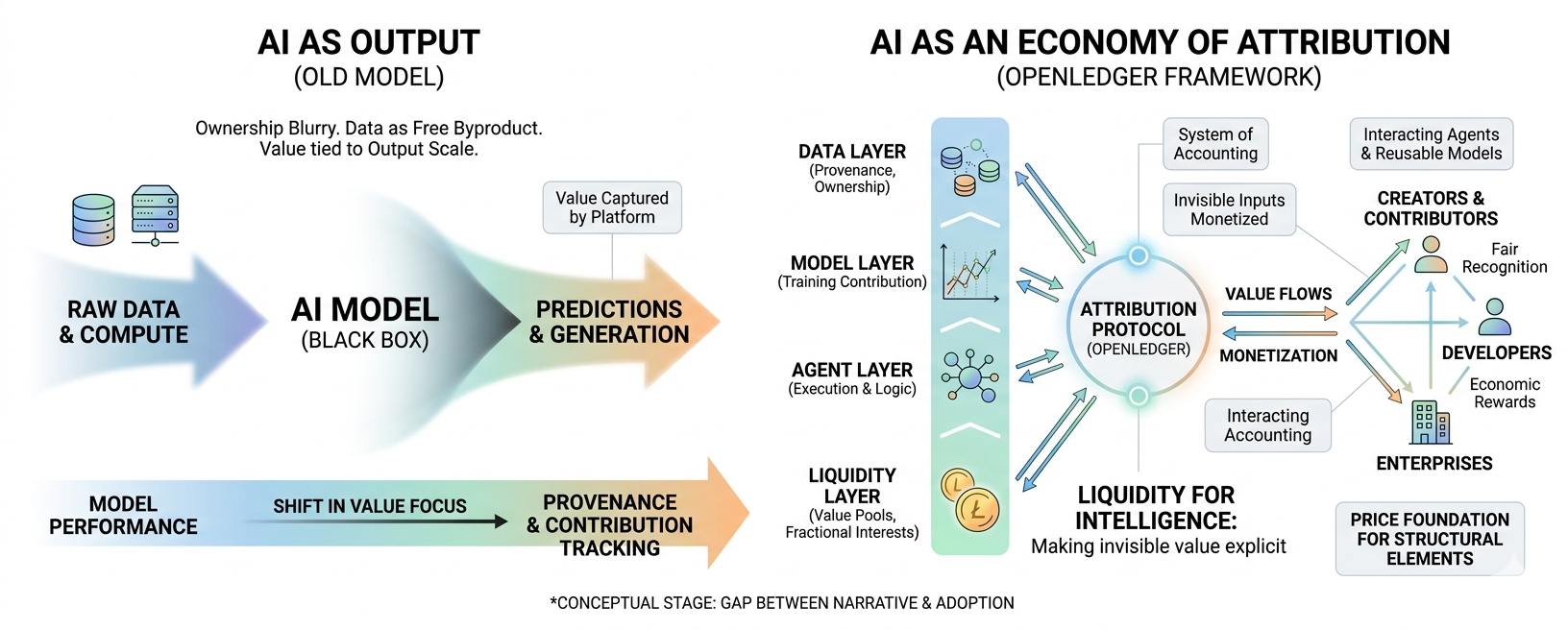
What stands out to me is the way the conversation shifts when you stop thinking about AI as just output generation and start thinking about what fuels it. Data, models, agents, all of it usually exists in systems where ownership is blurry. I remember when data was treated almost like a free byproduct of usage, something companies collected quietly in the background without anyone really asking who it belonged to in an economic sense.
Now that AI is scaling, that old assumption feels slightly uncomfortable. Maybe I’m overthinking it, but it seems like we are entering a phase where the question is no longer just what AI can do, but who gets recognized when it does it.
OpenLedger tries to frame this around liquidity and monetization of those layers. Data is not just stored, models are not just trained, and agents are not just deployed. They are part of a system where attribution becomes a kind of accounting problem. That idea sounds clean on paper, but in practice I keep wondering how messy it becomes once real users and real systems interact at scale.
There is also something interesting about the word liquidity being used here. In traditional crypto, liquidity usually refers to markets, tokens, trading depth. Here it is being stretched toward something more abstract. Liquidity for data or intelligence feels like a concept that is still trying to find its real shape. I’m not fully convinced I understand what that will look like yet.
I’ve seen similar ideas before in different forms, where projects try to attach value flows to previously invisible inputs. Sometimes it works in narrow use cases, sometimes it feels like the system becomes too complex for users to care. That tension is still present here, at least in my mind.
At the same time, I can’t ignore the broader direction. AI systems are clearly becoming more agent driven, more modular, more dependent on external data sources. If that continues, then some form of attribution layer feels almost inevitable, even if it doesn’t look like what we expect today.
But I also ask myself, who actually needs that layer first. Developers, enterprises, or speculative markets trying to price future coordination systems. The answer is not obvious, and I think that uncertainty is important.
There is a subtle shift happening in how we talk about value in AI. It used to be about model performance. Then it became about scale. Now it is slowly drifting toward provenance and contribution tracking. I’m not sure if that shift is fully priced in anywhere yet.
OpenLedger sits in that uncomfortable middle space where the idea makes sense intellectually, but the real adoption curve is still unclear. I’ve seen enough cycles to know that this gap between narrative clarity and product clarity is where most early systems either stall or slowly evolve without much attention.
Sometimes I think the biggest risk is not that the idea is wrong, but that it arrives before the world knows how to use it. And sometimes I think the opposite, that it arrives exactly when people start needing it but cannot articulate that need yet.
I don’t have a strong conclusion here. It feels more like a question that is still forming. If AI truly becomes an economy of interacting agents and reusable models, then some form of value attribution will matter more than it does today. Whether OpenLedger becomes part of that answer or just part of the early experimentation phase is something I honestly can’t predict.
For now, I’m just watching how this idea of monetizing the invisible layers of intelligence evolves. It still feels early, maybe even slightly abstract, but those are usually the spaces where the next structure quietly starts forming before anyone agrees it exists.
