
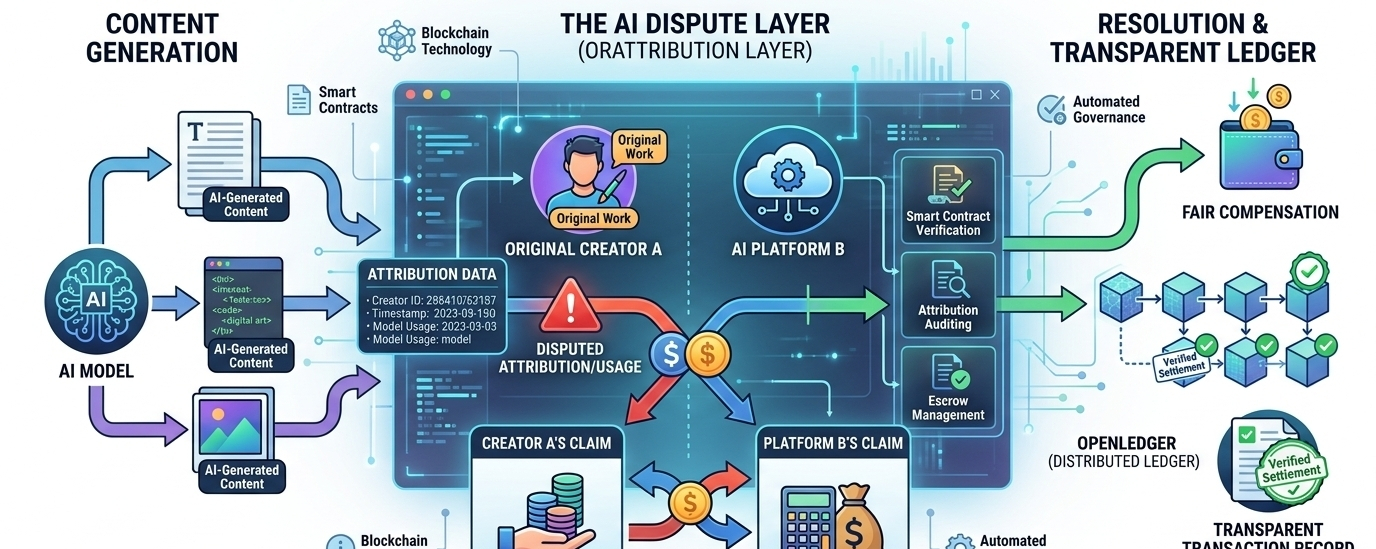
I have been thinking about attribution for a while now, and honestly I might have been assuming the wrong conflict from the start.
When people talk about AI attribution infrastructure, the story usually sounds clean. Data contributors provide something useful. Models consume it. Attribution creates fairness. Tokens coordinate incentives. I used to accept that ordering because it feels structurally neat. But now I am not so sure anymore.
Because here is the thing. Attribution only stays simple while everyone agrees.
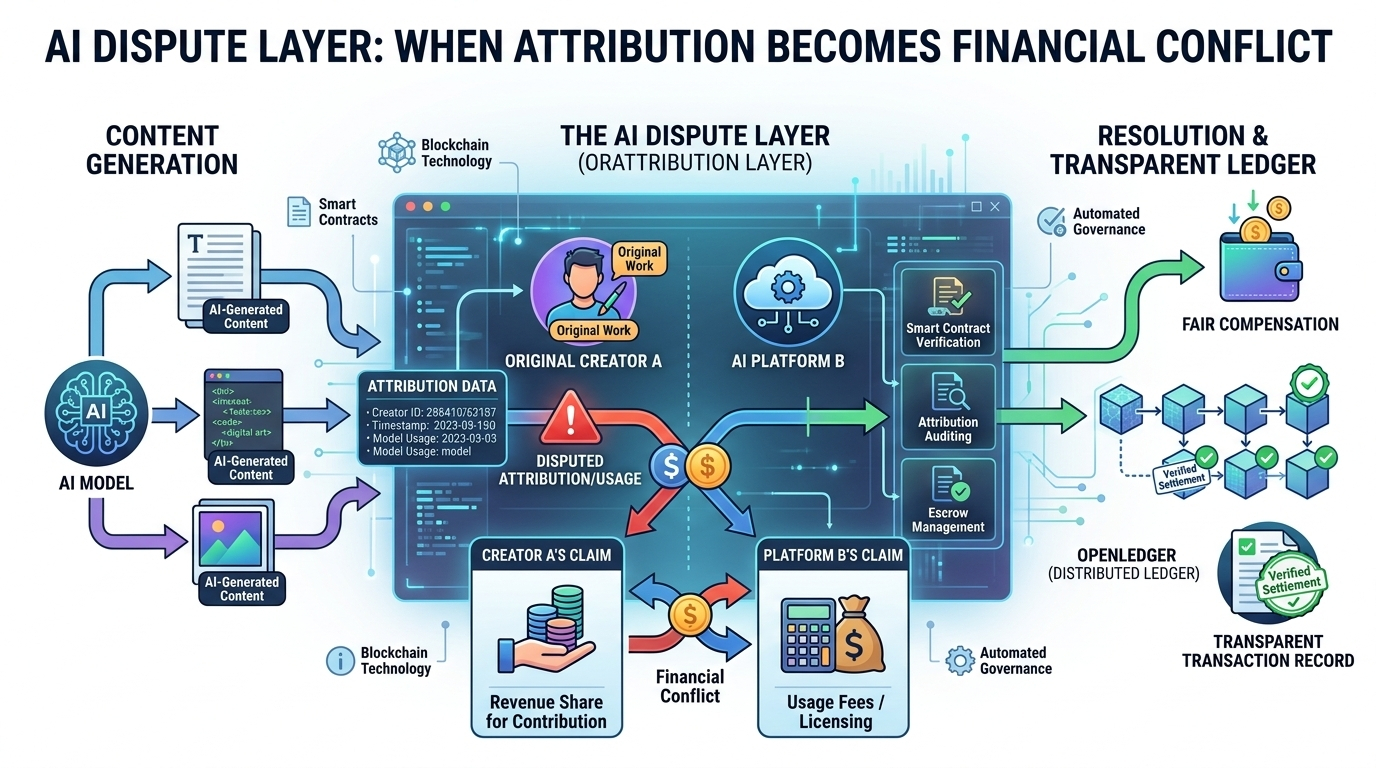
The moment money attaches to influence, attribution stops feeling like bookkeeping and starts looking more like dispute infrastructure. That shift feels small when you say it fast. But if a project is helping make AI contributions legible, then the obvious interpretation is that it is building transparency. Fine. But if that transparency becomes financially meaningful, then the more uncomfortable question comes up. What actually happens when multiple parties claim influence over the same output?
That is the part I keep returning to.
A system can record provenance. A system can emit attestations. A system can make contribution states visible enough for downstream consumption. But none of that automatically resolves conflict. It only makes conflict more economically precise. And maybe that is the hidden design choice that nobody talks about. Because once attribution affects payouts, access, royalties, model rights, or reputational eligibility, disagreement stops being a philosophical problem and becomes a market event.
There is a line that keeps sticking with me. Visibility creates claim surfaces.
I spend a fair amount of time watching creator ranking systems, not because they are identical to AI attribution, but because they reveal something useful about how legibility works. Influence scores look objective from the outside. A ranked creator appears structurally validated. But most observers never see the filtering logic underneath. What counted? What got excluded? What behavior survived preprocessing? What version of originality became visible enough to rank? The output looks stable. The pathway usually is not.
AI attribution feels dangerously similar to this.
An attribution layer does not capture truth in some universal sense. It captures the schema compatible version of contribution that survived system design. That distinction matters less when no money is attached. It becomes much heavier when financial consequence enters the picture. Because if Contributor A says their dataset shaped an inference outcome, and Contributor B says their signals materially changed model behavior earlier, who decides? Is it chronological influence? Direct training weight? Query time relevance? Economic utility? Observed reuse? What exactly becomes the recognized object?
That is where the surface narrative starts slipping for me.
People talk about attribution like it is evidence. Sometimes it is. Sometimes it is just legibility. And those are not the same thing. A protocol can only evaluate what reached its visibility boundary. Everything before that may be structurally real but economically invisible. Downstream systems tend to consume emitted state as if it is complete. That behavior is normal. Markets do this constantly. If a claim becomes sufficiently legible, applications inherit it. Not because it is perfectly true. But because it is usable.
That difference keeps getting underestimated. Usability often outranks certainty.
And once tokens sit underneath that process, conflict does not disappear. It gets priced. That is where I start thinking about this project less as infrastructure utility and more as potential dispute market coordination. Not courtroom dispute resolution. Something stranger. A machine readable financial conflict layer.
Because if attribution becomes economically important, systems need ways to process disagreement. Maybe staking around claims. Maybe confidence weighting. Maybe attestation hierarchies. Maybe reputation adjusted evidence layers. Maybe delayed settlement windows where disputed contribution states remain unresolved. I am speculating obviously. But structurally, something like that starts feeling less optional.
Attribution without conflict handling feels incomplete.
If repeated AI inference creates recurring economic flows, then disputes are not edge cases. They become native behavior. That is what changes the framing for me. Most digital systems assume contribution disputes are rare interruptions. AI systems may make them continuous background pressure.
Think about content ecosystems for a second. Rankings reward visible originality. Freshness matters. Relevance matters. Influence matters. But the scoring object is never your internal thinking process. It is the emitted artifact that passed eligibility boundaries. The system decides on what it was allowed to see. AI contribution markets may behave the same way. The real conflict may not be over truth. It may be over recognition eligibility.
That sounds abstract until money arrives. Then it becomes practical very quickly. Who deserves recurring compensation when an output reflects layered prior influence? Who gets priority when evidence overlaps? Who loses if attribution states change later? Can downstream payouts be replayed? Or does emitted visibility become financially final even if structurally incomplete?
There is another line that keeps bothering me. The object is stable. The consequence is not.
Because AI outputs look neat from the outside. A response exists. An action happened. A model generated something usable. But the contribution history underneath may be unstable, overlapping, partially missing, or economically contested.
Maybe this project is not just trying to make contribution visible. Maybe it is helping define what version of contribution becomes financially actionable. That is a much stranger role. Not attribution as recognition. Attribution as claim arbitration substrate. Not broken. Just incomplete. Or maybe necessarily incomplete. Because no infrastructure can perfectly reconstruct influence once enough layers compress into each other.
But if that is true, then the market question changes. The token would not just coordinate data usage. It might coordinate unresolved financial disagreement about influence itself. And I cannot tell yet whether that sounds like elegant infrastructure design or the beginning of a very expensive category of machine native conflict.