
There was a time when crypto conversations revolved mostly around charts, signals, and trading calls. But that landscape has shifted.
Today, almost every project wants to position itself as “AI-powered.” Some call themselves intelligent agents, others present themselves as trading assistants. On social media, they post market updates, interpret charts, and respond to users in a way that creates the impression they are actively participating in the market.
But behind this polished presence, a simple question keeps emerging how much of this AI is actually doing, and how much is just talking?... 🤔
Because in reality, many so-called AI trading agents are still limited to conversation.
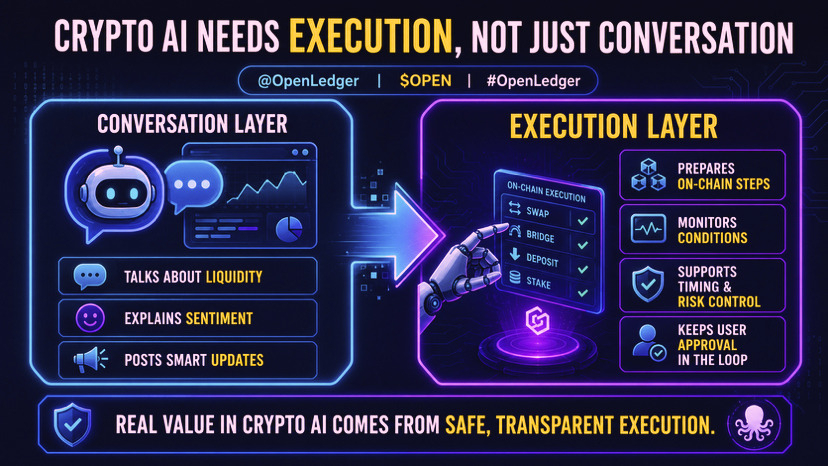
They can discuss liquidity, explain market sentiment, summarize on-chain data, and even produce well-written posts.
But understanding the market and executing real on-chain actions are two very different things.
And this is where the real turning point begins.
A chatbot can explain what is happening. But a true execution system should help users act on that information safely, transparently, and with full control.
In crypto, value is never just in analysis. Real value emerges from execution timing, risk management, and trust working together.
This is where @OpenLedger OctoClaw becomes interesting.
Because it is not just another attempt to build an AI personality around crypto. Instead, it aims to sit in the missing layer between human intent and on-chain action.
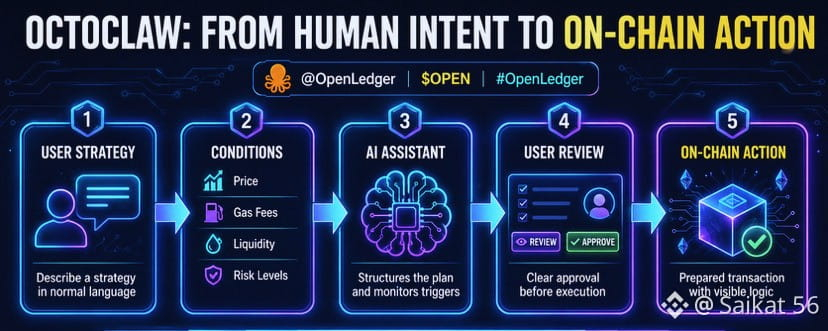
The idea is simple: a user describes a strategy in natural language, and the system translates it into structured on-chain steps.
For example, a user might want to execute trades based on price levels, gas fees, portfolio exposure, or liquidity conditions. A basic AI might only explain the idea. But a stronger system would configure those conditions, monitor them continuously, and prepare actions while keeping the user in control.
And that control is the most important part.
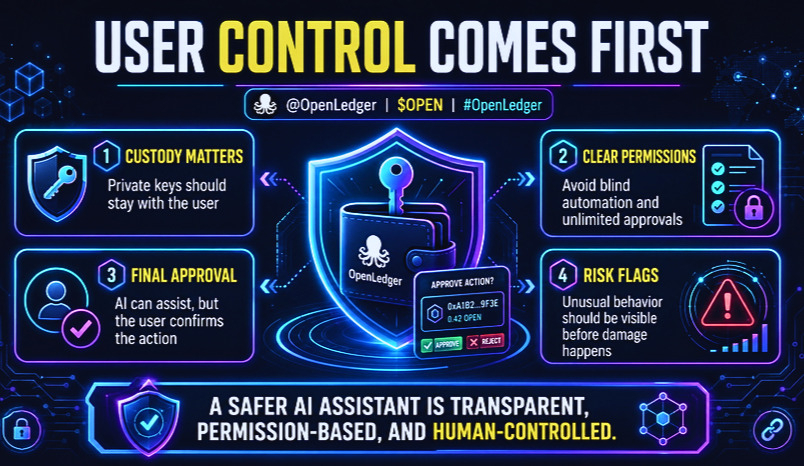
In crypto, ownership and custody are everything. Any AI that moves funds without explicit permission introduces serious risk. Private keys, automated approvals, and black-box decision-making can quickly become dangerous.
So no matter how advanced AI becomes, it should never replace user authority.
This is where OpenLedger’s approach feels more balanced. The AI can assist, suggest, prepare, and monitor but the final decision always stays with the user.
That transforms the system from a “robot trader” into a disciplined execution assistant.
And that is a healthier direction for crypto AI.
Because the future does not belong to agents that only sound intelligent. It belongs to systems that can explain themselves, can be tracked, and can be verified.
If an AI makes a suggestion, users should understand why. If it prepares a transaction, it should be visible. If something looks risky, the system should flag it early.
This is where verifiability becomes essential.
A serious AI execution layer should not only prioritize speed but also transparency. Users should know what data was used, what conditions triggered an action, and where potential risks lie. Without that clarity, AI tools risk becoming just another hype cycle with a better interface.
OpenLedger’s broader vision aligns with this shift.
It is not about simply combining AI and blockchain as a trend, but about making them reinforce each other. Blockchain provides accountability and traceability, while AI provides usability and automation.
Together, they can create real value.
But ultimately, everything depends on execution.
A good idea means little if it cannot survive real market conditions. Gas fees fluctuate, liquidity moves, bridges fail, and smart contracts behave unpredictably. The real world is messy, and crypto is even messier.
So the real test for OpenLedger is simple, but difficult:
Can OctoClaw deliver reliable, safe, transparent, and usable execution in real conditions?
If it can, then it will not just be another AI crypto narrative.
It will represent a shift where AI and blockchain move beyond conversation and become systems that can actually execute decisions in the real world.
And that is when it becomes clear it was never just a trend, but the beginning of a new structure.🤗