The more I study AI infrastructure, the more I realize the real challenge is no longer just building smarter models. The harder problem is creating systems that make AI collaboration transparent, scalable, and useful in the real world. Most projects talk about artificial intelligence in broad futuristic terms, but very few explain how contributors, datasets, developers, and deployment actually work together inside one ecosystem.
That is one reason I started paying closer attention to OpenLedger and the growing ecosystem around OPEN.
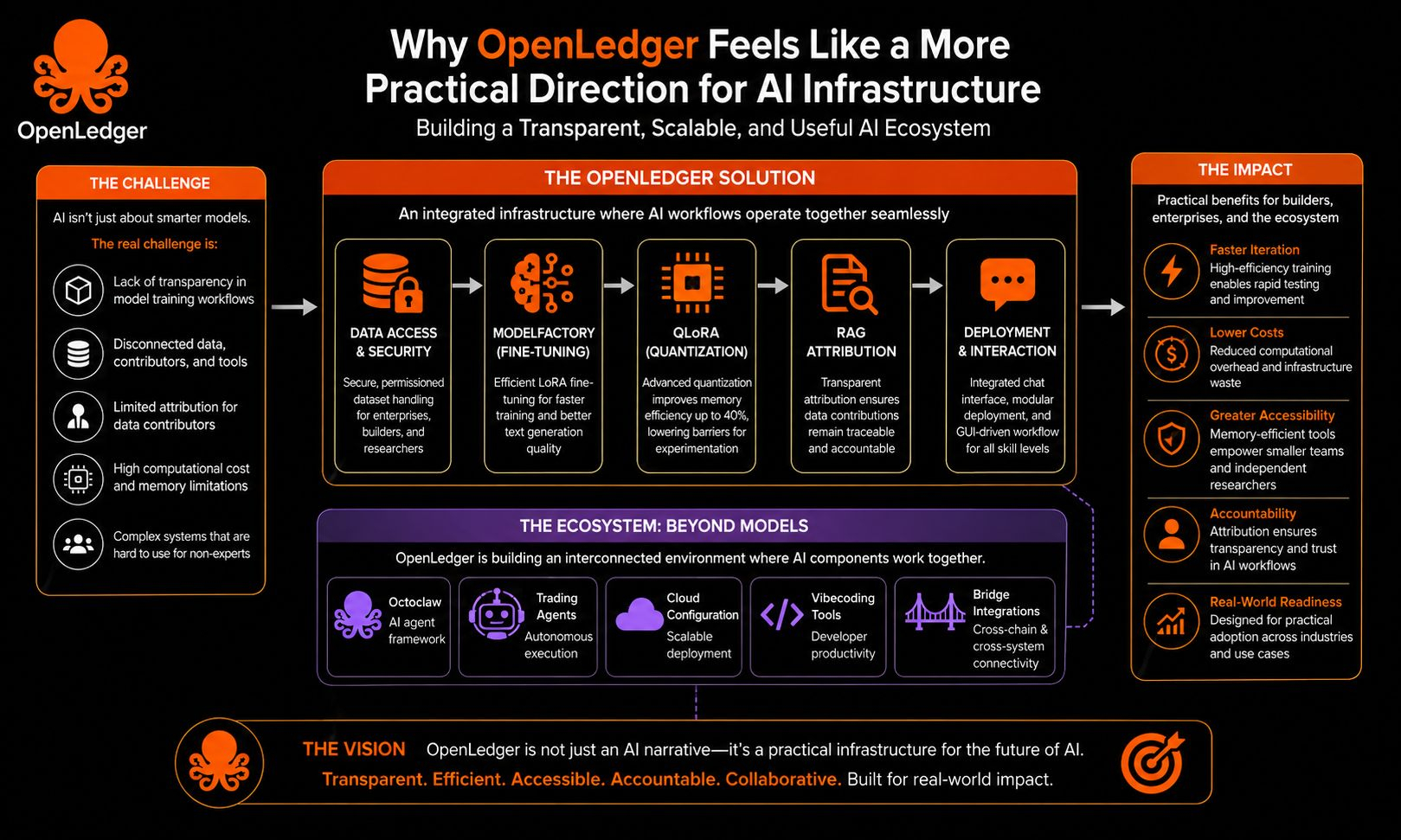
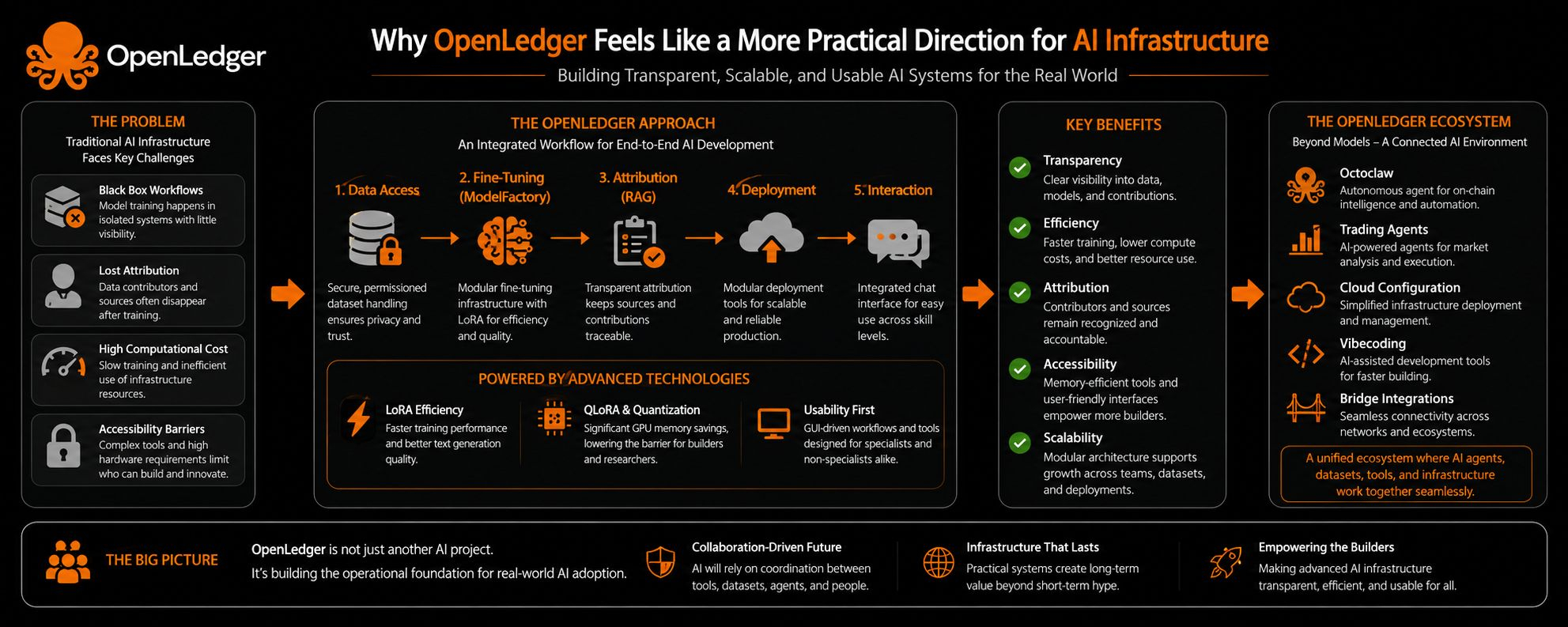
What stood out to me first was not marketing or hype. It was the architecture itself. OpenLedger appears focused on solving practical workflow problems that many AI systems still struggle with today. Instead of treating model training like a disconnected process happening inside black boxes, the platform introduces a structure where data access, fine tuning, attribution, deployment, and interaction all operate together in a more organized way.
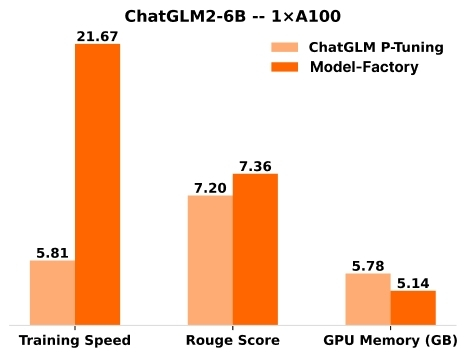
One part I found especially interesting is ModelFactory. Most conversations around AI fine tuning focus heavily on performance improvements, but OpenLedger approaches it from both efficiency and usability. The system combines secure dataset handling with modular fine tuning infrastructure, which makes the workflow feel more realistic for enterprises, builders, and researchers working with sensitive or permissioned information.
The efficiency gains are also difficult to ignore. Compared with traditional tuning approaches, ModelFactory’s LoRA implementation reportedly achieves much faster training performance while also improving output quality in text generation tasks. What makes this important is not just speed itself, but what speed enables. Faster iteration means developers can test ideas more efficiently, reduce infrastructure overhead, and improve models without excessive computational waste.
Another feature that caught my attention is the use of advanced quantization techniques through QLoRA. GPU memory limitations remain one of the biggest bottlenecks in AI development, especially for smaller teams and independent researchers. By improving memory efficiency significantly, OpenLedger lowers the barrier for experimentation and deployment. That matters because the future of AI will likely depend on accessibility just as much as raw capability.
I also think the platform’s focus on attribution is underrated.
In many AI systems today, data contributions disappear into the background once a model is trained. OpenLedger’s approach to RAG attribution introduces a more transparent framework where information sources and contributions can remain traceable inside the workflow itself. As AI becomes more integrated into business, research, and automation, systems that preserve accountability will probably become increasingly important.
Another reason the ecosystem feels more practical to me is the emphasis on usability. OpenLedger does not appear designed exclusively for machine learning specialists. The integrated chat interface, modular deployment tools, and GUI driven workflow suggest an attempt to make advanced AI infrastructure easier to operate across different levels of technical experience.
I also find the broader direction of the ecosystem interesting. Initiatives like Octoclaw, trading agents, cloud configuration systems, vibecoding tools, and bridge integrations suggest that OpenLedger is thinking beyond isolated AI models. The project seems focused on building an environment where AI agents, applications, datasets, and execution systems can interact more fluidly across infrastructure layers.
What makes this important is that AI ecosystems are becoming increasingly collaborative. Future systems will not rely on a single model doing everything. They will rely on coordination between tools, datasets, agents, contributors, and deployment environments. Projects that understand this early may end up building far more sustainable infrastructure over time.
For me, OpenLedger feels less like a short term AI narrative and more like an attempt to solve the operational side of AI adoption. That distinction matters. In a space filled with abstract promises, infrastructure that improves transparency, efficiency, attribution, and usability may ultimately create more lasting value.