
One thing that quietly shapes the internet is where things are allowed to live.
A creator can build an audience on one platform. A developer can publish tools inside one ecosystem. A company can store its data in one cloud. A model can be hosted in one marketplace. An agent can work inside one app.
At first, that feels normal.
The platform gives structure. It gives distribution. It gives users a place to find things. But after a while, the same structure can start to feel like a wall. The thing you created works, but only inside one environment. The value exists, but it does not travel easily.
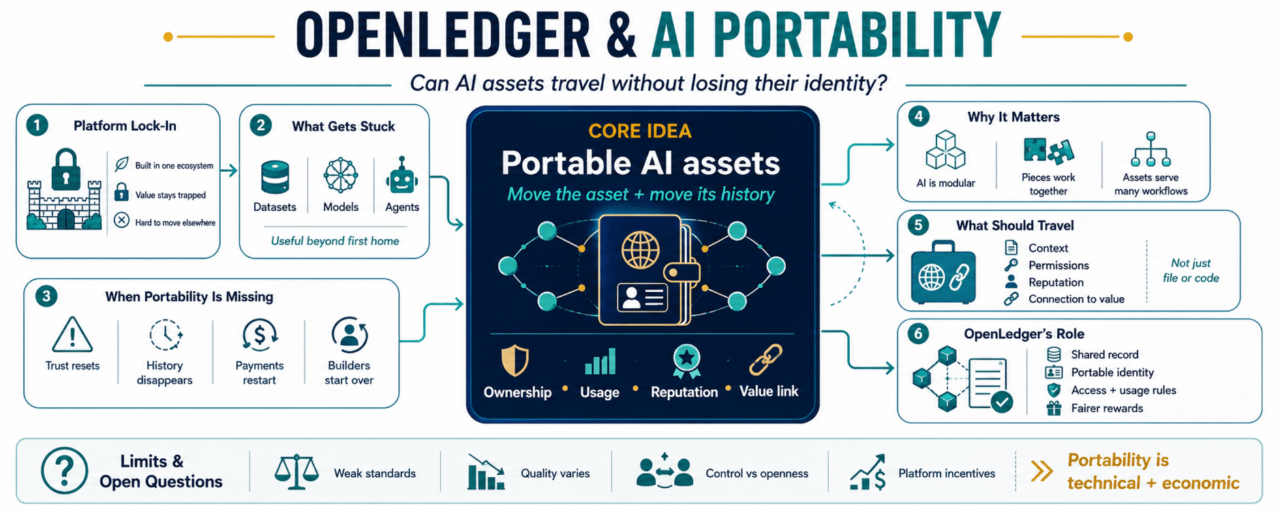
That is a useful way to look at OpenLedger.
Not only as an AI blockchain. Not only as a system for monetizing data, models, and agents. But as a response to a simple problem that shows up again and again in digital markets: useful things often get trapped where they were first created.
AI may make that problem more serious.
A dataset may begin inside one company. A model may be trained for one use case. An agent may be built for one platform. Each of these may have value outside its first home. But moving them is not always simple. Ownership may be unclear. Usage history may not travel with them. Reputation may stay locked to the platform that hosted them. Payment relationships may need to be rebuilt from zero.
So the asset exists, but it is not truly portable.
That matters because AI is becoming more modular. It is less about one tool doing everything and more about pieces working together. A small model may be useful in many workflows. A dataset may improve different agents. A specialized agent may serve several applications. But for that to happen, these parts need to move with some identity attached to them.
Not just the file.
Not just the code.
Not just the name.
The history has to move too.
Who created it? Who used it? What was it connected to? Did it improve something? Did people trust it? Did it earn value somewhere else? These questions become part of the asset itself.
You can usually tell when portability is missing. A builder has to start over every time they enter a new ecosystem. The same work needs to be proven again. The same asset needs to be introduced again. The same trust has to be rebuilt again from the beginning.
That slows everything down.
@OpenLedger seems to be working around this gap. If data, models, and agents can carry clearer records of ownership, usage, and contribution, then they do not have to depend entirely on one platform to explain their value. They can have a kind of independent memory.
That is where things get interesting.
A portable AI asset is not just something that can be copied. Copying is easy. The internet already does that too well. Portability means the asset can move while keeping its meaning. It carries its context, its permissions, its reputation, and its connection to value.
That is a different kind of movement.
For example, a dataset without a record is just data. A dataset with a record can show where it came from, how it was used, and whether it helped models or agents perform better. A model without history is just another model. A model with history can show its versions, its usage, and its place in a wider system. An agent without identity is just a tool. An agent with portable identity can build trust across more than one environment.
This is one of the quieter promises of blockchain in AI.
Not that it makes AI smarter. It does not.
Not that it removes all trust issues. It cannot.
But it may help AI assets become less dependent on closed databases owned by one company.
A shared ledger can give assets a record outside any single platform. That record can support ownership, access, usage, and rewards. It can let builders and contributors point to something more durable than a profile page or a marketplace listing.
And durability matters.
The AI space moves quickly. Platforms appear, change direction, shut down features, adjust terms, or build walls around their ecosystems. If an asset’s entire identity lives inside one of those places, the creator is always exposed. Their work depends not only on whether it is useful, but on whether the platform continues to support it.
OpenLedger’s angle feels different because it suggests that AI assets should not have to be born and die inside one system.
They should be able to travel.
That does not mean everything should be open or free. Portability is not the same as giving up control. In some cases, it may give more control. A creator can set terms. A dataset can have access rules. A model can be used under specific conditions. An agent can earn when it is called by another system.
The asset moves, but the relationship does not disappear.
That is important because AI value is often relational. A model becomes useful because a dataset improves it. An agent becomes useful because a model powers it. A workflow becomes useful because an agent performs one part well. These relationships can form across many places, not just inside one platform.
If those connections are visible, value can move more fairly.
Of course, there are limits.
Portability can become messy if standards are weak. Different systems may describe assets differently. Quality may vary. Some creators may want openness, while others may want tight control. Some platforms may not want assets to move freely because locked-in users are easier to monetize.
So this is not only a technical question. It is also an economic one.
Who benefits when AI assets are portable?
Who loses control when they are?
Who gets to define the rules for movement?
#OpenLedger sits near those questions.
$OPEN as the token, is part of how this movement could be coordinated. But the more grounded idea is larger than the token itself. It is about giving AI assets a way to exist beyond the place where they first appeared.
That may become more important over time.
As more people build datasets, models, agents, and small AI services, they may not want their work locked inside someone else’s walls forever. They may want their assets to move, to be used, to carry history, and to keep a connection to the value they create.
Not in a loud way. Just in a practical one.
AI is becoming a world of many parts. OpenLedger is asking whether those parts can travel without losing themselves along the way.
@OpenLedger #OpenLedger $OPEN

Άρθρο
OpenLedger (OPEN): The Question of Portability in AI
Αποποίηση ευθυνών: Περιλαμβάνει γνώμες τρίτων. Δεν είναι οικονομική συμβουλή. Ενδέχεται να περιλαμβάνει χορηγούμενο περιεχόμενο. Δείτε τους Όρους και προϋποθέσεις.