
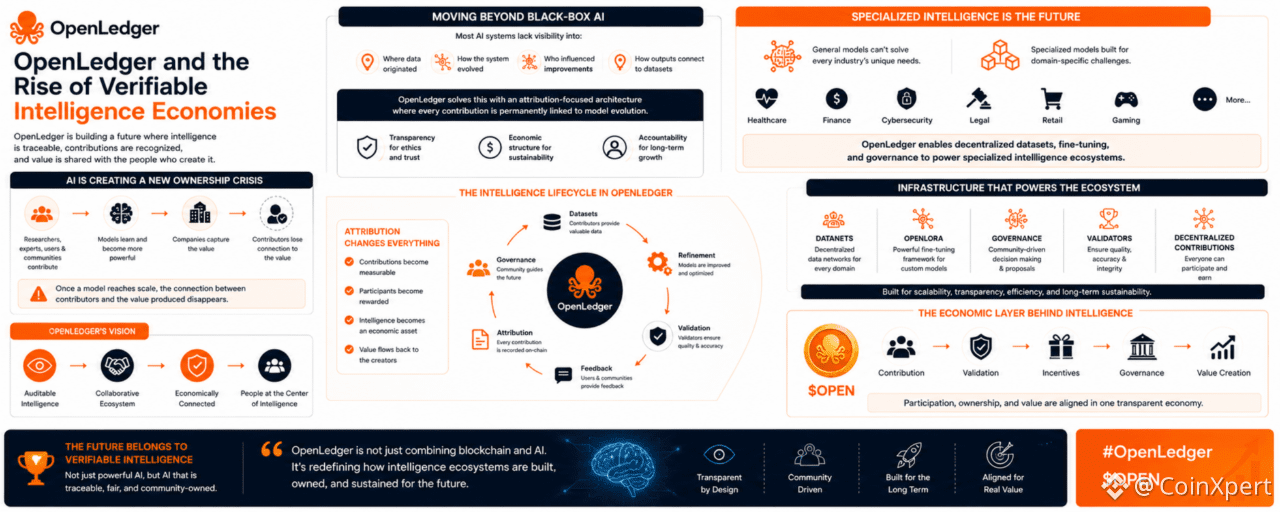
Artificial Intelligence Is Creating a New Ownership Crisis
The conversation around artificial intelligence usually focuses on speed, automation, and model capability. Companies compete to build larger systems, faster inference layers, and more advanced reasoning engines. But beneath all the innovation, another issue is quietly becoming more important: ownership of intelligence itself.
Modern AI systems depend on enormous amounts of human-generated input. Researchers refine architectures, domain experts provide knowledge, users generate behavioral patterns, validators improve responses, and communities continuously shape model quality through interaction. Yet once a model reaches scale, the connection between contributors and the value produced by the system almost disappears.
This is where OpenLedger introduces a very different perspective.
Instead of treating AI as a closed product controlled by centralized infrastructure, the project approaches intelligence as an ecosystem that should remain auditable, collaborative, and economically connected to the people helping build it.
Moving Beyond Black-Box Artificial Intelligence
One of the largest structural problems in the current AI industry is the lack of visibility surrounding model creation.
Most users cannot identify:
where training information originated,
how a system evolved over time,
which contributors influenced performance improvements,
or how outputs are connected to underlying datasets.
This creates a future where AI becomes increasingly powerful while remaining difficult to verify.
OpenLedger attempts to solve this challenge through an attribution-focused architecture where contributions are permanently linked to model evolution. Rather than allowing intelligence to develop inside isolated systems, the ecosystem creates transparent contribution histories tied directly to participation.
That distinction matters more than people realize.
Transparency in AI is not only about ethics. It is also about economic structure, accountability, trust, and long-term sustainability.
Why Attribution Could Become the Foundation of Future AI Systems
Most digital economies reward distribution more than contribution.
Social platforms reward attention. Advertising networks reward traffic. Traditional AI companies often reward ownership of infrastructure. But very few systems reward the actual origin of intelligence inputs themselves.
OpenLedger’s attribution framework changes that dynamic by introducing measurable contribution pathways into AI development.
Instead of data existing as an invisible resource, contributors become identifiable participants connected to the intelligence lifecycle. Datasets, refinements, validations, and feedback loops are transformed into economically relevant activities rather than disposable background processes.
That creates a major philosophical shift.
The ecosystem is no longer centered only around AI outputs. It becomes centered around the value creation process behind those outputs.
Specialized Intelligence May Replace Generalized Dependence
Another important direction OpenLedger seems to recognize early is the growing importance of specialized intelligence systems.
Large general-purpose models are powerful, but they are not automatically optimal for every industry. Healthcare environments require precise medical context. Financial systems require accurate risk interpretation. Cybersecurity tools require adaptive threat recognition. Legal automation requires structured reasoning tied to regulation and documentation.
General intelligence alone cannot fully solve these challenges efficiently.
This is why OpenLedger’s infrastructure around decentralized datasets, model refinement pipelines, governance mechanisms, and fine-tuning environments becomes interesting from a long-term perspective.
The ecosystem is designed to support focused intelligence ecosystems rather than forcing every application to depend on one centralized universal model.
That approach may eventually become more scalable, explainable, and economically sustainable.
Infrastructure Matters More Than Hype
Many blockchain and AI projects focus heavily on narratives before infrastructure exists. What makes OpenLedger more interesting is that much of its architecture revolves around operational systems rather than abstract marketing concepts.
Components like Datanets, OpenLoRA, model governance structures, validator participation, and decentralized contribution flows create a framework where collaboration can happen continuously instead of temporarily.
The technical direction suggests an ecosystem attempting to support:
scalable model deployment,
transparent contribution tracking,
efficient resource allocation,
decentralized participation,
and sustainable economic coordination.
Those elements are critical if decentralized AI ecosystems are expected to survive beyond speculation cycles.
The Economic Layer Behind Intelligence
Perhaps the most overlooked aspect of AI development today is that intelligence itself is becoming an economic asset class.
As AI systems continue integrating into industries, workflows, platforms, and autonomous agents, the infrastructure controlling those systems will influence how digital economies operate in the future.
OpenLedger positions itself directly within that transition.
Instead of separating contributors from ownership, the ecosystem attempts to align participation with long-term value generation through $OPEN. Governance, validation, incentives, and ecosystem activity become interconnected rather than isolated functions.
This creates an environment where intelligence production, coordination, and monetization evolve together inside one transparent framework.
Artificial intelligence is advancing rapidly, but the systems governing ownership, contribution recognition, and economic participation are still immature.
OpenLedger is exploring a direction where AI infrastructure becomes traceable, collaborative, and economically aligned with the people contributing to it. That idea goes beyond simply combining blockchain with AI. It challenges the underlying structure of how intelligence ecosystems may function in the future.
Whether decentralized AI adoption accelerates quickly or develops gradually over time, the broader themes OpenLedger is building around — attribution, transparency, specialized intelligence, and contributor participation — are likely to become increasingly important as AI systems continue expanding into every part of the digital world.