
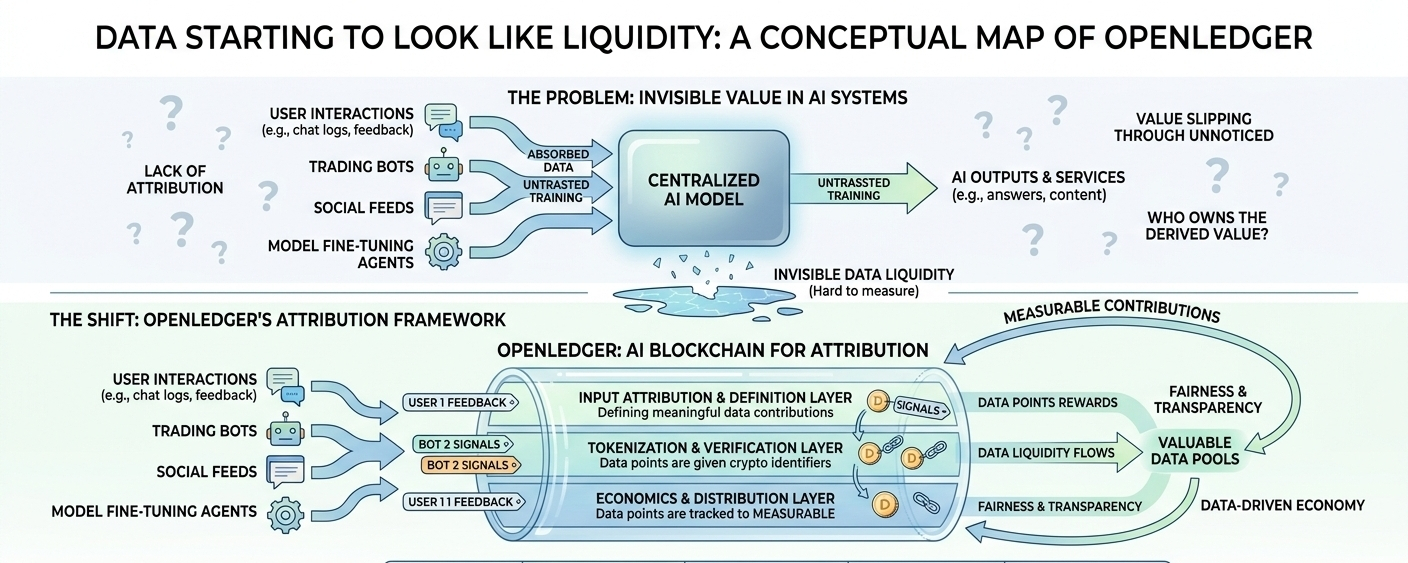

I’ve been seeing something interesting lately when I scroll through crypto conversations at night. Not the usual hype cycles or token chatter, but this quieter shift in what people think they actually “own” online.
A few years back, most of us were focused on price charts. Now it feels like the conversation is slowly drifting toward something more basic. Who owns the data being produced every second across AI tools, trading bots, social feeds, and models that quietly learn from us without much return going back.
When I first came across OpenLedger, I didn’t immediately know what to make of it. An AI blockchain that talks about monetizing data, models, and agents sounds almost too abstract at first glance. It felt strange in a way, like the idea was sitting between two worlds that don’t usually meet cleanly.
One side is blockchain, where ownership and transparency are the core narrative. The other side is AI, where data gets absorbed, trained on, and turned into outputs that often don’t trace back to where they came from. I remember thinking these systems were almost designed to ignore each other.
But then I started thinking about how much invisible value is already being created. Every time someone interacts with a model, fine-tunes an agent, or even just generates useful feedback, something is being added to a system that rarely attributes contribution properly. Maybe I’m overthinking it, but it does raise a quiet question about fairness.
OpenLedger’s framing of liquidity around data and models made me pause. Not because I fully agree or disagree, but because it tries to turn something abstract into something measurable. That’s always where things get tricky in crypto. We like measurement, but not everything meaningful fits neatly into numbers.
I keep going back to earlier DeFi cycles when liquidity meant capital flowing into pools and protocols. It was visible, almost mechanical. Now the idea is shifting toward information itself being treated like liquidity. I’m not entirely sure how clean that translation is, but the direction feels worth paying attention to.
If data becomes something that can be tracked and attributed, then every interaction starts to carry a slightly different weight. Not necessarily in a dystopian sense, but in a more structured one. Like every contribution leaves a footprint that might matter later in ways we don’t fully see yet.
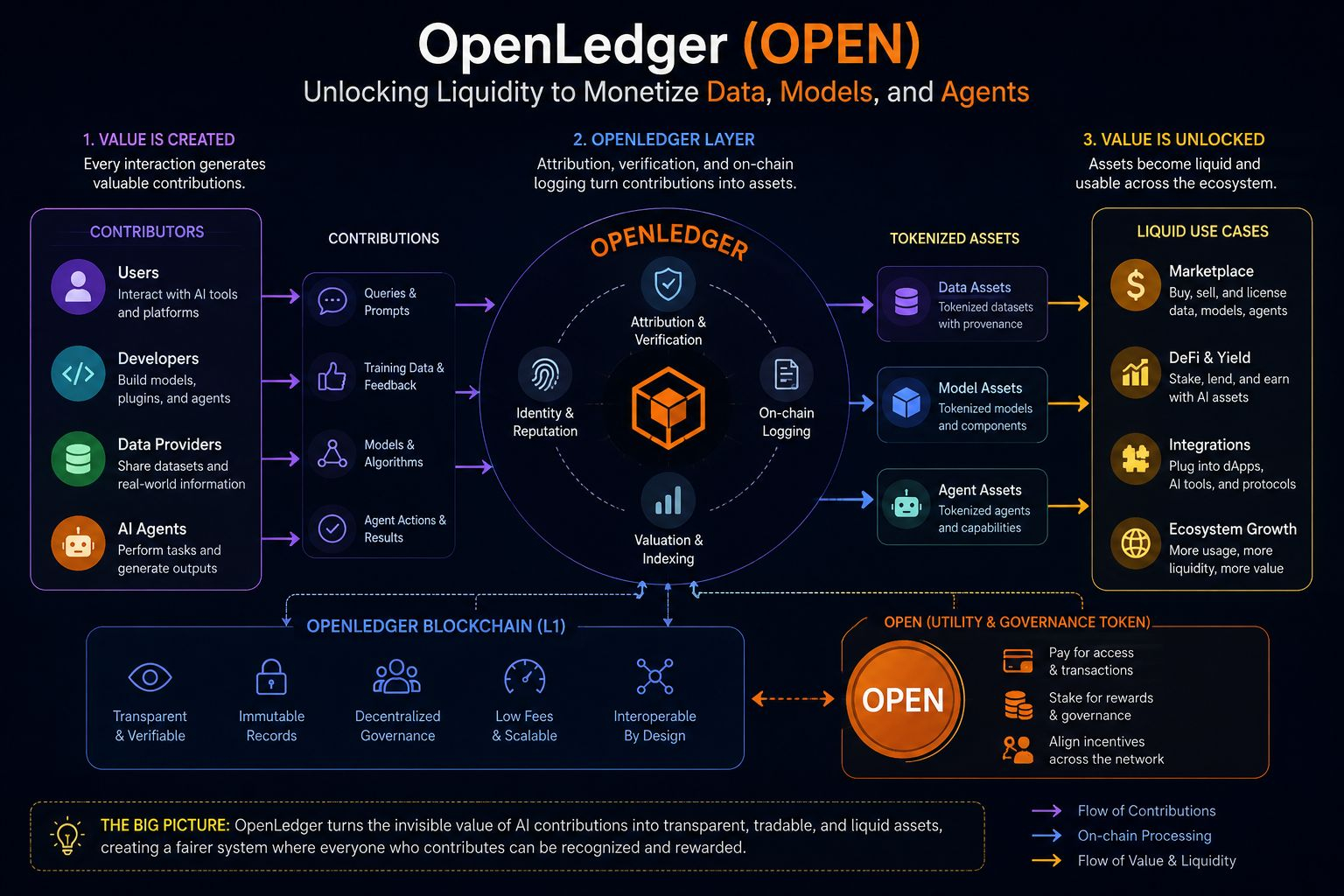
The uncertainty for me is scale. It’s one thing to talk about attribution in theory, and another to actually implement it across fragmented systems, models, and agents. I still wonder how that coordination works without creating friction or gaps where value slips through unnoticed.
Another question that keeps coming up is user behavior. Would people actually change how they interact if they knew their data had direct economic attribution attached to it. Or would most of it fade into the background the way most terms and conditions already do today.
Still, there’s something hard to ignore about the direction of travel. AI systems are becoming more dependent on constant input loops, and someone is always generating that input. Whether that contribution gets recognized properly feels like one of those unresolved tensions in the whole space.
I also can’t help thinking that attribution itself could become a point of disagreement in the future. Not just about ownership, but about definition. Who decides what counts as meaningful contribution when models learn in such layered and indirect ways.
Maybe OpenLedger is trying to map that messy boundary between data creation and value extraction. Or maybe it’s just one of those early experiments that shows how difficult it is to turn human activity into something economically structured without losing nuance along the way.
Either way, I keep coming back to the same quiet thought. If AI systems continue evolving in this direction, the real shift might not just be technical. It might be how we start understanding our own role inside systems that are constantly learning from us, whether we notice it or not.
