
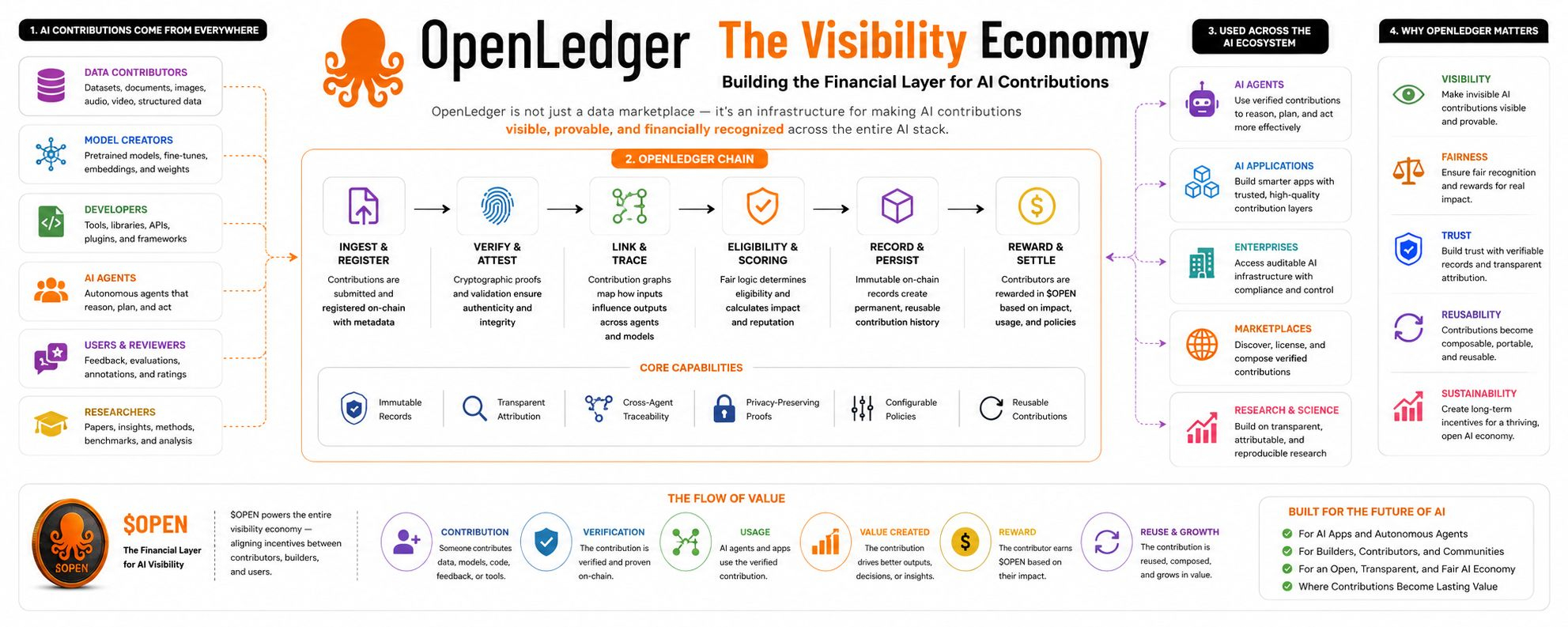
Data goes in. Models come out. Payments move around. Everyone gets rewarded fairly. The story sounds clean, organized, and easy to explain. That is why so many AI projects are quickly labeled as “marketplaces.” It gives people a familiar framework to hold onto in a space that still feels chaotic.
At first glance, OpenLedger seems easy to place inside that narrative.
It supports AI applications and autonomous agents. Its vision revolves around systems that can see, reason, and act. The blockchain is positioned as infrastructure for these emerging AI economies. Naturally, people assume the goal is simple: create a decentralized marketplace where data, models, and intelligence can be traded more efficiently.
But the deeper you think about it, the less convincing that explanation becomes.
Because OpenLedger may not actually be trying to build a marketplace in the traditional sense.
It may be trying to solve something much more invisible.
The real problem inside AI is not only who owns the data.
The real problem is that nobody can clearly see who contributed what.
And that changes the entire conversation.
Right now, AI feels magical partly because most of its inner workings are hidden from view. A chatbot answers a question in seconds. An AI agent completes a task autonomously. A model generates images, writes code, summarizes research, or makes decisions. From the outside, the output appears smooth and singular.
But underneath that smooth surface is a tangled web of invisible labor.
A single AI response may quietly depend on thousands of contributions: datasets refined by unknown people, model adjustments made months earlier, memory systems shaping context, tool integrations influencing reasoning, or previous interactions subtly changing future behavior. The output feels like it appeared instantly, but in reality it was assembled from layers upon layers of unseen influence.
Most of those contributors disappear.
That disappearance matters more than people realize.
Because economies are not only built around production. They are built around visibility. What society can measure, recognize, and track eventually becomes what society rewards.
And AI is entering a dangerous phase where contribution is becoming harder and harder to see.
This is where OpenLedger becomes genuinely interesting.
The project talks openly about AI agents that can interact, reason, and perform tasks autonomously. Many people focus on the technical side of that vision. Faster infrastructure. Better coordination. Scalable intelligence. But infrastructure always shapes economics in ways that are not immediately obvious.
Once a network begins tracking interactions between models, agents, tools, and contributors, it slowly transforms into something larger than a simple blockchain.
It becomes a system that decides what counts.
That may ultimately be the real meaning of the $OPEN token.
Not just a currency for transactions.
But a mechanism for making AI contributions financially visible.
That sounds abstract until you think about how modern AI actually works.
Traditional marketplaces are simple. One person sells something. Another person buys it. Ownership changes hands. The transaction ends there.
AI systems do not behave like that.
Value inside AI often accumulates quietly over time. A small correction to a model today may improve outputs months later. A useful reasoning pattern may spread across agents invisibly. A dataset contribution might influence thousands of future interactions without anyone noticing where the improvement originally came from.
The contribution keeps living long after the moment it was created.
So the real challenge is not merely monetization.
It is recognition.
How do you prove a contribution mattered?
How do you reward invisible influence?
How do you create reusable records without exposing every detail publicly?
Those questions sit at the center of OpenLedger’s design philosophy whether the project says it directly or not.
And this is where the conversation becomes more human than technical.
Because people naturally want their contributions to matter.
Even outside crypto, humans are deeply emotional about recognition. Workers want credit for effort. Artists want acknowledgment for inspiration. Builders want proof that they shaped something meaningful. Entire industries are built around the emotional connection between labor and visibility.
AI threatens to blur all of that.
As systems become more autonomous, individual contributions risk dissolving into machine outputs that feel detached from the humans or systems that shaped them. Over time, AI could create enormous value while quietly erasing the history of who helped create that value in the first place.
That is why OpenLedger’s vision feels larger than a “data economy.”
It feels closer to a visibility economy.
A world where the most important thing is not simply ownership of intelligence, but the ability to prove participation in its creation.
And once visibility becomes valuable, new tensions appear immediately.
Because visibility is power.
Whoever controls contribution records eventually influences who gets rewarded, who gains reputation, and who remains economically relevant. A blockchain that tracks AI contribution is not just storing information. It is shaping legitimacy itself.
That creates both hope and danger at the same time.
The hopeful side is obvious. Builders who were previously invisible may finally receive persistent recognition. Contributions can become reusable economic records instead of forgotten background labor. AI systems become more auditable. Attribution becomes more transparent.
But there is another side too.
Every system that rewards visibility eventually teaches people how to perform for visibility.
Social media already showed this clearly. Once attention became monetizable, people optimized behavior around algorithms instead of authenticity. AI contribution systems could face a similar problem. Participants may flood networks with low-quality activity simply because measurable activity becomes financially valuable.
The danger is subtle but serious.
A network meant to reward meaningful intelligence could accidentally reward whatever is easiest to track.
That tension may define whether OpenLedger succeeds or struggles in the years ahead.
Because creating a visibility economy is far more complicated than creating a marketplace.
Marketplaces only coordinate exchange.
Visibility systems shape behavior itself.
And yet the need for such systems is becoming impossible to ignore. AI agents are growing more autonomous every year. They will increasingly collaborate across platforms, tools, memory systems, and external environments. As that complexity expands, invisible contribution chains become harder to manage through centralized companies alone.
Someone will eventually build the accounting layer for AI participation.
The real question is who.
OpenLedger seems to understand that earlier than most projects in the decentralized AI space. Beneath the language of data liquidity and AI infrastructure sits a more profound idea: the future economy of intelligence may revolve less around owning AI and more around proving contribution within AI systems.
That is a very different future from the one most people imagine.
And it is also a far more emotional one.
Because beneath all the technical language, this conversation is ultimately about something deeply human:
the fear of becoming invisible in a world increasingly shaped by machines.
If OpenLedger succeeds, it may not be because it created another efficient marketplace for AI assets.
It may succeed because it recognized the coming battle over visibility before everyone else did.