
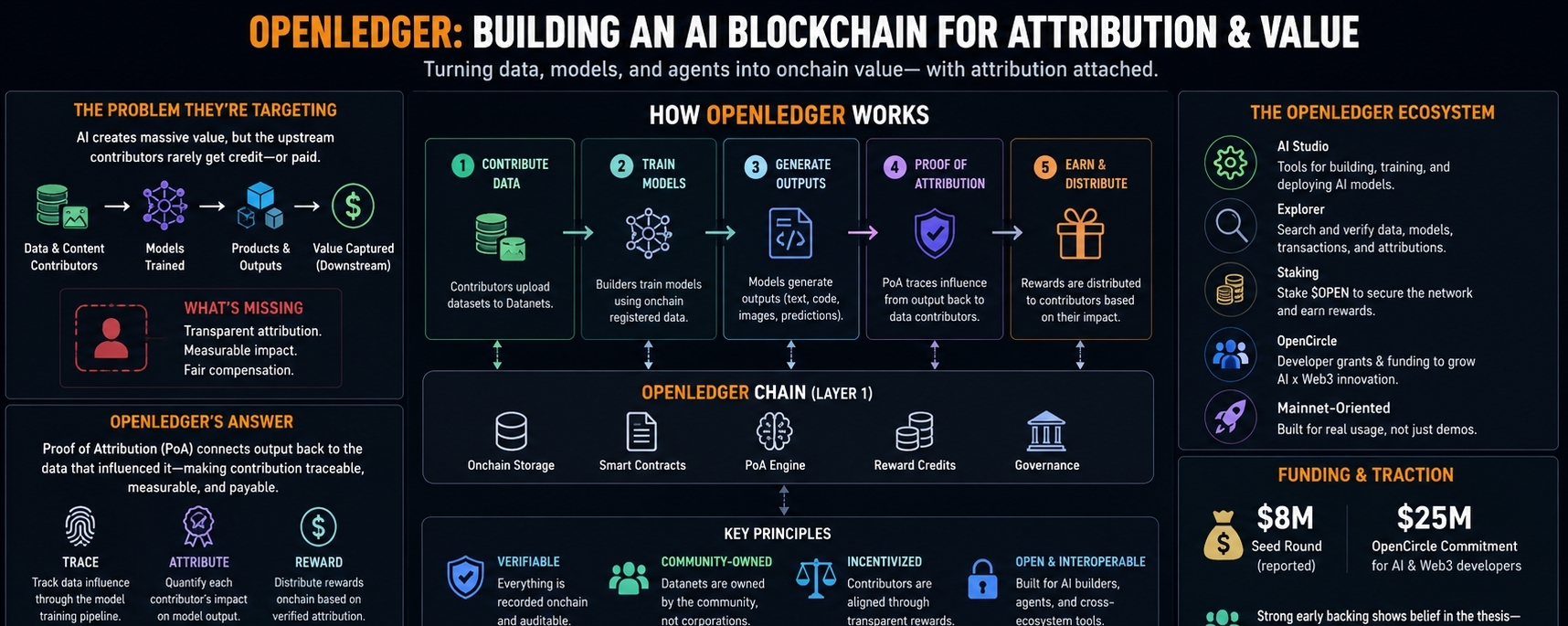
@OpenLedger At first glance, OpenLedger feels like one of those projects that knows the room is already tired. Tired of “AI x crypto,” tired of “we are the next chain,” tired of every team acting like the missing piece of the internet was, somehow, another token with a bigger story around it. And yet OpenLedger is not pretending to be a payments chain or a generic smart-contract playground. It is presenting itself as an AI blockchain, with OpenLedger Chain as the base layer, and it keeps returning to the same idea: data, models, and agents should be able to produce value onchain, with attribution attached instead of hand-waved away. That is the first impression, really. Not elegance. Not inevitability. More like a project leaning hard on a specific irritation in the market and saying, maybe the irritation is real enough to build around.
That matters because the crypto landscape has seen this movie so many times. Another Layer 1 arrives with a fresh vocabulary, a cleaner dashboard, a promise that this time the chain is finally aligned with the thing everyone cares about. Then reality comes along and does what it always does. It does not care about the pitch. It cares about usage. It cares about what happens when the nice demo stops being a demo and starts being a place where people actually show up. OpenLedger’s own docs are pretty explicit about what it wants the chain to do: dataset uploads, model training, reward credits, governance, all of it onchain. The whitepaper pushes the same thesis further, saying Proof of Attribution is supposed to trace data influence through model output and turn contribution into something measurable and payable. That is a real attempt at a protocol-shaped problem, not just a narrative-shaped one. Still, it is also the kind of ambition that tends to look cleaner in a deck than in production.
The blunt reality is that blockchains do not usually fail because the diagrams were ugly. They fail when the traffic gets messy. That is the stress test. Not idealized throughput charts, not the clean path through a prototype, but what happens when people, bots, arbitrage, social behavior, and plain old impatience all hit the thing at once. Solana is the obvious comparison because it has spent years being the poster child for speed, and also a reminder that speed is not the same thing as never wobbling. Its own network performance report says the chain suffered a 4 hour 46 minute outage on February 6, 2024, caused by a bug that halted consensus. That does not make Solana a failure. It makes it useful as a reminder. Good conditions are easy. Real conditions are where reputations get sorted.
So when OpenLedger talks like it is building infrastructure for data-heavy AI systems, the question is not whether the idea sounds coherent. It does. The question is whether the load actually behaves the way the story assumes it will. Maybe the future is not one dominant chain at all. Maybe it is a handful of ecosystems sharing the pressure, with specialized rails for specialized work. That sounds sensible, almost boring, which is usually a good sign in crypto. But it also raises the obvious doubt: do users really want to move across ecosystems just because the architecture makes sense on paper? Liquidity is sticky. Users are stickier. The best technical explanation in the world does not automatically pull habits out of one place and into another. OpenLedger’s own website hints at a broader ecosystem with AI studio, explorer, staking, OpenCircle, and a mainnet-oriented setup, which suggests it understands that distribution and developer activity matter just as much as the chain itself. Still, the gap between “ecosystem” and “people actually using it” is where most projects quietly get stuck.
What OpenLedger seems to notice, quietly, is that AI value creation is usually handled in a very clumsy way. Data goes in. Models get trained. Outputs get sold. The people upstream are lucky if they get a thank-you note, which they usually do not. OpenLedger’s answer is to formalize the path from contribution to compensation. Its docs describe community-owned datasets called Datanets, and the whitepaper frames Proof of Attribution as a way to connect model output back to the data that influenced it. That is not a small idea. It is a very specific answer to a very specific annoyance: the AI stack has become economically useful while still being weirdly vague about who deserves what. The project’s trade-off, though, is obvious. It is simplifying around attribution and incentive design, and probably accepting that it cannot solve every problem at once. It is not trying to be everything. It is choosing traceability, rewards, and specialized AI workflows, while leaving the more ordinary blockchain identity crisis to everyone else.
That kind of narrowing can be a strength. It can also be a way of hiding fragility. A project that picks one sharp problem sometimes ends up with a clearer path to usefulness than a project that tries to be a full-stack universe. But there is still a hard question sitting in the middle of OpenLedger’s model: will people actually move? Will contributors show up and create data? Will builders prefer this over the many easier places to ship AI products? Will liquidity follow the same route, or stay wherever it already has the deepest pools and the least friction? OpenLedger has clearly attracted serious attention, including a reported $8 million seed round and a later $25 million commitment through OpenCircle to support AI and Web3 developers. That is not nothing. It means somebody thought the thesis was worth funding. But funding is not adoption, and adoption is not retention, and retention is not a network effect. Those are all separate problems, and crypto likes to pretend they are one.
So the project lands in that familiar middle zone: more interesting than pure hype, less proven than the pitch would like, and still exposed to the basic laws of the market. If OpenLedger can make attribution feel real rather than ceremonial, and if the chain can handle activity without turning into another lesson in what stress does to theory, then there may be something there. Not a revolution. Just something that makes a little more sense than the last round of slogans. The problem is that crypto has trained everyone to suspect sense, especially when it shows up wearing an AI badge. So the honest position is just to leave the door open a crack and not more. It might work. Or nobody shows up.