
Something feels off in AI right now.
You can see it if you stare long enough.
Every week there’s another billion-dollar announcement, another giant model, another company promising that artificial intelligence will rewrite industries, automate labor, replace workflows, accelerate productivity — all the usual noise. Investors cheer. Tech executives grin through conference interviews. Markets react instantly.
Meanwhile, almost nobody asks the uncomfortable question sitting underneath the entire machine:
Who actually owns the raw material feeding this thing?
That silence matters.
Because AI didn’t build itself. It learned from us. From our writing, our conversations, our code, our habits, our searches at 2 a.m., our photos, our weird internet behavior accumulated over twenty years and quietly vacuumed into training systems large enough to imitate human reasoning.
And the people supplying that value? Mostly invisible.
That’s where OpenLedger enters the story — not as another flashy crypto experiment trying to attach itself to the AI boom, but as a project asking a very dangerous question for the current system:
What happens if data owners finally want a piece of the economy they helped create?
Big question.
The truth is, the internet trained us to give things away for free. We handed platforms our attention first. Then our behavior. Then our creativity. Social networks became trillion-dollar businesses while users fought for likes and exposure like digital street performers hoping the algorithm might notice them.
We accepted it because convenience is addictive.
Now AI raises the stakes dramatically because the systems aren’t just organizing information anymore — they’re generating economic output from it. Real output. Code. Research. Media. Analysis. Automation. Entire workflows.
That changes the equation.
I know what you’re thinking—blockchain usually shows up right around the moment a conversation becomes unbearable. Fair point. Most blockchain projects spent the last few years drowning the market in jargon and fantasy economics while building products nobody actually needed.
And honestly? That damaged the entire sector.
But occasionally a technology survives its own hype cycle because the underlying problem refuses to disappear. AI ownership feels like one of those moments.
OpenLedger’s core idea is surprisingly simple once you strip away the technical language: if data, models, and AI agents generate value, there should be infrastructure capable of tracking contribution and distributing value back to participants instead of concentrating everything inside centralized systems.
Essentially, attribution becomes economic infrastructure.
Not marketing. Infrastructure.
That distinction matters more than people realize.
Because AI is entering a phase where raw scale alone may not be enough anymore. The first wave rewarded whoever could scrape the largest amount of internet data and throw massive computing power at it. Bigger model. Bigger valuation. Bigger headlines.
But things are changing now.
Quietly.
The industry is starting to realize high-quality data is becoming scarce — and incredibly valuable. Not random internet noise. Structured datasets. Verified information. Specialized training environments. Human-labeled behavioral systems. Financial records. Medical data. Legal reasoning frameworks.
The expensive stuff.
And once something becomes scarce, ownership suddenly becomes very real.
Actually, this is where the conversation gets interesting.
Because OpenLedger isn’t really betting on hype. It’s betting that AI economies eventually need accountability layers underneath them. Systems capable of answering basic but essential questions:
Where did this data come from?
Who contributed to the model?
Who gets compensated?
How do autonomous agents transact with each other?
Who verifies authenticity?
Simple questions. Brutal implications.
Especially once AI agents become more autonomous.
That part still feels underestimated to me. Everyone’s focused on chatbots while a much bigger shift is happening underneath. AI agents are slowly evolving from passive assistants into operational systems capable of executing tasks independently — managing workflows, coordinating software, interacting with APIs, handling transactions.
Digital labor.
That’s what this really becomes.
And once machines start participating economically, the old internet structure starts breaking apart. Because now ownership isn’t theoretical anymore. It becomes financial architecture.
Look, centralized AI companies still hold enormous power. We shouldn’t pretend otherwise. They control the compute, the talent, the distribution pipelines, the proprietary data environments. Most decentralized projects underestimate how difficult it is to compete against that level of concentration.
Convenience usually wins.
It always has.
That’s the real challenge for OpenLedger and projects like it. The technology can’t just work philosophically. It has to work operationally. Developers won’t sacrifice speed for ideology. Enterprises won’t tolerate friction because a whitepaper sounds intellectually elegant.
It works. Or not.
Still, there’s pressure building beneath the surface of the AI market that feels impossible to ignore. Creators are becoming defensive about training rights. Governments are circling regulation discussions. Enterprises want traceable AI systems because legal uncertainty terrifies corporate lawyers — and honestly, for good reason.
Nobody wants future lawsuits attached to invisible datasets.
And maybe that’s the bigger story here.
Not blockchain. Not tokens. Not speculative markets.
Trust.
AI has a trust problem growing in slow motion. Most people just haven’t fully processed it yet because the products still feel magical enough to distract us. But eventually the excitement fades and harder questions arrive:
Who owns intelligence trained on public behavior?
Can attribution exist at machine scale?
What happens when autonomous systems start generating wealth using data pulled from millions of people who never explicitly agreed to participate?
Messy questions.
Necessary questions too.
I keep coming back to this thought — the first internet monetized our attention without properly compensating us for it. AI risks monetizing cognition itself. Our thoughts, patterns, creativity, and interactions become economic fuel for systems we don’t control.
That should make people uncomfortable.
And maybe that discomfort is exactly why projects like OpenLedger exist in the first place. Not because success is guaranteed. It isn’t. Most experiments fail. Some deserve to fail.
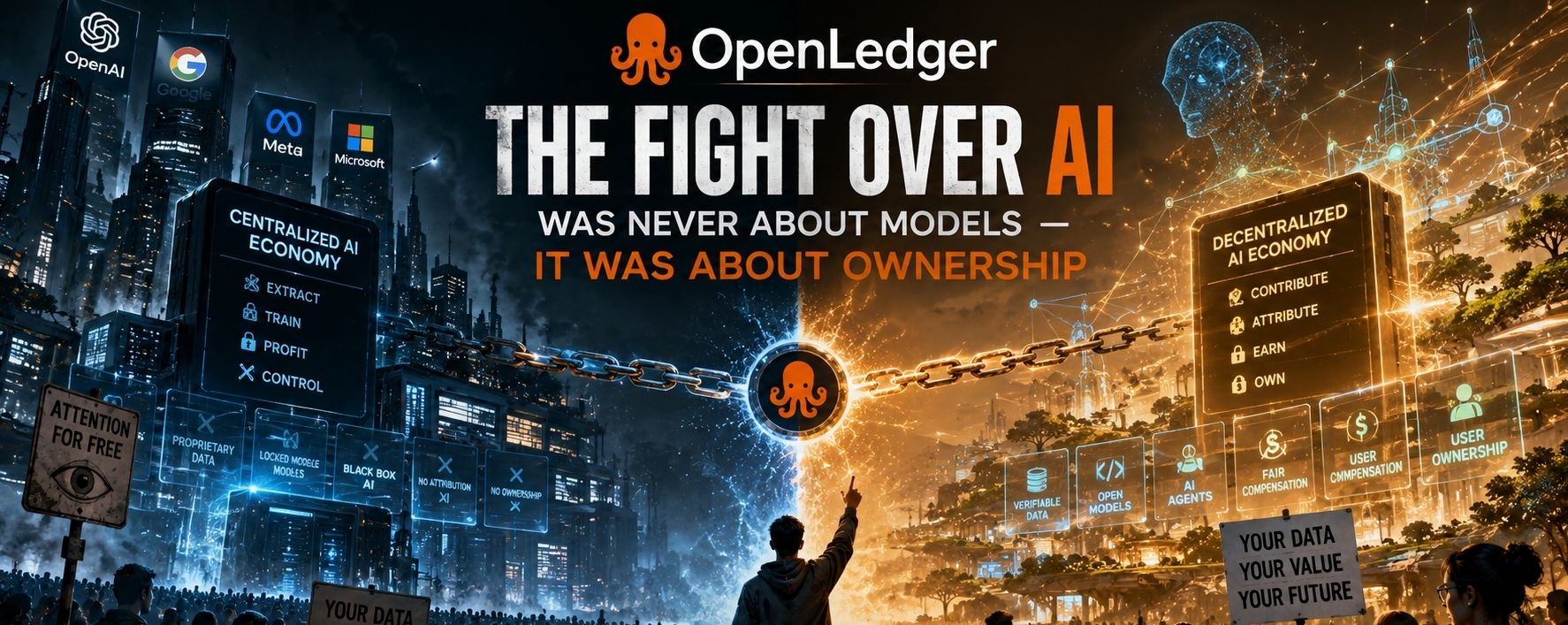
But the fight over AI was never really about who builds the smartest model.
It was always about who owns the value after the model learns from all of us.