
I keep thinking about how casually people give away intelligence online.
Not artificial intelligence, but human intelligence.
Every search, correction, conversation, image upload, review, prompt, and interaction slowly becomes part of a larger machine. Most people never notice it happening because the process feels invisible. You open an app, type a question, upload a file, and move on with your day. But somewhere in the background, systems learn from that behavior.
For years, the internet mainly monetized attention. Platforms competed for clicks, time spent, and advertising revenue. AI changed the equation because now behavior itself has become raw material. Human interaction is no longer just traffic. It is training data.
The strange part is that the people producing this value rarely have any ownership over it.
This imbalance has existed for a long time, but AI made it harder to ignore. Large technology companies accumulated enormous datasets, computing infrastructure, and distribution networks while contributors remained fragmented and disconnected from the systems they helped improve. Developers building models often faced another problem entirely: even if they created something useful, accessing reliable data and distributing models at scale remained expensive and highly centralized.
Many blockchain projects tried to solve parts of this problem before. Some focused on decentralized storage. Others attempted data marketplaces where users could sell datasets directly. A few experimented with tokenized AI infrastructure or shared computing networks.
But most of these systems struggled for a simple reason: data is not naturally liquid.
Unlike cryptocurrencies, data is messy, contextual, difficult to verify, and constantly changing. Two datasets may look similar while producing completely different outcomes inside a model. Quality matters more than quantity, but quality is difficult to measure objectively. Most marketplaces also assumed people would actively package and sell data themselves, which rarely fits normal human behavior.
Even decentralized AI projects often reproduced the same concentration problems they claimed to oppose. Ownership became distributed on paper while actual control remained concentrated among technical insiders, infrastructure operators, or early capital.
That is partly why I find interesting, although I am still unsure whether the broader model can fully work at scale.
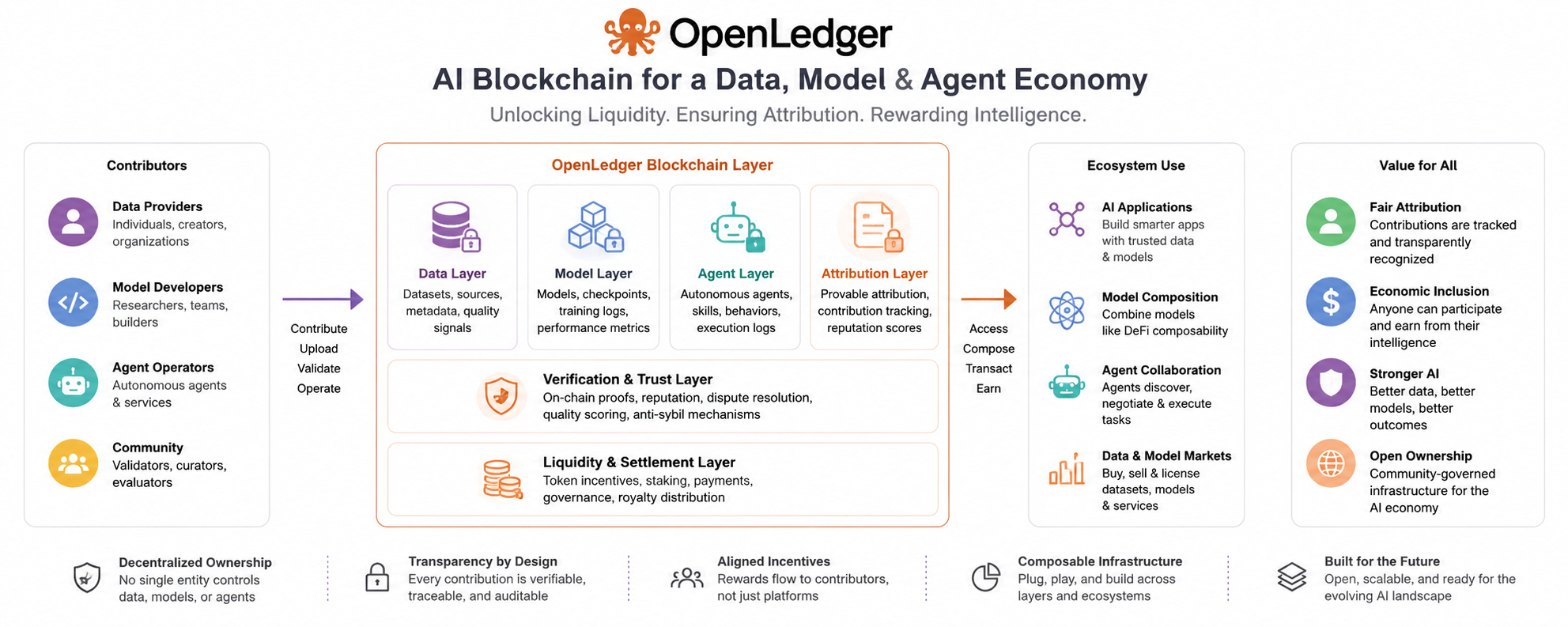
Instead of treating AI purely as computation, OpenLedger seems to approach AI as an economic coordination problem. The project focuses on creating liquidity around data, models, and autonomous agents through blockchain infrastructure. In simple terms, it is attempting to build systems where contributions to AI networks can be tracked, attributed, and potentially rewarded more transparently.
The idea sounds straightforward at first, but the underlying challenge is complicated.
Most AI systems today operate like black boxes. People contribute data, developers fine-tune models, agents perform tasks, and somewhere along the chain value accumulates. Yet tracing where intelligence actually came from becomes extremely difficult once everything blends together.
OpenLedger’s design appears to focus heavily on attribution layers. The broader argument is that if contributions can be measured more clearly, then economic incentives can also be distributed more fairly. Data providers, model creators, and agent operators could theoretically participate inside the same ecosystem instead of remaining separated across closed platforms.
What makes this approach different from earlier blockchain experiments is the attempt to treat AI components as composable financial primitives. Models, datasets, and agents are not just tools inside the system; they become assets capable of interacting with each other economically.
At least conceptually, this reflects a larger shift happening across AI infrastructure. The industry is slowly moving away from static software toward networks of autonomous systems that generate, exchange, and refine information continuously. In that environment, ownership structures may matter as much as technical performance.
Still, I think there are uncomfortable questions beneath this vision.
One issue is whether financial incentives actually improve knowledge systems or quietly distort them. Once data becomes monetizable, people may optimize for reward rather than accuracy. Quantity may overpower usefulness. Low-quality synthetic information could flood networks if incentive structures are poorly designed.
There is also the problem of verification. Blockchain systems are often good at proving transactions occurred, but proving whether data is valuable, truthful, or ethically sourced is far more difficult. AI already struggles with hallucinations, bias, and unreliable outputs. Attaching financial markets to those systems may amplify some of those weaknesses rather than solve them.
Another concern is accessibility.
Projects discussing decentralized AI often speak about openness, but participation still requires technical understanding, infrastructure access, and financial risk tolerance that many ordinary users simply do not have. The people contributing meaningful behavioral data online are not always the same people capable of navigating blockchain ecosystems.
So even if ownership becomes theoretically more distributed, practical participation may remain uneven.
I also wonder whether monetizing every layer of digital behavior creates its own long-term cultural costs. Not everything humans produce online fits neatly into ownership markets. Conversations, creativity, curiosity, and collaboration often emerge naturally because they are social experiences first, not economic transactions.
If every interaction eventually becomes part of an incentive structure, the internet itself may begin to feel different.
That does not mean projects like OpenLedger are pointless. In some ways, they may simply be responding to a reality that already exists. AI companies are already extracting enormous value from global human behavior. The difference is that most people currently participate without visibility, attribution, or negotiation power.
Maybe the deeper question is not whether data should become financialized. Maybe that process already started years ago without public discussion.
The real question might be whether decentralized systems can genuinely redistribute power inside the AI economy, or whether they simply create a new layer of infrastructure around the same concentration dynamics that existed before.
