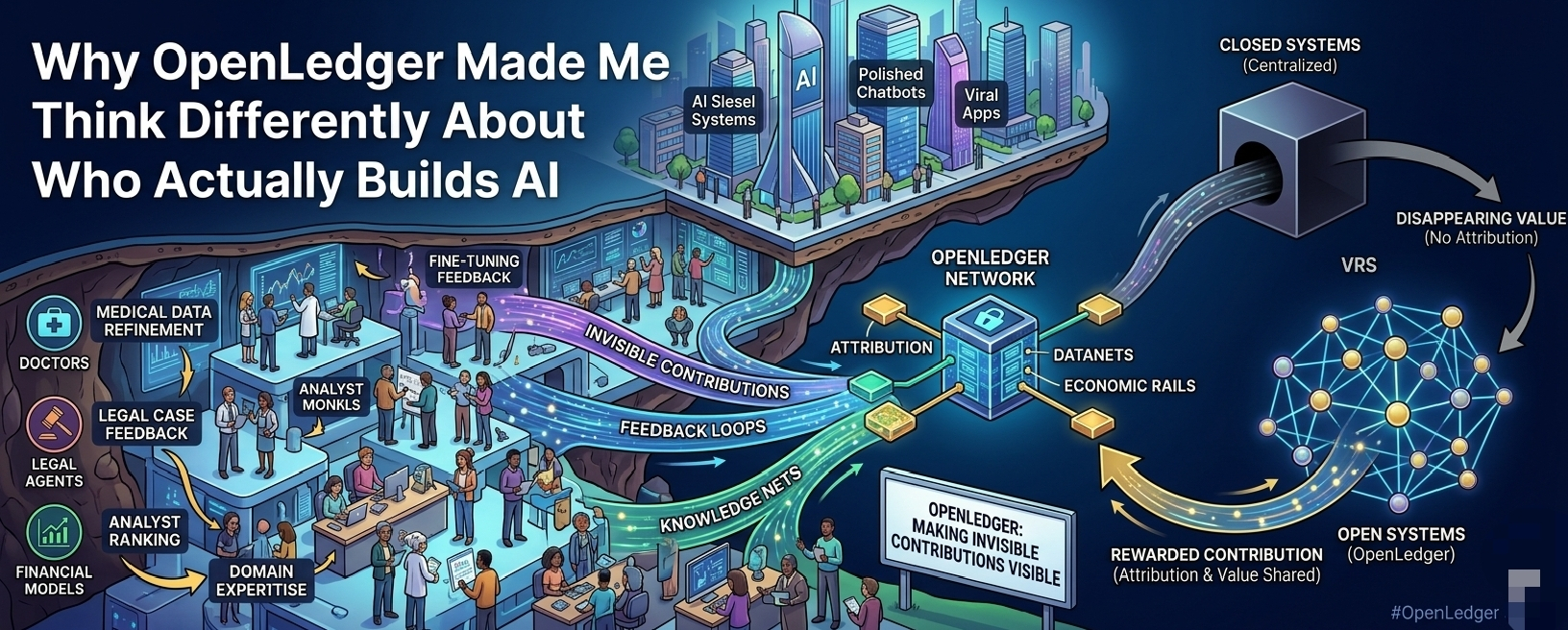

Yesterday I went down another AI rabbit hole for a few hours.
Same conversations everywhere.
Which models are smartest.
Which startups are exploding.
Which companies might own the next cycle.
But while reading all of it, I kept thinking about something people barely talk about: Who actually helps build these systems underneath?
That thought kept bringing me back to @OpenLedger .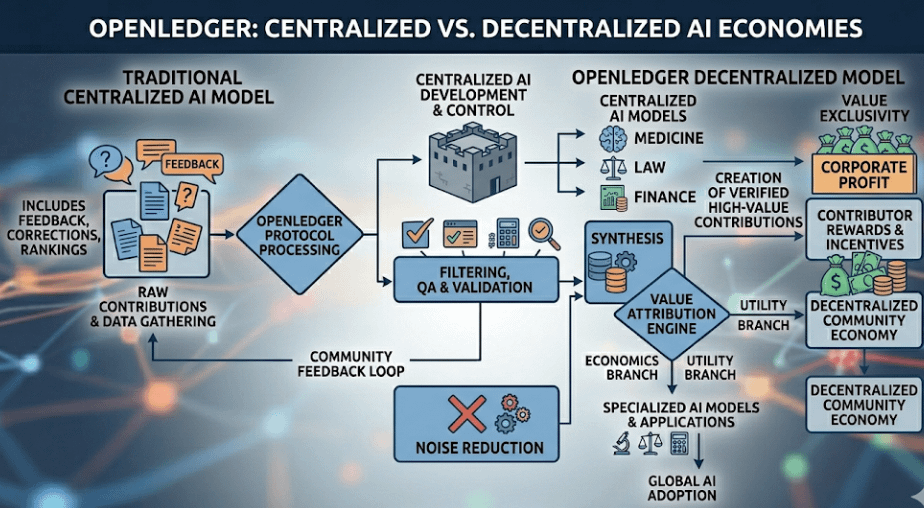
What genuinely interests me about OpenLedger is not just the AI angle itself. It’s the fact that it’s trying to make invisible contributions visible.
Most people only ever see the final output from AI.
The polished chatbot.
The clean interface.
The impressive response.
But almost nobody sees the layers underneath that slowly shape those systems over time. The corrections, feedback, ranking, testing, refinement, domain expertise and constant iteration happening quietly in the background.
And honestly, OpenLedger made me realize how invisible most contributors are in today’s AI economy. A few years ago, the internet trained us to think content was the valuable layer. Now AI is shifting that again.
What feels different with OpenLedger is that it’s exploring whether contribution itself can become part of the infrastructure instead of disappearing into centralized systems with no attribution attached to it.
The more I thought about it, the more AI started feeling similar to a massive city.
From the outside, everyone notices the skyscrapers first.
The flashy apps.
The viral products.
The interfaces people post online every day.
But cities don’t run because of skyscrapers alone.
They run because invisible systems underneath keep everything connected.
Electricity.
Roads.
Water.
Coordination.
That’s the layer OpenLedger seems interested in building for AI. And that’s probably why I keep paying attention to it even while louder projects dominate headlines.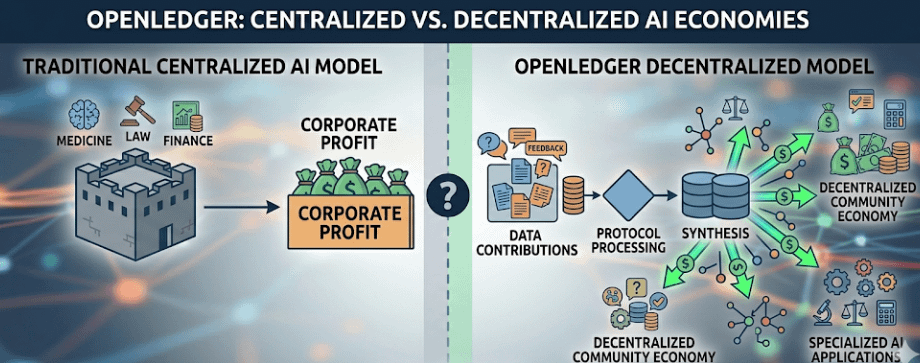
OpenLedger doesn’t feel focused on short-term attention.
It feels more focused on building economic rails around intelligence itself. Its attribution systems, Datanets and infrastructure approach all point toward a bigger idea:
Future AI systems may depend on communities continuously contributing knowledge instead of relying only on centralized data accumulation forever.
And I think OpenLedger raises a question most AI conversations still avoid:
If millions of people indirectly shape intelligent systems through data, expertise, corrections and feedback… should all of that value permanently disappear into closed platforms?
That question gets even more interesting once AI becomes more specialized.
Imagine healthcare systems refined by doctors over years.
Legal agents shaped by niche case expertise.
Financial models improved through trusted analyst feedback.
Those ecosystems become incredibly valuable over time.
And OpenLedger seems designed around the belief that contributors inside those ecosystems should remain economically connected to the value they help create. Of course, none of this is easy.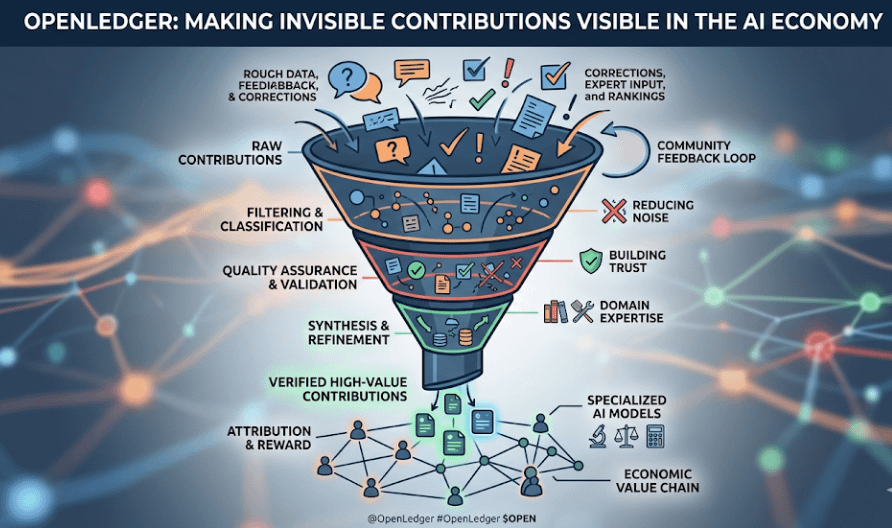
The hard part isn’t only building the infrastructure.
The harder part is building trust around the infrastructure.
Because the second incentives appear, human behavior changes too.
Every open network eventually runs into the same challenge:
How do you reward real contribution without drowning in noise?
And honestly, I think OpenLedger understands this is partly a social problem disguised as a technical one.
That’s why infrastructure stories are always difficult to judge in real time.
They usually look slow.
Sometimes even boring.
Until suddenly entire ecosystems quietly start depending on them underneath everything else.
The internet evolved that way.
Cloud infrastructure evolved that way.
Digital payments evolved that way.
And maybe OpenLedger is trying to position itself in a similar layer for AI.
Not necessarily as the loudest application.
Not necessarily as the biggest model.
But as infrastructure that helps specialized AI systems coordinate, scale and function economically over the long run.
The more I think about OpenLedger, the more I feel the real conversation here is much bigger than crypto speculation or short-term hype cycles.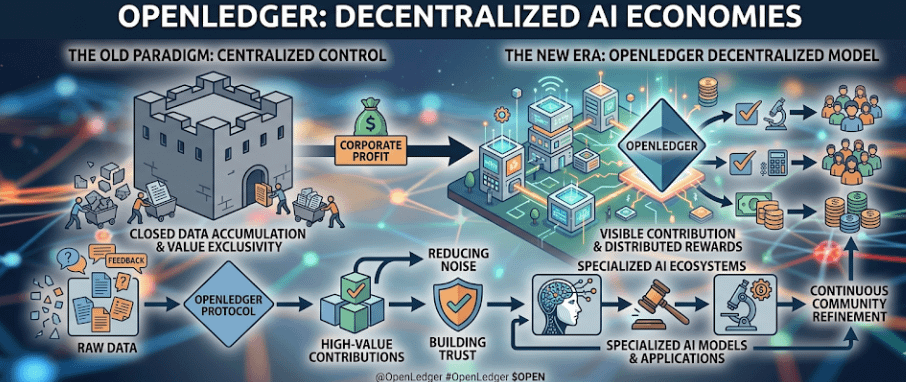
The deeper question is whether future AI economies stay controlled by a handful of centralized entities…
Or whether networks like OpenLedger can create systems where value stays connected to the people helping produce it in the first place.
I don’t think anyone fully knows the answer yet.
But I do think OpenLedger is asking one of the more important long-term questions in AI right now. And sometimes the projects asking the right questions quietly end up mattering more than the projects making the most noise.
#OpenLedger $OPEN $SUPER $GENIUS