
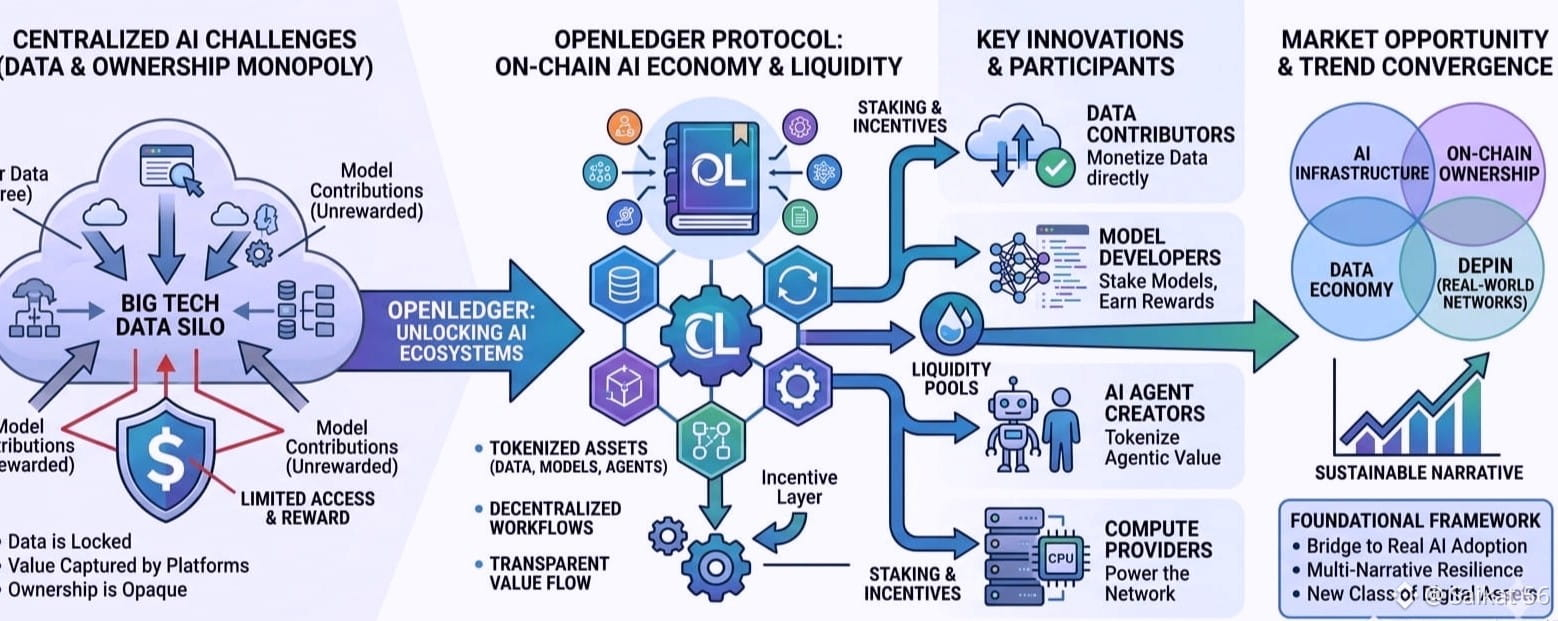
A while ago, I barely paid attention to the AI infrastructure narrative. To me, it felt like just another crypto cycle a temporary trend the market would hype for a few weeks before moving on. But recently, my perspective started changing...🤔
Crypto markets follow a familiar pattern. Liquidity moves fast. One week everyone is obsessed with meme coins, the next week it’s AI agents, then suddenly gaming or another narrative takes over. Because of that constant rotation, it often feels like everything is driven purely by attention rather than substance.
But not every narrative is completely empty. Some connect to real shifts already happening outside crypto. And AI is starting to feel like one of those shifts.
At first, I didn’t think much about OpenLedger either. It looked like another AI token trying to ride the trend cycle. But the deeper I looked into it, the more it felt like something larger than a simple speculative asset. It seemed like an attempt to build an actual economy around AI itself.
The biggest difference is the focus on ownership.
Today’s AI ecosystem is heavily centralized. Large companies train models using enormous amounts of user data, yet the people contributing that data rarely receive value in return. Most users simply feed the system while the economic upside stays concentrated at the top.
Crypto has always tried to challenge that imbalance by creating systems where contribution becomes visible and valuable. OpenLedger seems to be targeting that exact problem.
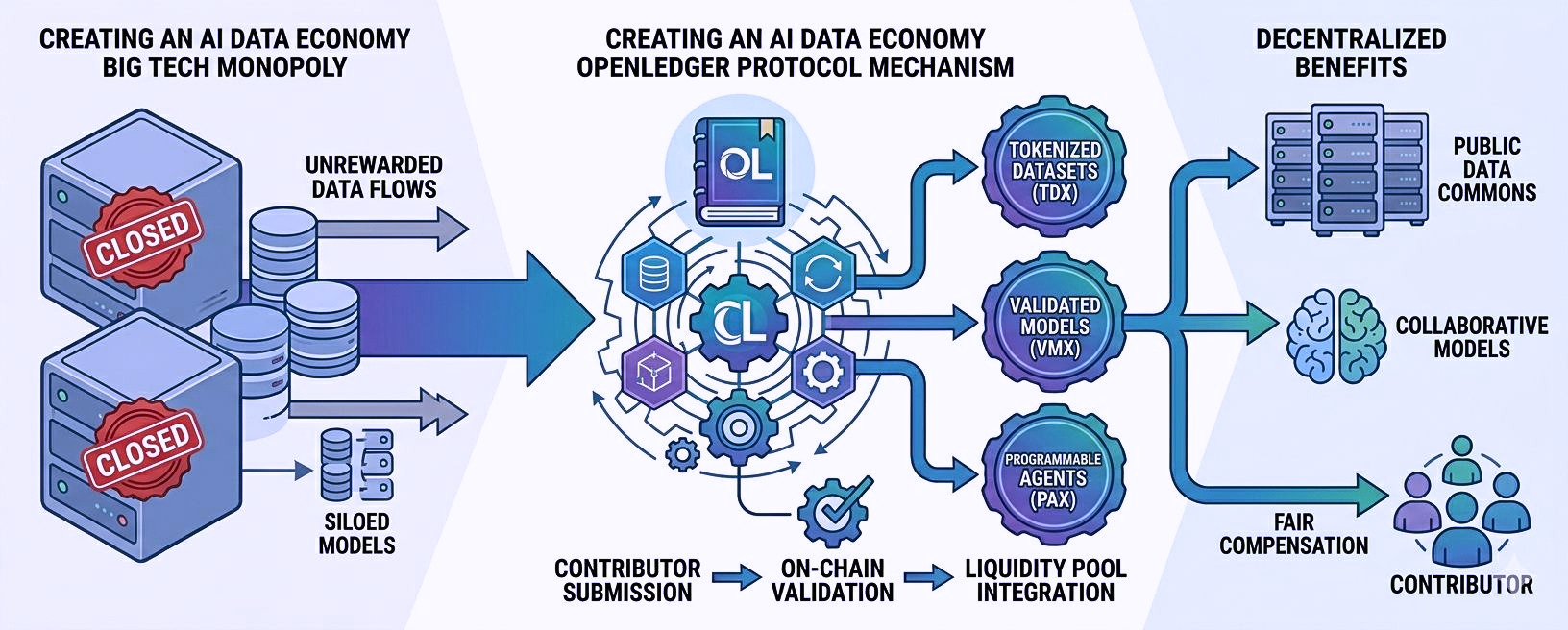
What caught my attention most was the idea of Datanets.
Instead of one giant pool of mixed information, Datanets are specialized, domain-focused data ecosystems.
A legal Datanet could contain case law, contract structures, and regulatory logic provided by actual legal professionals.
A medical Datanet could include clinical notes, research insights, and diagnostic reasoning from doctors and researchers.
A financial Datanet could hold market structure analysis, institutional knowledge, and risk modeling frameworks.
Each ecosystem becomes curated around expertise rather than generic internet-scale information.
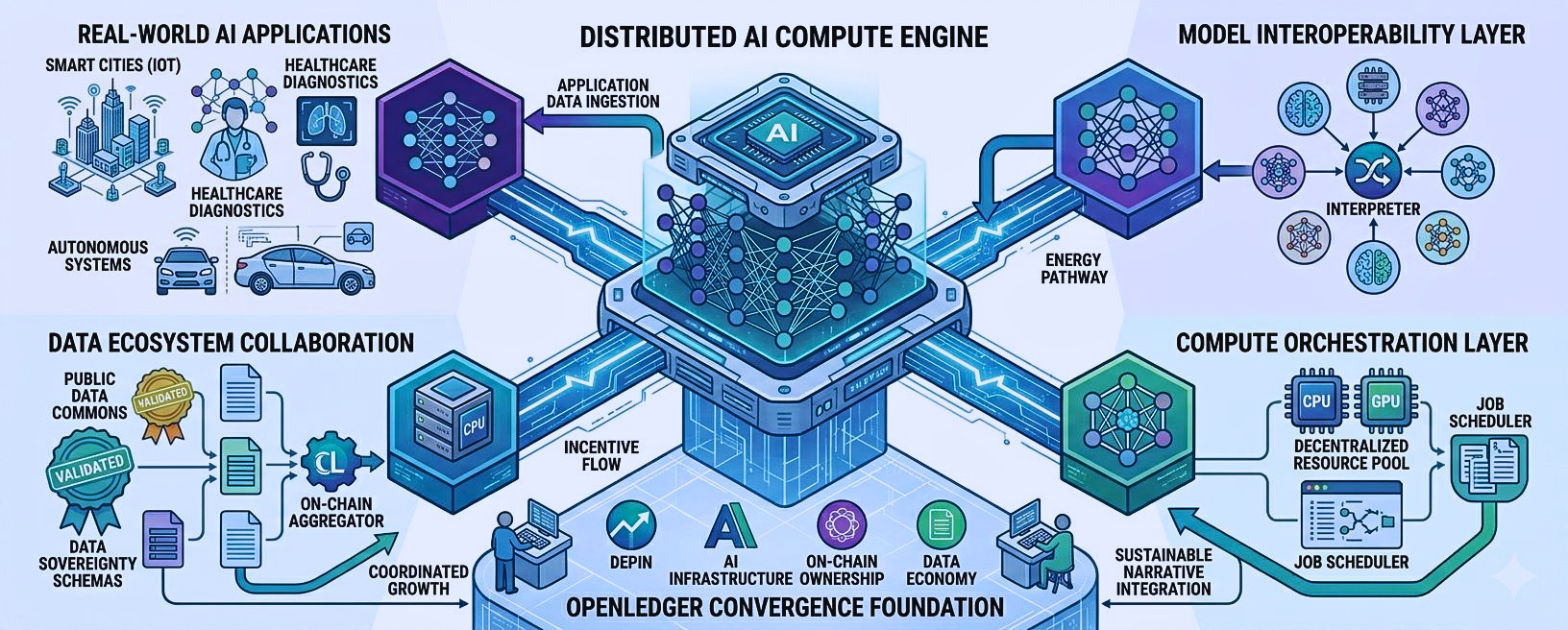
That matters because most general AI models still operate at a surface level in specialized fields. Domain-specific models trained on high-quality expert data can perform far better in real-world professional environments.
But that raises the most important question: Where does the data come from?
OpenLedger’s answer is simple, the data comes from practitioners themselves. The people contributing expertise maintain and improve the system while receiving compensation whenever their data contributes to useful outputs.
If that model works, data stops being a passive resource and becomes an active economic asset.
That’s the part I keep thinking about most.
Because this is not just about improving AI models. It’s about redesigning how value flows through the entire system.
At the same time, I’m still skeptical.
Crypto has a long history of pricing infrastructure narratives far ahead of real adoption. AI is especially dangerous in that way because futuristic language often makes people stop asking hard questions.
As the network grows, will contributors actually receive fair value over time? Or will validation and influence slowly become concentrated among larger operators with more resources?
That question still doesn’t have a clear answer.
Another important issue is measuring real usage.
Metrics like transaction activity, micro-payments, and protocol revenue matter far more than social engagement or short-term hype. Those are the signals that can reveal whether actual economic behavior is forming underneath the narrative.
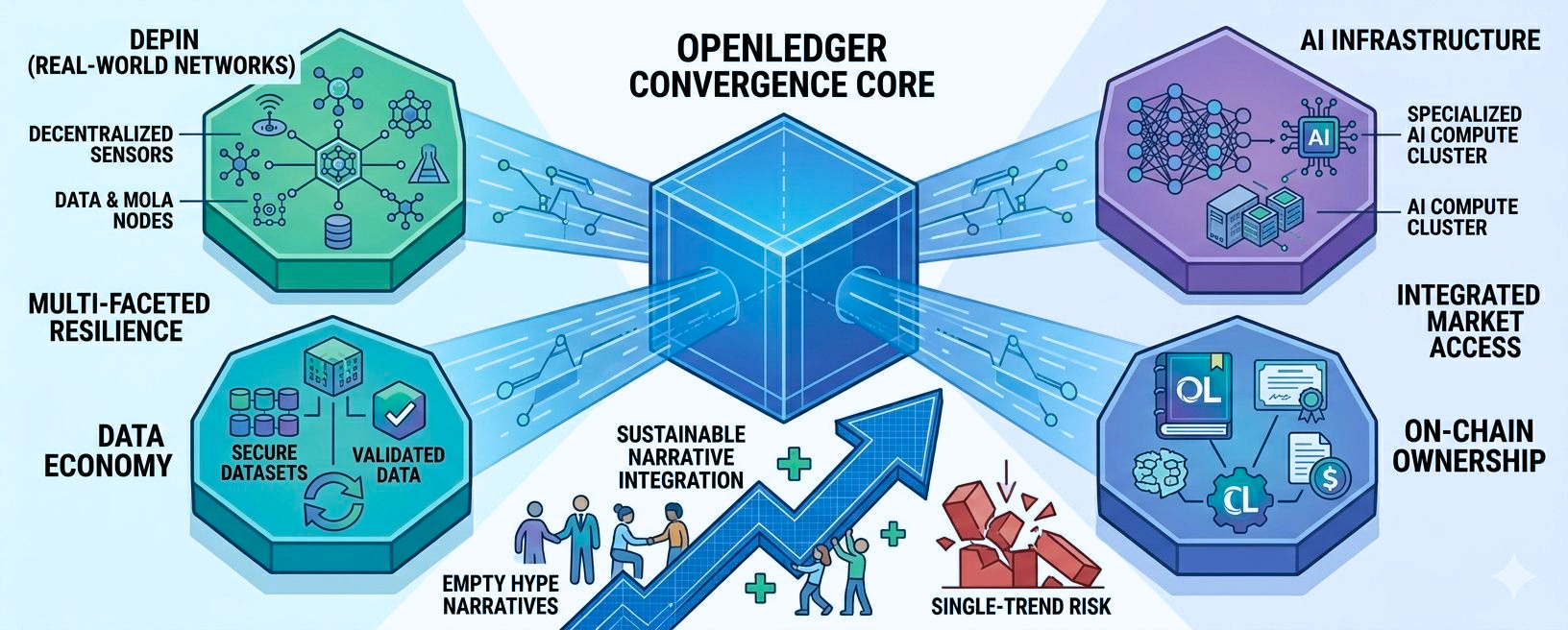
The things I’ll personally keep watching are simple: Does usage continue even without incentives?
Do small repeated transactions suggest real AI-driven activity? Can the system generate sustainable fee revenue during quiet market periods?
Those are the signs that separate infrastructure from speculation.
What also makes this narrative interesting is the cultural overlap between AI and crypto.
AI is no longer just becoming a tool. It’s evolving into an economic layer. And crypto introduces ownership, coordination, and incentive systems into that layer.
When those two worlds fully overlap, digital ownership itself could start looking very different from today.
I still don’t believe success is guaranteed for OpenLedger or any similar project.
Nothing in crypto is certain.
But I do think we are entering a phase where AI, data ownership, and on-chain economies are beginning to merge together.
And the projects capable of operating at that intersection may become far more important than most people currently realize.
The reality is that this entire space is still extremely early.
There’s uncertainty everywhere. Risks are high. Most of the long-term outcomes remain unclear.
But historically, the systems that eventually matter the most usually look confusing in the beginning.
And OpenLedger feels like one of those early experiments uncertain, imperfect, but directionally aligned with where the future may already be heading. 😊