
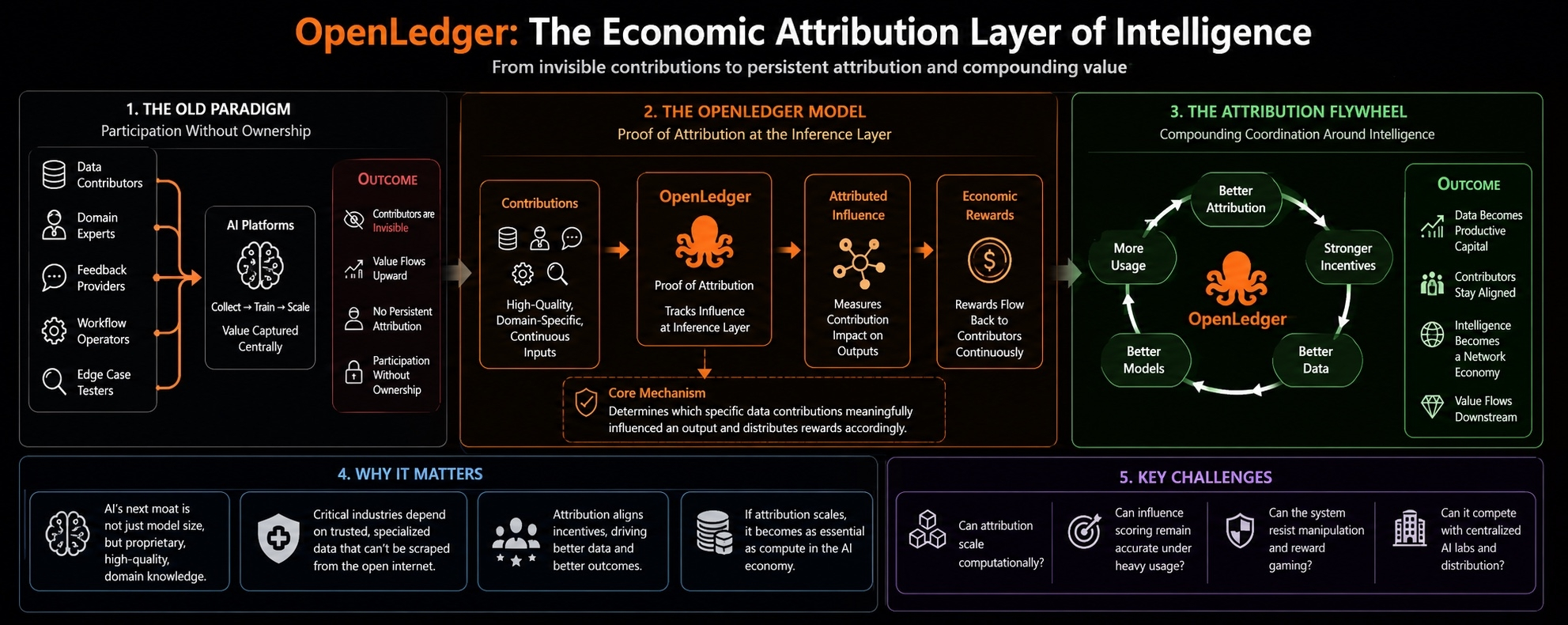

The more I analyze OpenLedger, the more I think the market may still be underestimating what it is actually trying to build.
Most people continue framing it as another decentralized AI project or another AI token narrative, but honestly, that feels too surface level.
Because the deeper idea here may not be AI infrastructure alone.
It may be the economic attribution layer underneath intelligence itself.
And I think that distinction matters.
The current AI economy runs on a strange contradiction.
The industry talks endlessly about models, compute, and scale, yet the actual substance that makes AI valuable usually comes from human contribution:
specialized datasets,
domain expertise,
feedback loops,
real world operational workflows,
edge cases,
continuous refinement.
Without these inputs, most models become generic very quickly.
But once this knowledge enters a model, attribution almost always disappears.
The contributors become invisible.
The platforms absorb the value.
The models scale.
Revenue compounds upward toward centralized entities.
That has basically been the architecture of the internet for years:
participation without ownership.
And OpenLedger seems to be directly challenging that structure.
What makes it interesting to me is that it is not simply trying to tokenize AI activity.
A lot of projects already attempt that.
It is trying to create persistent attribution at the inference layer itself.
That is a much harder problem.
Tracking transactions is relatively easy.
Tracking influence inside intelligence systems is far more complex.
OpenLedger’s Proof of Attribution model is essentially asking:
which specific data contributions meaningfully influenced a model’s output, and how should economic rewards flow back accordingly?
If they solve even part of that problem, the implications become much larger than one protocol.
Because suddenly data stops behaving like disposable input material and starts behaving more like productive capital.
That changes incentives entirely.
Instead of contributors being compensated once during collection, attribution can theoretically remain attached to future usage.
If your dataset materially improves a model, and that model continues generating valuable outputs over time, contributor rewards can continue flowing alongside inference demand.
That creates a very different relationship between humans and AI systems.
And honestly, I think this becomes increasingly important as AI shifts toward specialized intelligence rather than just larger general purpose systems.
General models are already becoming crowded.
Capabilities are diffusing rapidly.
Open source competition is accelerating.
The long term moat may not simply be model size.
It may be access to proprietary, continuously updated, high quality domain knowledge.
Medical AI depends on trusted clinical datasets.
Cybersecurity AI depends on evolving threat intelligence.
Financial AI depends on specialized workflow data and edge case reasoning.
That type of intelligence cannot scale purely through scraping the open internet.
It depends on contributors remaining economically aligned with the system.
That is where OpenLedger’s structure becomes interesting.
The flywheel is not only technical.
It is behavioral.
Better attribution creates stronger incentives.
Stronger incentives attract better data.
Better data improves models.
Better models increase usage.
More usage increases contributor rewards.
If sustainable, that creates compounding coordination around intelligence itself.
Of course, major challenges still exist.
Can attribution scale computationally?
Can influence scoring remain accurate under heavy usage?
Can decentralized contributor economies resist manipulation and reward farming?
Can this model compete against centralized AI labs with massive distribution advantages?
Those are real questions.
But I think OpenLedger matters because it is focused on a layer most of the AI market still barely discusses:
the ownership rails underneath intelligence creation.
And if AI eventually becomes the dominant economic layer of the internet, attribution may become just as important as compute.
