I’ll be honest, I almost ignored OpenLedger the first time I came across it.
At this point, I’ve spent enough time around AI and blockchain projects to recognize the familiar pattern pretty quickly. Everyone talks about infrastructure now. Everyone says they are building the foundation for decentralized intelligence, autonomous systems, data ownership, AI economies, coordination layers. The wording changes slightly, but after a while it all starts blending together into the same pitch.
Then you look closer and realize most of the actual systems still depend on fragmented tooling, centralized execution somewhere in the middle, or workflows that become difficult the moment real usage starts happening at scale.
That was my mindset going into OpenLedger. More cautious than curious.
But the more I looked into how the system was structured, the more I realized the interesting part was not really the AI narrative itself. It was the coordination problem underneath it.
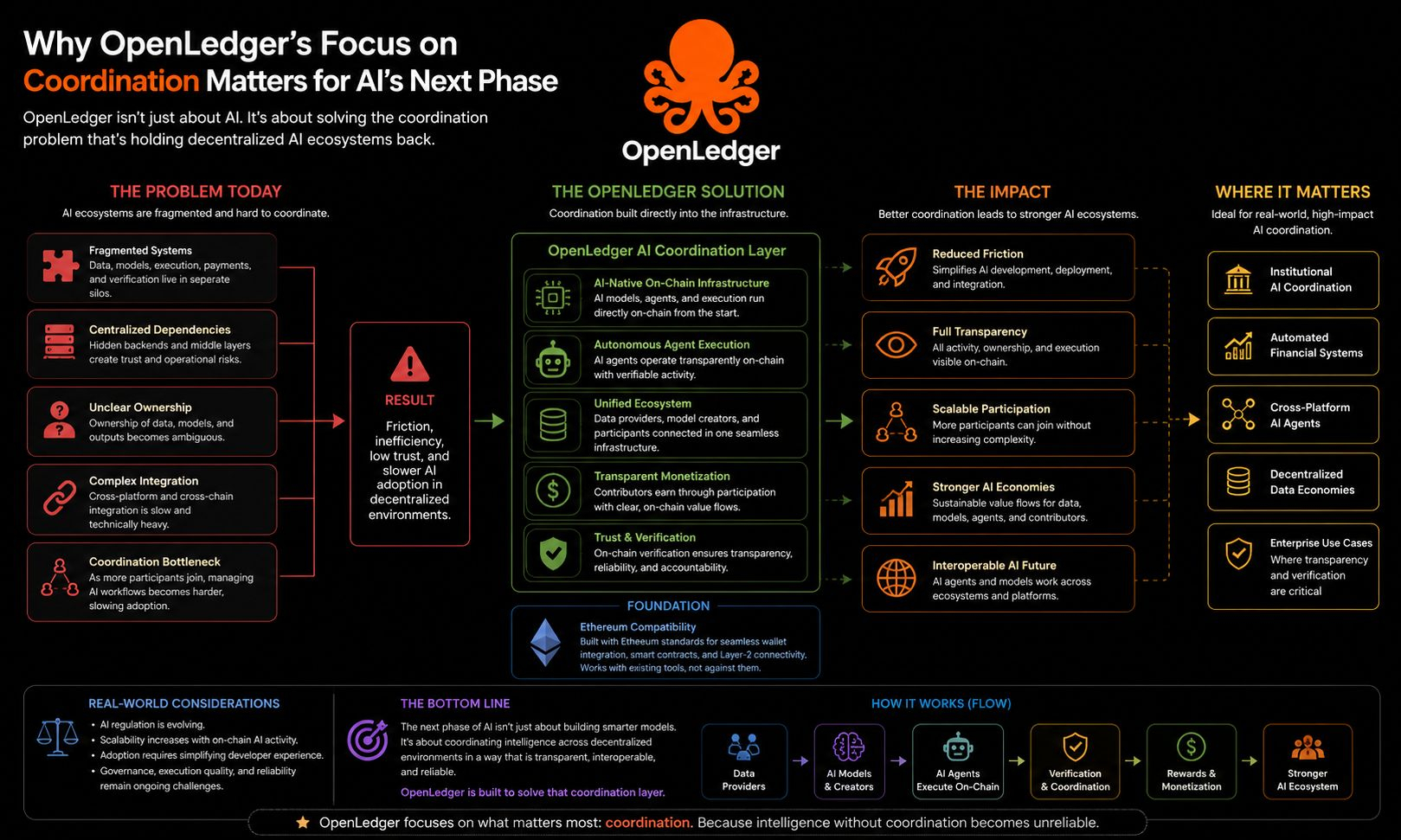
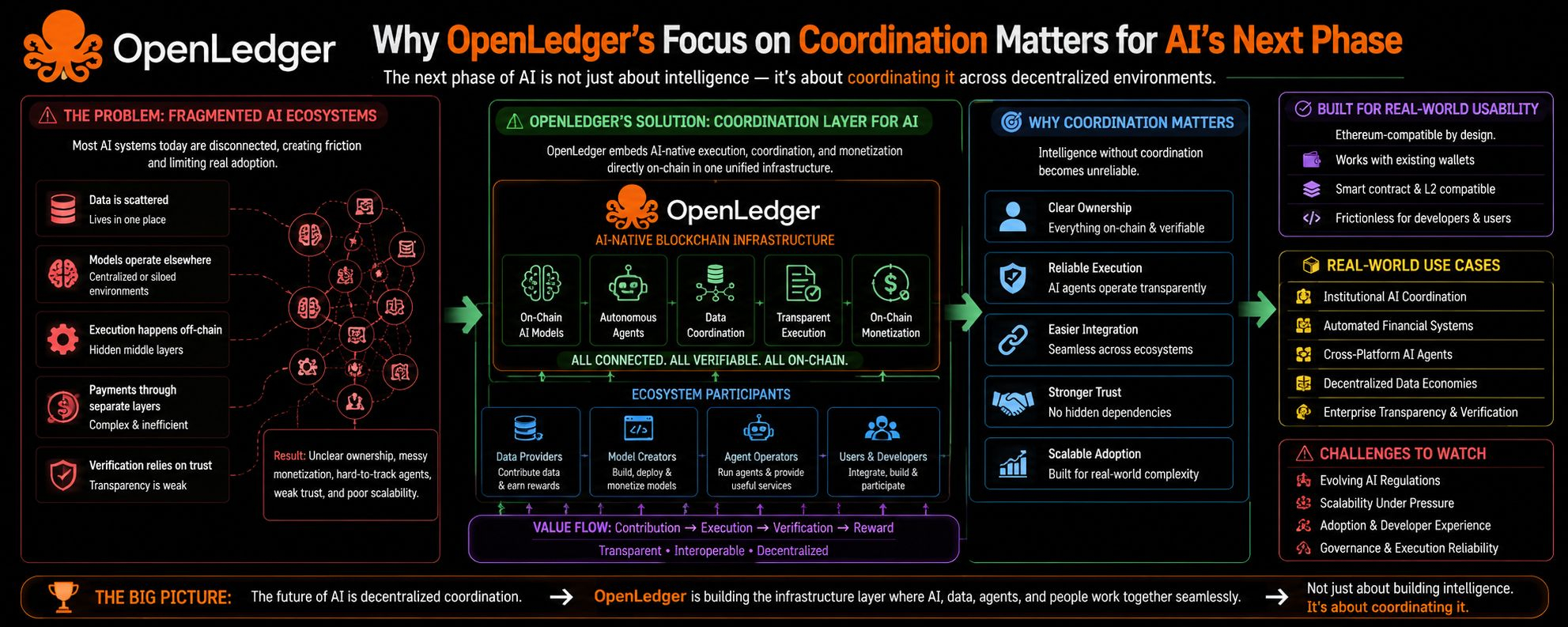
Most AI ecosystems today feel disconnected in ways people do not talk about enough. Data lives in one place, models operate somewhere else, execution happens off chain, payments move through another layer entirely, and verification still depends heavily on trust. Even when projects claim decentralization, the actual operational flow usually feels stitched together from separate systems that do not naturally communicate with each other.
That fragmentation creates friction everywhere.
Ownership becomes unclear. Monetization becomes messy. AI agents become difficult to track. Integrating models across blockchain environments turns into a technical headache. And once multiple participants are involved, whether developers, validators, users, or data providers, coordination itself starts becoming the real bottleneck.
That is the part OpenLedger seems to understand better than most.
What caught my attention was how aggressively the infrastructure appears designed around AI participation directly on-chain rather than treating AI like an external tool connected afterward. The difference sounds subtle at first, but operationally it changes a lot.
Instead of forcing AI systems to rely on scattered execution environments, OpenLedger tries to place model activity, agent deployment, coordination, and monetization inside the same infrastructure layer itself. The more I thought about that, the more practical it started to feel.
A lot of projects talk about AI agents now, but very few explain how those agents actually operate across decentralized environments without creating another layer of dependency somewhere in the middle. Usually there is still a centralized backend doing the heavy lifting quietly behind the scenes.
With OpenLedger, the architecture seems built specifically for AI native execution from the start. AI models can interact directly with blockchain infrastructure. Autonomous agents can operate on-chain with transparent activity. Data contributors, model creators, and participants are all connected through the same ecosystem rather than separated into isolated systems.
That matters more than people think.
One thing I keep noticing in AI infrastructure conversations is that people focus heavily on intelligence itself while ignoring operational coordination. But intelligence without coordination becomes unreliable very quickly in decentralized environments.
You can have powerful models, useful agents, strong datasets, all of it. But if execution is fragmented, verification becomes difficult. If verification becomes difficult, trust weakens. And once trust weakens, adoption slows down no matter how advanced the technology sounds in theory.
OpenLedger’s approach feels centered around reducing that friction directly inside the infrastructure.
The Ethereum compatibility also makes practical sense to me. A lot of blockchain projects still behave like isolated ecosystems that expect users and developers to completely rebuild their workflows from scratch. That rarely scales smoothly in reality. People already operate through existing wallets, smart contracts, and Layer 2 ecosystems. Forcing entirely separate operational environments usually creates more resistance than adoption.
OpenLedger seems aware of that.
By integrating into Ethereum-standard infrastructure instead of competing against it structurally, the system feels more usable from the beginning. Wallet integration, smart contract interaction, and Layer 2 connectivity are treated like part of the operational foundation rather than optional extras added later.
And honestly, that kind of design maturity is becoming increasingly rare.
The more I studied the platform, the more I realized OpenLedger is less about abstract AI promises and more about infrastructure plumbing. That sounds less exciting on paper, but probably more important long term.
Because most of the friction in AI economies is not coming from model quality alone anymore. It comes from coordination complexity.
Who owns the outputs?
Who verifies execution?
How are contributors rewarded?
How do autonomous agents interact across ecosystems without constant manual oversight?
How do you create transparent systems where model activity, data contribution, execution, and incentives all remain visible and interoperable?
Those are infrastructure questions more than branding questions.
And OpenLedger seems built around trying to answer them directly through architecture instead of marketing language.
What also stood out to me was the emphasis on monetization through participation rather than pure speculation. Data providers, AI model creators, and agent operators are treated as active infrastructure participants instead of passive users. That creates a more functional ecosystem structure if implemented properly.
A lot of AI systems today rely heavily on centralized ownership despite using decentralized branding publicly. The actual value extraction still happens in closed environments. OpenLedger at least appears to be pushing toward a model where participation itself becomes economically visible on-chain.
That does not automatically guarantee success, obviously. Infrastructure alone does not solve everything.
There are still real concerns here.
AI regulation is evolving unpredictably almost everywhere. Scalability pressure increases quickly once autonomous systems start operating continuously on-chain. Adoption barriers remain very real, especially for developers who already struggle with blockchain complexity before adding AI coordination into the equation. And decentralized systems still face difficult challenges around governance, execution quality, and operational reliability.
Even technically strong infrastructure can fail if real-world implementation becomes messy.
I think that is important to acknowledge honestly because too many projects pretend complexity disappears simply because blockchain and AI are combined together in the same sentence.
It does not.
If anything, combining AI and decentralized infrastructure increases operational complexity dramatically.
Still, I think there are environments where OpenLedger’s design philosophy makes genuine sense.
Institutional AI coordination. Automated financial systems. Cross-platform AI agents. Decentralized data economies. Enterprise environments where transparency and verification matter more than speed alone. Situations where execution visibility actually becomes valuable rather than optional.
In those cases, embedding coordination directly into blockchain infrastructure starts feeling practical instead of theoretical.
That is probably why I kept paying attention to the project longer than I expected.
Not because the branding convinced me. Mostly because the system appears focused on execution problems that actually exist already.
And at this point, I trust operational design more than narratives.
I also think projects like OpenLedger need to be judged very carefully through real usage rather than assumptions. Infrastructure always sounds cleaner in documentation than it does in practice. The real test comes later when ecosystems grow, integrations expand, and workflows start handling actual activity under pressure.
That is the phase I usually watch most closely now.
Do AI workflows operate smoothly on chain?
Do integrations feel natural or forced?
Does coordination actually become easier?
Can autonomous agents function reliably without hidden centralized dependencies?
Does the infrastructure reduce friction, or simply move complexity somewhere else?
Those questions matter more to me than ecosystem slogans.
Because adoption rarely happens through announcements alone. Most meaningful infrastructure growth happens quietly through systems that gradually become useful enough that people stop thinking about the complexity underneath them.
That is usually the real signal.
And after looking deeper into OpenLedger, I think that is the part that changed my perspective slightly. Not because I suddenly became fully convinced. I’m still cautious with AI and blockchain infrastructure projects in general.
But I do think OpenLedger understands something important about where the next phase of AI systems is heading.
The challenge is no longer just building intelligence.
The harder problem now is coordinating intelligence across decentralized environments in ways that remain transparent, interoperable, and operationally reliable over time.
That is a much less glamorous problem to solve. But probably the more necessary one.