
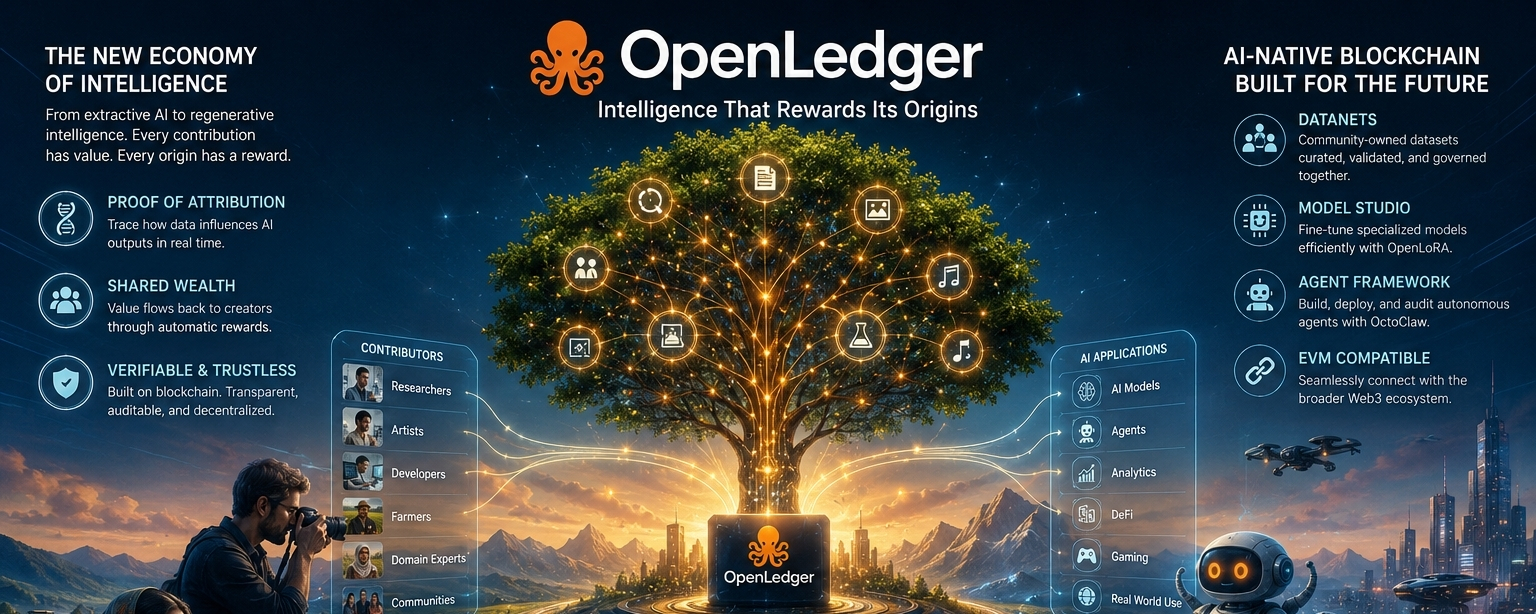
OpenLedger stands as a quiet revolution in the evolving landscape of artificial intelligence and decentralized systems, a place where the raw materials of thought—data points, creative sparks, specialized knowledge—finally find a home that remembers their origins and rewards their keepers. Picture intelligence not as something harvested in shadowy server farms and repackaged by distant corporations, but as a living garden tended by countless hands across the globe, where every seed planted contributes to a shared harvest that flows back fairly to those who nurtured it. This is the essence of what OpenLedger proposes: an AI-native blockchain that turns the often invisible contributions behind modern intelligence into transparent, liquid, and ownable assets.
The current AI ecosystem thrives on an unspoken imbalance. Enormous troves of human-generated content, personal experiences, and domain expertise fuel the most advanced models, yet the creators rarely see compensation or recognition. A photographer's image, a researcher's dataset, a local artisan's unique patterns—all risk vanishing into the training abyss without trace. OpenLedger challenges this by building a foundational infrastructure where every element in the AI lifecycle carries provenance. Launched into its mainnet phase in late 2025, the network has gained traction by mid-2026 as developers and communities experiment with its tools for traceable intelligence.
At the heart of this architecture lies Proof of Attribution, a mechanism that functions like digital DNA for contributions. Rather than relying on vague influence estimates common in traditional machine learning research, OpenLedger's approach records and quantifies how specific data shapes model outputs in real time. When an AI generates a response or makes a decision, the system traces the threads of influence back through the training process, assigning cryptographic credits that trigger automatic distributions. This creates a new economic loop: usage generates value, value returns to origins, origins are incentivized to contribute more and better material. It transforms AI from a one-way extraction into a regenerative cycle, where quality data earns ongoing royalties and poor or malicious inputs face natural penalties through reputation systems and staking.
This attribution layer sits within a broader, purpose-built stack designed specifically for AI workloads rather than adapted from general-purpose chains. Datanets emerge as collaborative hubs where communities pool, curate, and govern specialized datasets—think agricultural insights from regions like Punjab, medical annotations crowdsourced globally, or creative writing styles preserved with cultural nuance. Participants stake tokens and reputation to validate entries, ensuring higher standards while earning shares as their collective knowledge powers downstream models. These aren't static archives; they evolve like living organisms, refined through human feedback and on-chain interactions.
Complementing this are tools for practical creation and deployment. Builders use integrated studios to fine-tune smaller, specialized language models optimized for particular tasks, avoiding the resource bloat of massive general systems. Frameworks like OpenLoRA handle efficient serving of these adaptations, slashing computational costs and enabling broader access. Agents come alive through environments such as OctoClaw, where users construct autonomous entities capable of real-time actions—executing trades, managing workflows, or assisting in research—while every decision remains auditable on the ledger. The entire system maintains EVM compatibility, allowing seamless connections with existing decentralized applications while introducing native primitives for intelligence flows.
The OPEN token serves as the vital fluid circulating through this ecosystem. With a fixed supply and thoughtful distribution favoring long-term community participation, it powers transaction fees, secures the network through staking, and facilitates governance decisions on everything from model standards to treasury use. Revenue from network activity—whether inference queries, agent executions, or data licensing—ties directly back into incentives, creating alignment where increased adoption strengthens the commons rather than diluting it. This design acknowledges the economic reality that high-quality, domain-specific data represents immense untapped value, potentially unlocking markets measured in hundreds of billions by making previously siloed assets programmable and tradable.
As we move through 2026, several converging forces amplify OpenLedger's relevance. Regulators worldwide intensify demands for explainable AI, pushing enterprises away from opaque black boxes toward systems with verifiable lineages. The rise of smaller, efficient models favors exactly the kind of specialized, community-owned intelligence this network cultivates. Agentic systems proliferate, requiring trustworthy foundations where actions carry accountability. Meanwhile, synergies with decentralized physical infrastructure open possibilities for distributed training across real-world nodes, blending digital ledgers with tangible resources.
Challenges remain, as with any frontier technology. Scaling attribution calculations without compromising speed or decentralization demands ongoing innovation. Attracting meaningful data contributions requires overcoming habits formed in an era of free scraping. Competition from other AI-crypto initiatives tests differentiation, yet OpenLedger's depth in native attribution and full-stack focus sets it apart. Token dynamics, including scheduled unlocks, will test market resilience, but the emphasis on genuine utility over speculation provides a steadier path.
Beyond the technical and economic dimensions lies a deeper human resonance. In places far from traditional tech centers, individuals gain agency: a farmer contributing soil and climate patterns could see their insights shape predictive models while earning passive returns; an artist embedding stylistic elements into a Datanet might watch ethical remixes generate royalties as agents draw inspiration. This shifts the cultural narrative around technology from replacement and extraction toward co-creation and stewardship. Intelligence becomes less artificial and more collective—an extension of humanity's shared wisdom rather than a detached force.
Looking forward, OpenLedger hints at broader horizons: interoperable data networks spanning multiple chains, marketplaces for intelligence derivatives, hybrid governance blending human judgment with machine precision. It invites us to envision an AI renaissance defined not by scale alone but by wisdom, plurality, and fairness. In this future, models don't merely predict—they honor the sources that made them possible.
The ledger remains open, waiting for contributions that will shape what intelligence truly means in the coming decades. What emerges will depend on those who choose to participate, weaving their knowledge into a fabric that remembers every thread.