
A New Digital Turning Point Where Data Finally Finds Its True Owner
In today’s fast-moving digital world, data is created every second. Every click, every interaction, every model output contributes to something much larger than we often realize. Yet, despite this constant flow of digital intelligence, most of it disappears into closed systems where the true creators of that value rarely see recognition or reward. OpenLedger enters this landscape not as just another technological concept, but as a response to a growing imbalance in how value is created and distributed in the age of artificial intelligence.
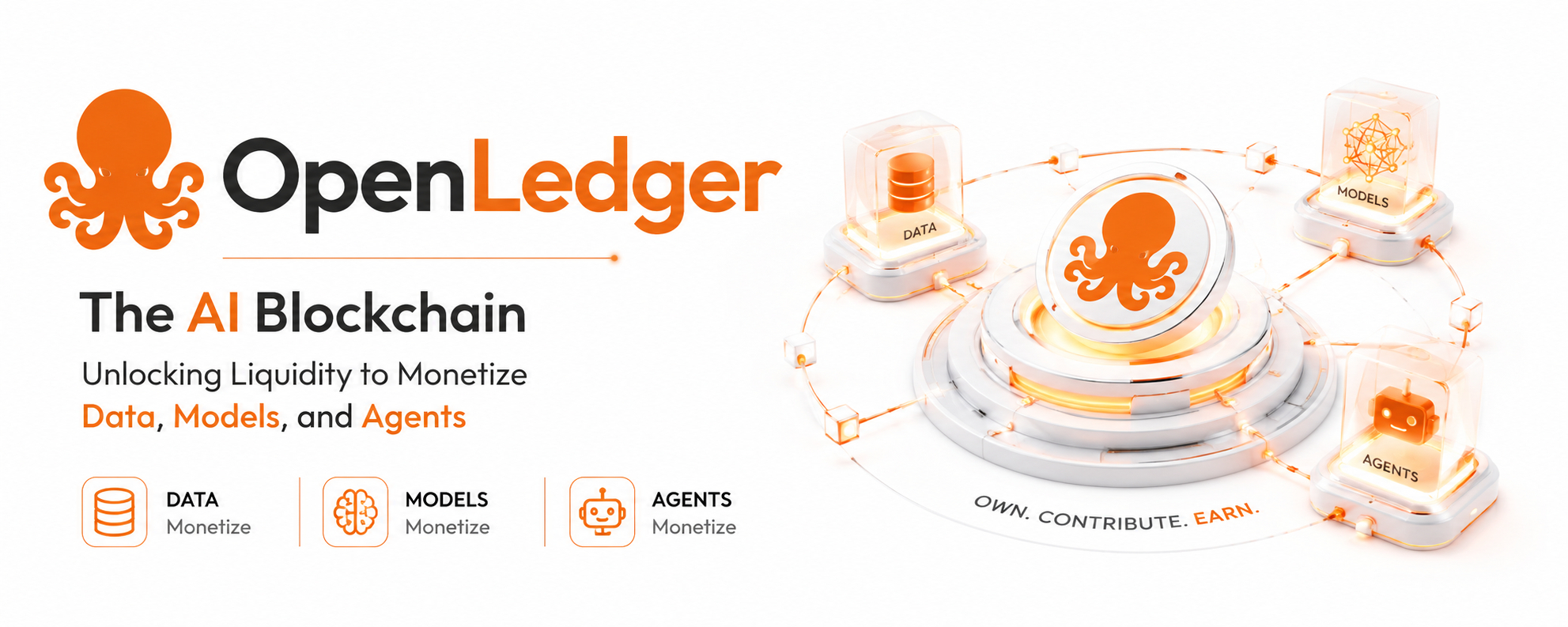
OpenLedger is designed as an AI-focused blockchain ecosystem where data, models, and intelligent agents are not just used—they are recognized as assets with measurable worth. Instead of being locked inside isolated platforms, these digital contributions can move into a transparent environment where their impact can be tracked and their value can be fairly attributed. This shift may sound technical on the surface, but at its core, it represents something deeply human: fairness in the digital economy.
Where Intelligence Becomes a Living Asset
Imagine a world where every piece of data you contribute to an AI system doesn’t vanish into silence but instead becomes part of a living digital economy. In the OpenLedger vision, data is not static. It is active, evolving, and continuously influencing AI systems that depend on it.
For example, think of a developer training an AI model using specialized datasets. In traditional systems, the contribution of that dataset often fades into the background once the model is deployed. In OpenLedger’s approach, that contribution remains traceable, and its influence can be acknowledged over time. This creates a chain of value that connects contributors directly to outcomes, even long after their initial input.
The same idea extends to AI models and autonomous agents. These are not treated as isolated tools but as evolving participants in a larger ecosystem where their performance and usage create measurable economic signals. This turns AI from a closed utility into an open, trackable economy of intelligence.
Breaking the Silence Between Creation and Reward
One of the quiet frustrations of the modern AI era is the invisible gap between creation and compensation. People, systems, and communities generate massive value, but most of it is absorbed by centralized platforms. OpenLedger challenges this structure by introducing a framework where contribution and reward are no longer disconnected.
Instead of asking who controls the platform, the focus shifts to what was contributed and how much influence it had. This creates a more balanced digital environment where value does not disappear into black-box systems but returns to the ecosystem that created it.
This change is not only technical—it is emotional. It redefines trust in digital systems. When contributors know that their work is not being lost in opacity, but instead being measured and acknowledged, it builds a stronger connection between human effort and machine intelligence.
A Real-World Reflection of Digital Fairness
To understand this better, imagine a data scientist in Karachi who contributes a dataset that improves an AI system used for language understanding. In most traditional platforms, that contribution becomes part of a larger dataset with no clear recognition of individual impact. In the OpenLedger model, however, the influence of that dataset can be traced through its effect on model performance and usage. Over time, this creates a measurable footprint of contribution that can be linked back to its source.
This does not just benefit individuals. It also improves the overall quality of AI systems. When contributions are visible and valued, the incentive to produce high-quality data and models naturally increases. The entire ecosystem becomes more responsible, more transparent, and more aligned with real value creation.
The Quiet Shift Toward an Open Intelligence Economy
What makes OpenLedger significant is not only its architecture but the direction it represents. The world is moving toward systems where intelligence is no longer confined to isolated machines or companies. Instead, intelligence is becoming distributed, collaborative, and continuously evolving.
In this environment, OpenLedger acts as a coordination layer where contributions from different sources can coexist and be measured in a unified way. It allows AI to grow not just through computation, but through collaboration across a wide network of contributors.
This creates a new kind of digital economy—one where value is not assumed or hidden, but continuously verified through real usage and impact.
A Future Built on Transparent Intelligence Flow
As AI continues to expand into every part of life, from communication to automation to decision-making, the question of ownership becomes more important than ever. Who owns the intelligence we collectively build? Who benefits from the systems trained on global data?
OpenLedger does not claim to solve everything, but it introduces a direction where answers can be built more openly. It suggests a future where data is no longer lost after use, where models are not isolated artifacts, and where agents are not silent executors but recognized participants in an economic system.
This is not just a technical shift. It is a structural change in how digital intelligence is perceived and valued.
Closing Perspective
OpenLedger represents a quiet but powerful idea: that the age of invisible contribution is ending. In its place, a more transparent and accountable system is emerging—one where every piece of data, every model improvement, and every intelligent action can carry meaning beyond its immediate function.
It is not about exaggeration or hype. It is about alignment between effort and recognition in a world increasingly shaped by artificial intelligence.
And in that alignment lies the real transformation—not just of technology, but of trust, ownership, and digital fairness itself.
