
I think one mistake most AI projects are making right now is focusing only on “smarter outputs” while ignoring where those outputs actually come from.
Because let’s be honest…
If an AI model gives a great answer but nobody can trace the data behind it, can we really call the system transparent?
That’s probably the first thing that stood out to me about OpenLedger.
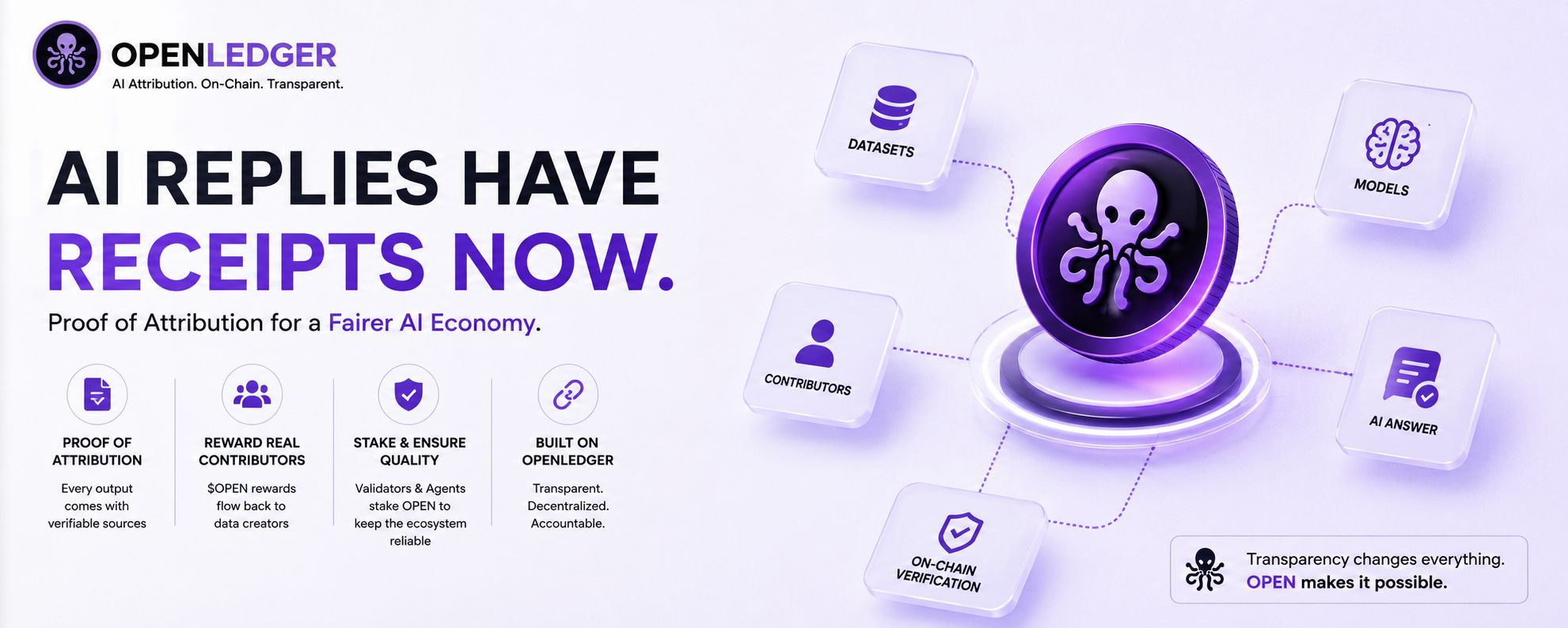
Instead of treating AI like a black box, OpenLedger is trying to build a system where every contribution leaves a footprint. Their Proof of Attribution mechanism tracks which datasets, models, and contributors helped shape an AI response before the output is finalized.
And the more I looked into it, the more it felt like they’re approaching AI from an infrastructure angle rather than a hype angle.
The current AI economy is weird. Data creators help train systems, communities contribute information, users interact with models daily… but most of the value usually stays concentrated at the top. Attribution almost disappears once training is complete.
OpenLedger seems to be challenging that structure through Datanets.
Datasets, models, and agents are registered on-chain with transparent histories, which means contributions can actually be tracked instead of getting lost inside closed systems. If a specific dataset influences an output, the network can route OPEN rewards back toward contributors connected to that data.
That changes incentives in a pretty important way.
Validators and AI agents also stake OPEN to participate in the ecosystem, which adds accountability to performance. Reliable participants benefit, while poor behavior can carry economic consequences. In theory, that creates stronger quality control across the network.
Another thing I noticed is that OPEN isn’t being positioned as just a speculative token. It functions across the ecosystem itself — model registration, Datanet updates, governance, AI requests, agent activity, and network operations all use OPEN in some form.
So instead of value flowing in one direction only, the system is designed more like a circular economy between users, builders, validators, and contributors.
I checked the on-chain activity earlier as well. Current supply metrics show a max supply of 1 billion OPEN with tens of thousands of holders already interacting with the token. Transfer activity also looks relatively active for a project still building its ecosystem. Binance listing support in 2025 added another layer of visibility through multiple trading pairs.
Still early obviously, and there’s a long way to go before attribution becomes standard across AI systems.
But personally, I think projects focusing on transparency, contributor ownership, and verifiable AI infrastructure may end up becoming far more important later than people expect right now.
Source: Etherscan + Binance Academy
Not financial advice. DYOR.