
## The Fatigue of the 100x Narrative
Been around crypto long enough to develop a bad habit. I see a new narrative getting hot and my brain automatically starts looking for exits before entries.
DeFi summer kinda broke that part of me. Or maybe NFTs did. Hard to say. I still remember when DeFi summer hit and people were copy-pasting yield farm UIs, changing token names, throwing APYs into orbit, and pretending it was innovation. Every cycle has its thing. AI feels exactly like that lately.
Every project has "AI" slapped on it now. Infrastructure. Intelligence layer. Agent economy. Autonomous whatever. Half the time I read these AI whitepapers, I feel like I accidentally opened a university textbook while running on two coffees and bad sleep.
OpenLedger landed on my radar recently, and at first, I almost skipped it. Another AI x crypto thing. Cool. We have seven hundred of those already.
Then I kept reading.
## The Black Box Problem
Not because I instantly got it either. Actually, the opposite. RLHF, attribution systems, data contribution economics, model training layers. There was a point halfway through where I genuinely stopped and thought, alright, maybe I’m too tired for this.
But one thing stuck.
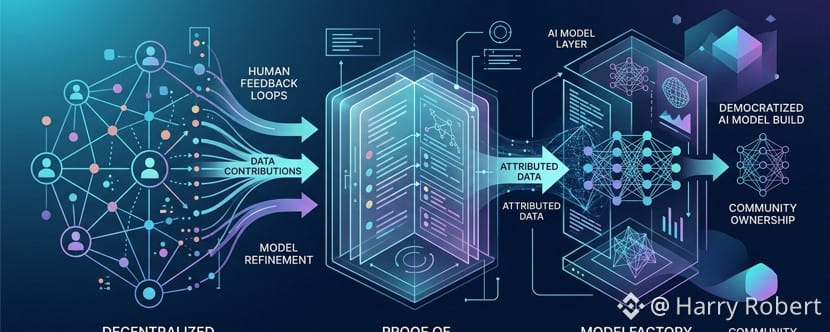
AI gets trained by people. Feedback loops, data contributions, humans ranking and improving outputs. Communities add the real value. Yet somehow, most of the upside disappears into giant, centralized systems nobody outside the company walls ever touches.
OpenLedger seems focused on that specific imbalance.
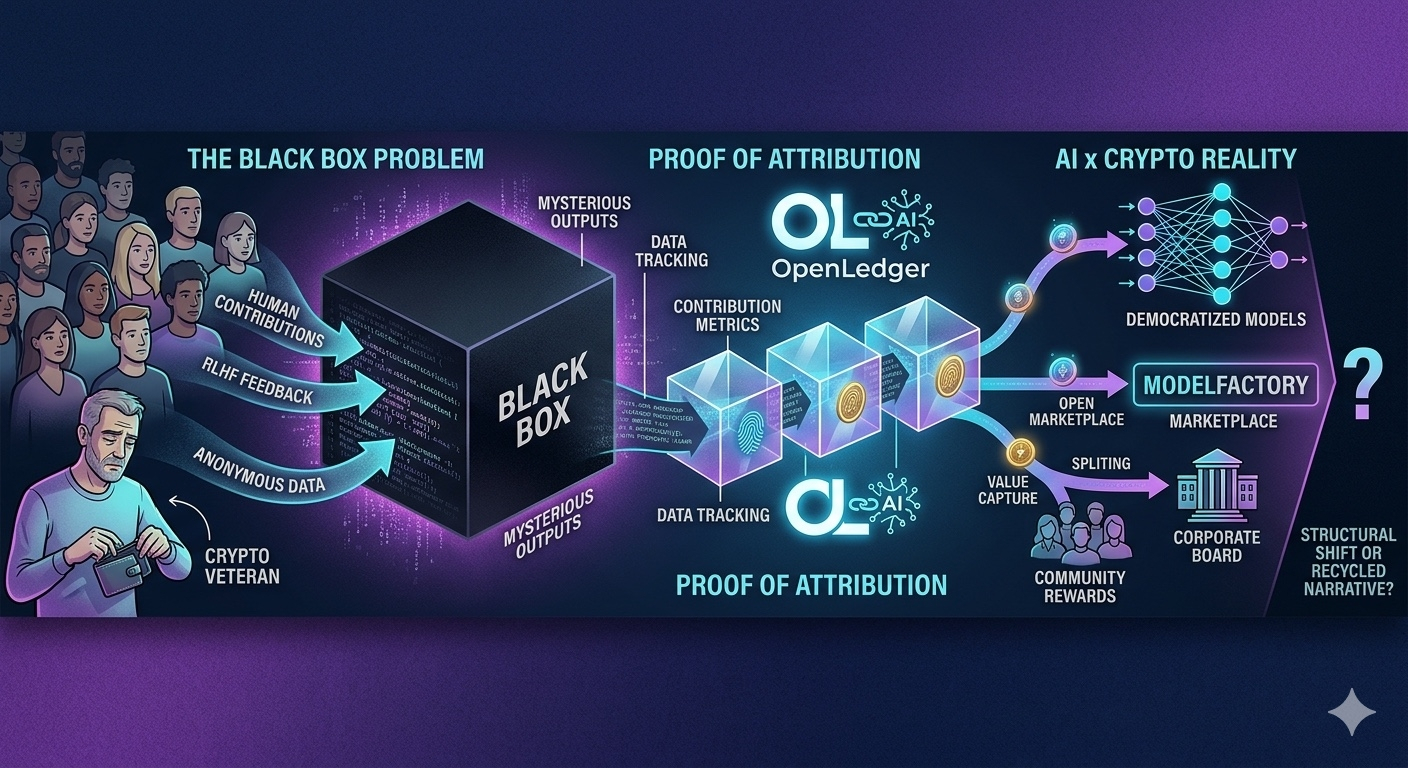
The mechanism they keep talking about is Proof of Attribution. It sounds like one of those buzzy crypto phrases people invent because normal words stopped sounding advanced enough. But after sitting with it for a bit… I track why they care.
The core idea is contribution tracking. AI models learn from datasets. Humans rank outputs. People help refine systems. Instead of all that effort disappearing into a black box, Proof of Attribution tries to make that contribution visible and measurable.
## Theory vs. Live Market Reality
Does it actually work in practice? No idea. Serious answer. I don’t know.
Tracking contribution sounds clean on paper until real humans get involved, systems get messy, edge cases pile up, and suddenly everybody thinks they deserve credit for something. Crypto veterans know that movie already.
Then there’s ModelFactory.
The pitch feels aimed at making AI model building more accessible instead of keeping everything locked behind giant compute players and centralized infrastructure. Which sounds good on paper.
But I’ve seen crypto promise democratization before. Usually right before somebody launches a token and calls it community ownership. I'm not saying OpenLedger is doing that; I’m just saying I’ve been in this market too long to buy into perfect whitepapers. Real systems are always messy, and the risk of narrative exhaustion is real.
## The Bottom Line
The funny thing is I almost talked myself out of caring about it entirely. Then caught myself reading more docs anyway. Which annoyed me a little. Because there is something genuinely interesting buried under all the heavy AI language:
* Ownership: Who actually owns the foundational intelligence being built?
* Contribution: How do you reward the anonymous network providing the data?
* Value Capture: Does the upside go to the infrastructure layer or the corporate board?
Crypto figured out years ago that incentives matter way more than ideology. AI is running straight into that same wall right now.
I’m still not fully sold. Some parts feel genuinely thoughtful; some parts feel too neat. I spent an afternoon digging through the architecture and walked away mostly with mixed feelings and four browser tabs still open. Which honestly… these days, that probably means it’s worth watching.
Are we looking at an actual structural shift in data infrastructure, or is the market just desperate to keep the AI x Crypto narrative alive?