
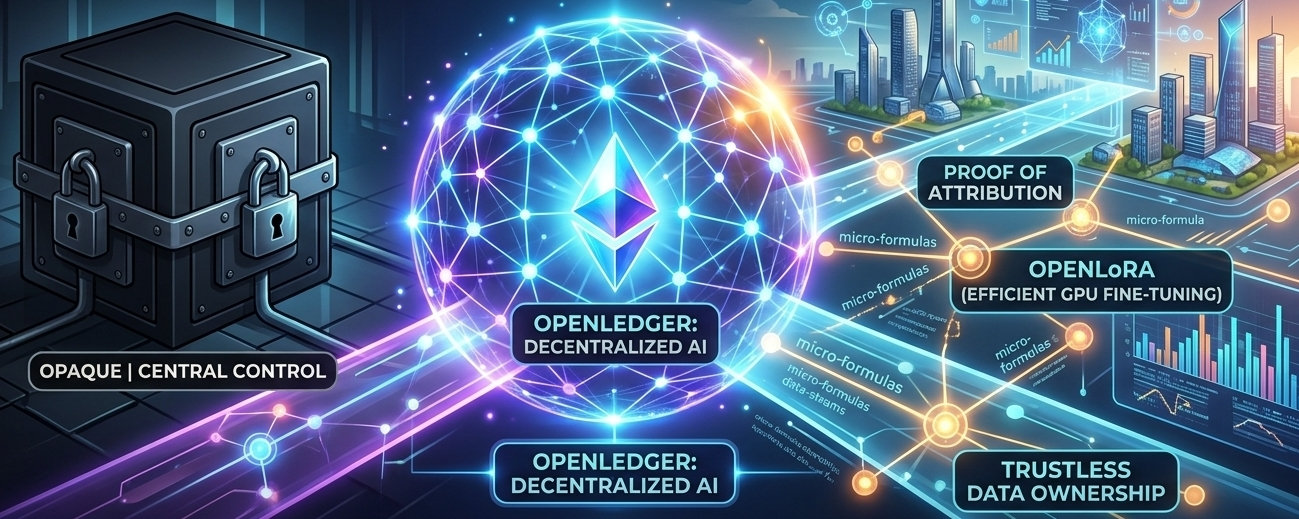
The convergence of Artificial Intelligence (AI) and Web3 is no longer just a speculative trend; it has evolved into a multi-billion-dollar infrastructure movement. Yet, the current mainstream AI stack is fundamentally broken. Tech monopolies scrape public data, train massive models behind closed doors, and capture all the monetization, leaving data contributors and model researchers completely cut out of the value loop.
This is where @OpenLedger (https://www.binance.com/en/square/profile/openledger) steps in with a paradigm-shifting solution. Instead of forcing complex, data-heavy machine learning workflows onto general-purpose blockchains designed only for simple financial transfers, OpenLedger is built as an EVM-compatible, AI-native blockchain designed specifically for data, model, and agent workflows.
Breaking Down the Tech Moats of OpenLedger
Three core pillars make the network uniquely positioned to capture the next wave of decentralized AI (DeAI) growth:
Proof of Attribution: This is the heart of the network's on-chain accountability. Using advanced mathematical modeling, Proof of Attribution measures the exact influence of specific training datasets on final model outputs. Contributors are programmatically and fairly rewarded based on the actual utility of their data, eliminating backroom disputes and creating a transparent data marketplace.
The OpenLoRA Serving Framework: Deploying isolated hardware for thousands of specialized, fine-tuned models is incredibly expensive. OpenLedger’s multi-tenant GPU infrastructure allows thousands of low-rank adaptation (LoRA) adapters to share a single, pre-trained base model simultaneously, radically lowering computational costs.
Decentralized Datanets: These are community-curated, specialized data repositories. They allow developers to easily access high-quality, domain-specific training data to streamline fine-tuning through user-friendly interfaces like the ModelFactory GUI.
Sustainable Tokenomics: The $OPEN Utility Flywheel
A network's success relies on sustainable, real-world utility. The native token $OPEN serves as the core economic settlement layer for this machine economy. Every time an AI model serves an inference, fees are programmatically collected. A net portion of these fees is automatically distributed back to the model creators, stakers, and data contributors.
This creates a self-sustaining loop: as actual model utility and demand grow, network security and contributor incentives scale proportionally.
As we move deeper into a digital future dominated by autonomous AI agents, transparent, explainable, and verifiable data ownership is no longer optional—it is a necessity. Keep a close eye on $OPEN as @OpenLedger builds the foundational layer for an open, community-powered AI future.