
I keep staring at this problem and I can't quite put my finger on it…
Everyone's talking about AI right now. The models are getting smarter, the demos are impressive, but something feels off. Like we're building something huge on a foundation we haven't really thought about.
The Hidden Problem Nobody's Talking About
Here's what I keep coming back to: AI needs data. A lot of it. But the best data? It's locked up.
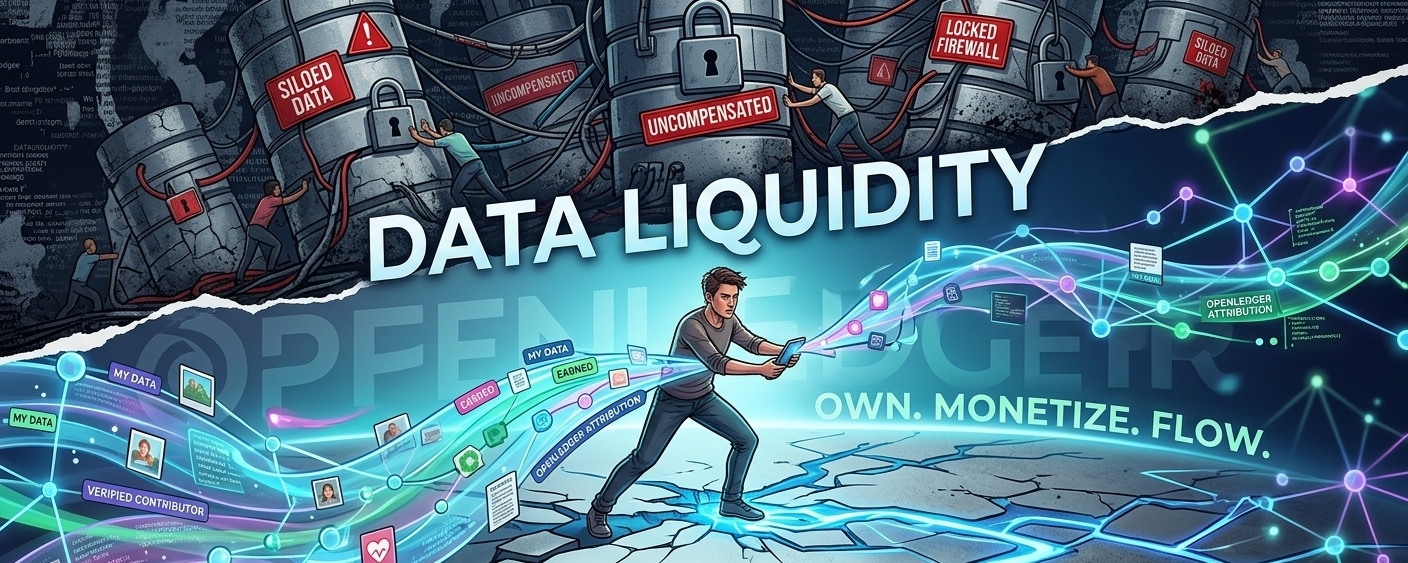
Think about it. You have researchers with medical records. You have companies with user behavior data. You have individuals with their own lifetimes of information. None of it talks to each other. It's trapped in silos… guarded by lawyers and firewalls.
But here's what's really weird: the people who create the data—the actual humans—don't get paid when AI companies use it. They just… lose out.
I stop and think here… why does this feel like the internet all over again? Remember when early web creators got nothing when their content became valuable?
Breaking It Down
The problem has layers, and I'm trying to see all of them:
Layer 1: Data is fragmented. It's scattered across thousands of databases, private servers, individual devices. No single place can access it all.
Layer 2: Attribution is broken. When an AI model gets better because of certain data, the person who contributed that data has no way to prove it. No way to get credit. No way to get paid.
Layer 3: Liquidity doesn't exist. In crypto, we understand liquidity. You can trade tokens anywhere. But data? You can't just "move" it easily. You can't set up a market for it. It's illiquid assets in the purest sense.
This is where things get interesting…
Why Humans (and Manual Systems) Fail Here
I've been thinking about why this hasn't been solved yet. It's not for lack of trying.
Manual tracking? Impossible at scale. How do you track which specific data point improved which model parameter when you're dealing with billions of data points and trillion-parameter models?
Centralized databases? They become the very silos we're trying to break. Plus, who controls the database controls the money. That's a power dynamic that never ends well.
And good luck getting humans to honestly report their own data contributions. We're… well, we're human. Self-interest wins every time.
But here's the real point: maybe the solution isn't more human intervention. Maybe it's removing humans from the verification process entirely.
Enter OpenLedger (OPEN)
This is where I started looking at OpenLedger. Not because I'm convinced, but because the problem they're addressing is the exact one I've been circling.
Their idea is pretty straightforward on the surface: what if you could put data attribution on-chain? What if every time data contributed to a model improvement, it was recorded immutably and the contributor got paid automatically?
They call it "Proof of Attribution." Sounds technical, but the concept is simple: trace the lineage from data to model output to payment.
They're building Datanets—communities where people upload data and get tracked for their contribution. There's a Model Factory where you can train models with built-in attribution. Everything's on an Ethereum L2, so it's EVM-compatible.
I'm not fully convinced yet…
The Skepticism Part
Let me be honest about what makes me pause.
First: The market is tiny right now. OPEN is trading around $0.19 with a market cap of about $40M. That's… small. Does that mean nobody believes in it? Or does it mean it's early? Could be both.
Second: Technical execution is everything here. Proving that specific data improved a model isn't just hard—it's maybe the hardest problem in machine learning. If their attribution system is flawed, the whole thing collapses.
Third: Who's actually using this? I see Binance listed them, which is good. But are real AI companies integrating? Are data contributors actually earning meaningful amounts? I don't have clear answers.
Fourth: The tokenomics. 1 billion total supply, 215 million circulating. Standard setup, sure, but what drives actual demand for OPEN beyond speculation? Gas fees, staking, governance… that's pretty generic crypto utility.
Why This Could Actually Matter
But then I think about the upside, and I can't ignore it.
If AI is really going to be the next computing paradigm—and I believe it is—then data is the oil. And right now, the oil is stuck in underground reservoirs nobody can access.
What if OpenLedger actually works? What if they solve attribution at scale?
Suddenly you have:
Medical researchers who can finally monetize their datasets
Individual users who get paid when their data improves AI
A liquid market where data becomes a tradeable asset
AI companies that can access diverse, high-quality data透明ly
This isn't just about crypto. It's about rewriting the economic contract between data creators and AI companies.
Think about YouTube. Before YouTube, creators had no way to monetize video content at scale. After YouTube, you had overnight celebrities and creator economies worth billions.
What if OpenLedger does for data what YouTube did for video?
The Tension Between Possibility and Reality
Here's where I'm stuck…
The vision is compelling. The problem is real. The timing might be right.
But so many crypto projects fail at execution. So many solve problems nobody actually has. So many promise attribution and end up being just another token.
I look at traditional AI companies. They're raising billions. They're not waiting for blockchain solutions. They're building their own walled gardens.
Why would they switch to OpenLedger? What's the real incentive?
And then I think: maybe they don't switch. Maybe the centralized AI companies get richer while this stays niche. Maybe data liquidity is a problem that's too hard to solve.
Or maybe… maybe the next wave of AI isn't built by the giants. Maybe it's built by communities, by individuals, by people who want ownership and fairness. Maybe that's where OpenLedger thrives.
Where I'm At Right Now
I don't have a clear answer.
Part of me thinks this is the kind of infrastructure that's obvious in hindsight—like wondering why nobody thought of Bitcoin before 2008. The problem is real, the solution is elegant, and the market is early.
Another part of me is deeply skeptical. The token is small for a reason. The technical challenges are massive. The competition is enormous.
What I do know is this: if AI continues to grow at the current pace, data will become the most valuable resource on the planet. And right now, that resource is locked up, uncompensated, and illiquid.
Whether OpenLedger is the solution or just another experiment in a crowded field… I'm watching. Not shilling, not dismissing. Just watching.
Because the idea that data creators should own and monetize their contributions? That feels right. Whether this particular project pulls it off is a different question.
What do you think? Is data liquidity the next big narrative in crypto, or am I chasing a ghost?
@OpenLedger #Openledger #openledger $OPEN #cryptouniverseofficial #Binance #coin
