
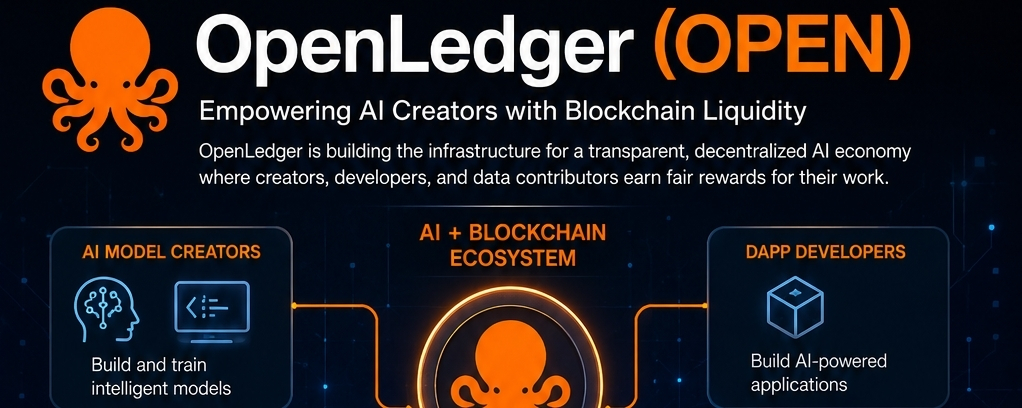
The connection between artificial intelligence and blockchain technology is becoming one of the most exciting developments in the digital economy. While AI continues transforming industries through automation, prediction systems, and intelligent applications, blockchain is solving long-standing problems related to transparency, ownership, and decentralization. In the middle of this transformation stands OpenLedger, a project aiming to reshape how AI creators, developers, and data contributors earn value from their work.
OpenLedger is not simply another AI themed crypto project trying to ride a market trend. It is building an infrastructure where AI models, datasets, applications, and autonomous agents can be tracked, verified, and monetized directly on-chain. The project focuses on solving what many analysts describe as the “data liquidity problem,” where massive amounts of valuable data remain locked away, unused, or uncompensated. According to project documentation and market analysis, OpenLedger wants to create a transparent AI economy where every contributor receives measurable rewards for their participation.
At the center of this ecosystem is the OPEN token, which acts as the economic engine powering transactions, rewards, governance, and liquidity within the network. As AI adoption expands globally, OpenLedger is positioning itself as a bridge between decentralized finance and intelligent systems.
One of the biggest problems in today’s AI industry is the lack of transparency. Major AI companies train models using enormous datasets, but contributors often receive no recognition or compensation. Data creators, researchers, developers, and communities usually lose control over how their information is used. OpenLedger addresses this challenge through a system called “Proof of Attribution,” which tracks how datasets influence AI outputs and automatically distributes rewards to contributors.
This approach could fundamentally change the AI economy. Instead of centralized companies controlling everything, OpenLedger introduces a system where ownership and contribution become traceable. Every dataset, model improvement, or AI-generated output can potentially create revenue for the original contributor. In simple terms, OpenLedger is trying to make AI fairer, more transparent, and financially rewarding for everyone involved.
The project gained major attention after the launch of its OPEN token and exchange listings in 2025. Reports showed that the token surged strongly following its market debut, attracting significant trading activity and investor interest. While many crypto projects experience temporary hype, OpenLedger continued building its infrastructure even during difficult market conditions. That long-term development strategy has helped the project maintain relevance in the rapidly evolving AI blockchain sector.
Another reason OpenLedger stands out is its focus on real utility instead of pure speculation. The platform enables developers to train AI models using decentralized datasets while ensuring all contributors receive compensation. Businesses can also deploy specialized AI systems on-chain with verifiable data sources. This creates trust, especially at a time when regulators and enterprises are becoming increasingly concerned about “black-box AI” systems that cannot explain how decisions are made.
In 2026, OpenLedger revealed an ambitious roadmap focused on accountable AI infrastructure. The project announced plans to create a full-stack ecosystem for transparent AI applications, emphasizing auditability, attribution, and economic fairness. These developments arrived during a period when governments and technology companies worldwide began demanding stronger oversight of AI systems.
This timing could become extremely important for the project’s future growth. As global AI regulations tighten, companies may need blockchain-based verification systems to prove where AI data comes from and how models are trained. OpenLedger’s infrastructure could therefore become useful not only for crypto users but also for enterprises seeking regulatory compliance and trustworthy AI operations.
Another significant update involved OpenLedger’s partnership initiatives around intellectual property and AI licensing. The platform explored systems that allow creators to license content for AI training while automatically receiving payments through blockchain-based smart contracts. This development addresses one of the most controversial issues in modern AI: the use of copyrighted material without proper compensation.
From a technological perspective, OpenLedger combines decentralized storage, attribution mechanisms, AI computation frameworks, and blockchain settlement systems into one ecosystem. The project has also experimented with efficient AI infrastructure solutions such as OpenLoRA, which reportedly allows thousands of AI models to run on a single GPU environment more efficiently. Innovations like these show that the project is not only focused on token economics but also on solving technical scalability challenges within AI deployment.
The OPEN token itself plays a central role in network activity. It is used for transaction fees, rewards, staking, governance participation, and liquidity incentives. According to recent market data, OPEN has experienced high volatility, reflecting both investor excitement and broader uncertainty within the crypto market. Like many emerging blockchain projects, OpenLedger has gone through periods of rapid growth followed by sharp corrections.
However, despite market fluctuations, the project continues expanding its ecosystem. OpenLedger also introduced a token buyback initiative designed to strengthen liquidity and restore balance within the network economy. Such strategies are often viewed positively because they demonstrate active management of token sustainability and long term ecosystem support.
The growing interest in AI agents and decentralized machine economies may further increase OpenLedger’s relevance. Across the crypto industry, there is increasing discussion about autonomous AI systems capable of managing financial transactions, executing smart contracts, and interacting with decentralized applications independently. These future AI systems will require transparent data attribution, decentralized payment rails, and trustless infrastructure exactly the type of environment OpenLedger aims to provide.
Current market appreciation toward OpenLedger remains mixed but optimistic overall. Supporters believe the project is entering one of the most promising sectors in crypto: the convergence of AI and blockchain. Critics, however, point out concerns regarding token volatility, adoption speed, and competition from larger AI focused blockchain ecosystems.
Still, many analysts agree that OpenLedger possesses one major advantage: a clearly defined problem statement. Instead of offering vague promises, the platform specifically targets AI attribution, data monetization, and decentralized ownership. These are real problems affecting the modern AI industry today.
The future benefits of OpenLedger could become substantial if adoption continues growing. AI developers may gain direct access to monetizable datasets without relying on centralized corporations. Data contributors could finally earn recurring rewards whenever their information helps train successful AI systems. Businesses may use OpenLedger to build transparent AI applications that satisfy regulatory standards. Meanwhile, investors and token holders could benefit from increased utility and ecosystem growth if the platform achieves widespread adoption.
Another important long term advantage is the concept of “Payable AI,” which OpenLedger frequently promotes. This model creates an economy where every contribution within the AI lifecycle becomes measurable and financially rewarded. If successful, this could redefine how digital labor and knowledge are valued in the AI era.
The broader market trend also supports projects like OpenLedger. The global AI economy continues expanding rapidly, while blockchain technology increasingly moves beyond speculative finance toward real world infrastructure. Many experts now believe that decentralized AI systems could become one of the next major phases of Web3 development.
OpenLedger is attempting to place itself directly at the center of that transformation.
Although challenges remain, including scalability, regulation, market volatility, and ecosystem competition, OpenLedger represents an ambitious attempt to create a more transparent and economically fair AI future. The project combines blockchain verification, decentralized incentives, and AI innovation into a single framework that could reshape how intelligent systems are built and monetized.
As artificial intelligence becomes more deeply integrated into daily life, the question of ownership, attribution, and compensation will only become more important. OpenLedger’s vision is built around answering those questions before the industry reaches its next major stage.
Whether OPEN eventually becomes a dominant AI-blockchain asset or remains a niche infrastructure project, one thing is already clear: OpenLedger is participating in a technological shift that could redefine the relationship between AI creators, data contributors, and digital economies for years to come.