Most AI crypto projects are still selling the same narrative with different branding. faster models, bIgger datasets, more agents, more automation. I searched through multiple AI blockchain ecosystems recently and the pattern looked almost identIcal everywhere: strong marketing around inteLligence, very little discussion about ownership, attribution, or economic distribution. that disconnect is becoming diffIcult to ignore.
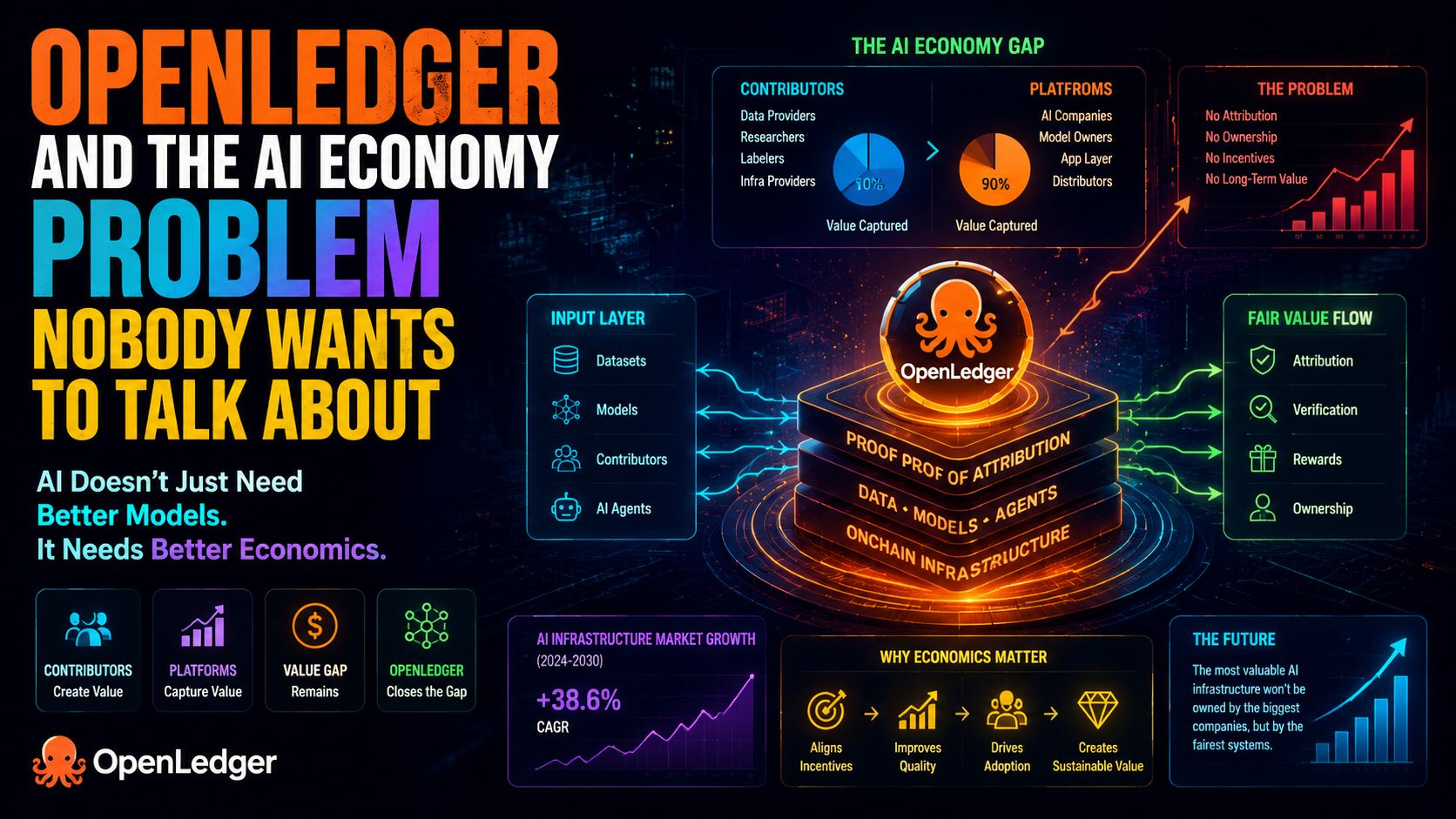
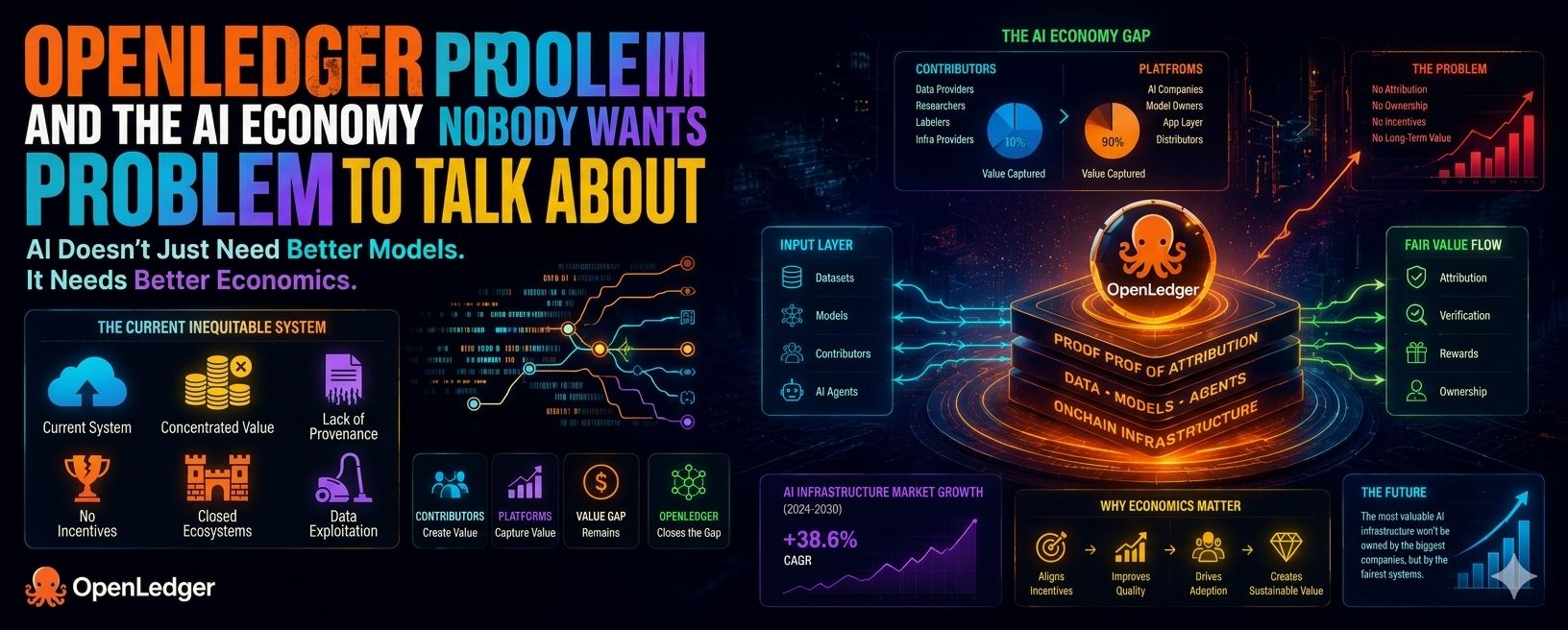
The AI industry today is not suffering from a lack of models. they already exist at massive scale. The real weakness sits underneath the models themselves. data contrIbutors, researchers, labeling systems, and infrastructure providers continue creatIng value while most of the financial upside concentrates at the applIcation layer. I checked how current AI ecosystems operate and the structure looks surprisingly extractive. intelligence gets monetized, but the sources feeding that inteLligence rarely participate in long term value creation.
that is where OpenLedger starts becoming more interestIng than many speculative AI tokens enterIng the market right now.
they are not positIoning themselves only as another AI chain chasing attention around inference speed or agent narratIves. what they are trying to build is an attribution economy around AI itself. that difFerence matters because infrastructure markets usually become more valuable than applIcation hype once specuLation cools down.
I have read through their architecture design and what stands out is the focus on Proof of Attribution. instead of treating AI training liKe a black box, they are attemptIng to track which datasets, contributors, or systems influence model outputs over time. most crypto projects talk about decentralization in abstract terms. OpenLedger is applyIng it to something measurable: contrIbution tracking and economic reward distrIbution.
this is also why I think many investors are framing AI tokens incorrectly. most people still evaluate them liKe meme narratives tied to short-term attention cycles. I do not think that is where the durable value will emerge. Infrastructure protocols that organize data ownership, model coordInation, and economic incentives may eventually control more strategic posItioning than the models themselves.
another thing I noticed while researching the project is their emphasis on smaller domain-focused AI systems instead of competIng directly with giant generalIzed models. That approach actually looks more practical from an operational perspective. large universal models consume enormous compute resources and are becoming increasingly centralized because only a few companies can sustain those costs. specialIzed AI systems, however, are cheaper to train, easier to optimize, and often commercially superior for industry specific tasks.
we discussed this problem frequently across blockchain and AI infrastructure cIrcles. Scale alone does not automatIcally create efficiency. in many cases, scale creates dependEncy on centralIzed compute monopolies. OpenLedger appears to understand that the future AI market may reward coordInation eFficiency more than raw model size.
the OPEN token also deserves a more careful interpretation than the typIcal AI coin label people attach to it. I checked the token design and its role is tied to contributor incentives, governance partIcipation, and economic settlement across the ecosystem. that still carries speculative risk like every early stage crypto asset, but at least the utility logic aligns with the protocol’s actual infrastructure thesis.
most AI-related tokens today are priced almost entirely on narratIve momentum. if attention disappears, the token usually loses its purpose quickly. OpenLedger is attempTing to connect token value to measurable particIpation inside AI coordInation markets. whether they fully achieve that remains uncertain, but structurally the approach looks more coherent than many competing projects.
there are still serious risks here. Attribution systems are technicalLy diffIcult to verify at scale. measuring how much influence a dataset has on AI output is not simple. if attribution becomes inaccurate or manIpulable, the entire reward structure weakens immedIately. I say this often when reviewing AI protocols: transparency claims are easy to market but extremely hard to operationalize.
competItion is another reality investors should not underestimate. Large AI firms already control infrastructure, distribution, and proprietary data pipelines. Open decentralIzed systems may offer stronger transparency, but transparency alone does not guarantee adoption. builder activity, liquidity depth, and developer incentives will determine whether these ecosystems survive long enough to mature.
What I find most important is not whether OpenLedger becomes the dominant AI blockchain tomorrow. The bigger point is that projects like this are exposing a structural flaw inside the current AI economy. The market keeps rewarding outputs while largely ignoring the contributors who make those outputs possible.
My takeaway after researching the project is relatively simple: the next major AI infrastructure layer may not be the company with the largest model. It may be the network that creates the most efficient system for tracking, rewarding, and coordinating intelligence itself. That is a harder market to build, but historically infrastructure with real economic alignment tends to survive longer than hype cycles built purely around attention.