
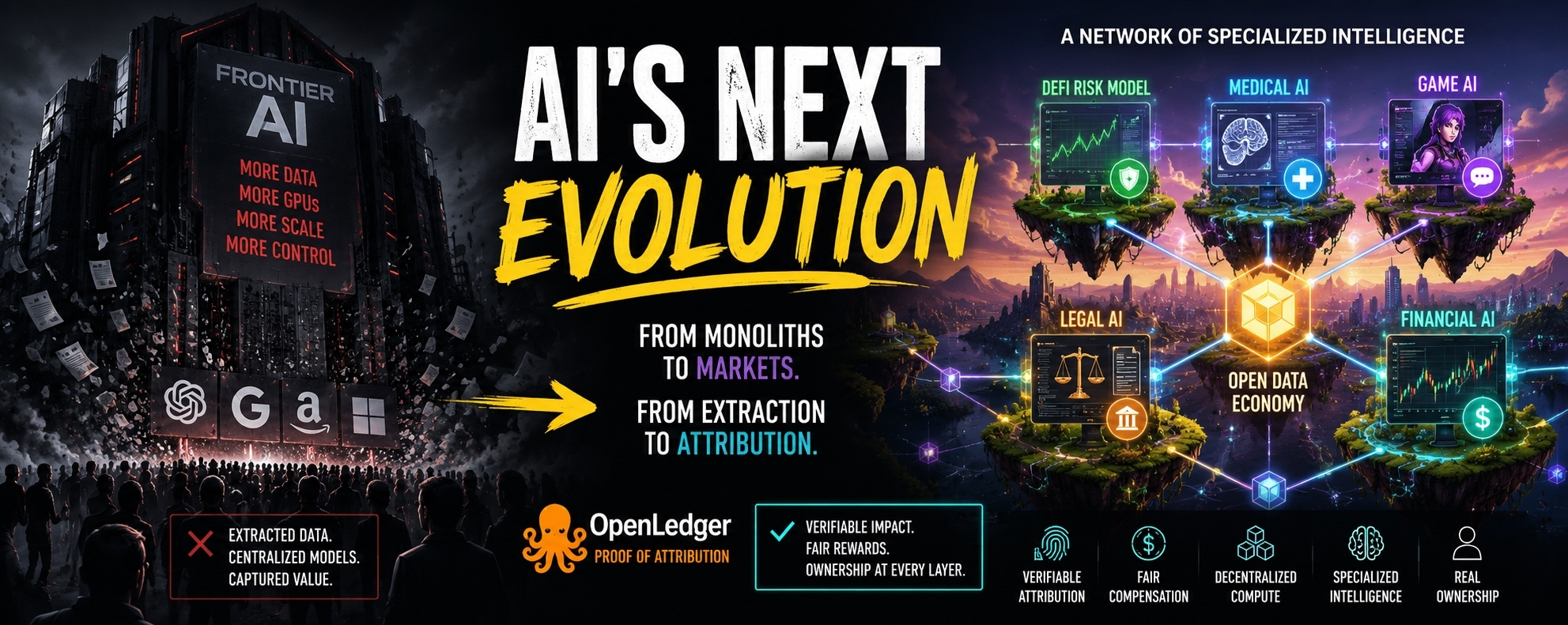
Crypto’s doing that thing again where it mistakes brute force for inevitability.Every cycle needs its religion. This one picked GPUs.
For the last few years the entire AI narrative has basically been: bigger model smarter future. More parameters. More H100s. More data scraped from people who never agreed to any of this in the first place. Then slap a trillion dollar valuation on top and call it progress. And look, fair enough scaling laws weren’t fake. The jump from old NLP garbage to modern LLMs was real. Nobody can honestly deny that.
But I think the industry got hypnotized by size.
Like genuinely hypnotized.
You see it everywhere now. Every startup pitch sounds identical. General purpose autonomous agents powered by frontier intelligence.Cool. So another chatbot with a memory tab and an anime pfp pretending it can replace an operations team. Revolutionary stuff.
The cracks are already showing, though. Enterprises are quietly realizing they don’t actually need some god model that can explain medieval warfare, write fan fiction, generate pixel art, summarize SEC filings, and flirt with lonely people at 2am. That’s not a product. That’s a demo reel.
Most businesses want one thing solved. One. Cheaply.
A hedge fund wants better risk modeling around volatile DeFi collateral. A hospital wants faster medical document analysis without leaking sensitive data into some centralized black box. A game studio wants NPC dialogue trained specifically on its own lore and player behavior. Legal firms want systems that understand legal structure instead of confidently hallucinating fake case law like a drunk intern.
That’s where this is going.
Not upward forever. Sideways.
Thousands of smaller models. Hyper specialized. Domain trained. Weird little machines that are insanely good at one narrow task and don’t waste compute trying to become Shakespeare with image generation capabilities.
And honestly? Specialized systems usually beat giant generalized ones inside constrained environments anyway. That’s the dirty secret under all the frontier model theater. Once the novelty wears off, utility wins.
Every time.
The economics matter too. People ignore this part because the AI market right now is basically operating like Uber during the subsidized rides era. Burn infinite money. Capture users. Figure the rest out later.
Except inference costs are nasty. Training costs are worse. The current model only really works if you’re one of like four companies on earth with absurd compute access and enough capital to set money on fire for strategic positioning.
Not exactly decentralized innovation.
It gets even uglier once you look at attribution.
This whole AI boom runs on extracted value. The internet got strip mined. Artists, researchers, niche communities, forum writers, open source devs everybody fed the machine. Almost nobody owns any part of the upside. Their data disappears into centralized models and comes back out as subscription revenue for corporations that suddenly act like they invented intelligence itself.
That system feels broken because it is broken.
And crypto, for once, actually has a legitimate role here beyond turning frog memes into temporary GDP.
That’s the part of OpenLedger I find interesting.
Not the usual AI + blockchain slop where someone duct tapes a token onto a chatbot and calls it infrastructure. I mean the actual data coordination layer they’re trying to build around attribution and specialized AI economies.
The core idea is surprisingly simple if your data materially improves a model, there should be cryptographic proof that your contribution mattered.
Crazy concept apparently.
They call it Proof of Attribution. Which sounds boring at first until you realize how foundational that becomes if AI turns into an actual economic layer instead of a VC sponsored land grab. Because now attribution stops being vibes and screenshots and turns into verifiable infrastructure.
That changes incentives fast.
Suddenly datasets become productive assets instead of free fuel for centralized scraping operations. Smaller developers can deploy specialized models and monetize inference directly. Contributors can theoretically receive royalties tied to actual impact instead of applause and community recognition nonsense.
The internet never solved this properly. AI is forcing the issue.
And no, I don’t think decentralization magically fixes everything. Half of crypto can’t even survive a memecoin cycle without collectively losing its mind. But ownership coordination? Incentive routing? Open marketplaces around data and compute contribution? That’s literally what this industry was originally built for before everybody got addicted to casino mechanics and cartoon tokens with billion dollar fully diluted valuations.
The irony is kind of brutal.
Crypto spent years searching for a real use case while AI accidentally stumbled directly into crypto’s strongest design space: attribution, coordination, provenance, payments, market formation.
Because the future AI stack probably looks less like one omniscient machine ruling the planet and more like fragmented intelligence networks constantly interacting with each other. Specialized models serving specialized markets. Financial models talking to legal models. Gaming engines connected to inference marketplaces. Healthcare systems requiring auditable provenance layers because nobody wants mystery datasets touching medical decisions.
That future needs infrastructure underneath it.
Not just bigger GPUs.
And honestly, I suspect people are massively underestimating how much the data layer determines everything upstream. If the data economy stays centralized, the intelligence economy stays centralized too. Doesn’t matter how many decentralized agents are posting on Crypto Twitter pretending to autonomously negotiate yield strategies while secretly routing through OpenAI APIs.
Still dependent. Still rented intelligence.
That’s why all these anime agent projects feel backwards to me. Everybody’s obsessing over personalities and interfaces while ignoring the underlying ownership structure of the intelligence itself.
Who trained the model?
Who contributed the data?
Who gets paid when the model generates value?
Who owns the improvements?
Right now the answer is mostly not the people who actually built the intelligence substrate.
That probably doesn’t hold forever.
I think the next phase of AI ends up looking much messier than the current narrative. Less one model to rule them all. More fragmented ecosystems competing on specialization, attribution, privacy, latency, and domain accuracy. Smaller models. Local inference. Industry specific intelligence rails. Actual markets around contribution.
Which is funny because that starts sounding less like Silicon Valley monopoly logic and more like what crypto people were talking about before the entire industry became a dopamine farm for leverage addicts.
We might finally be circling back to the original point.