
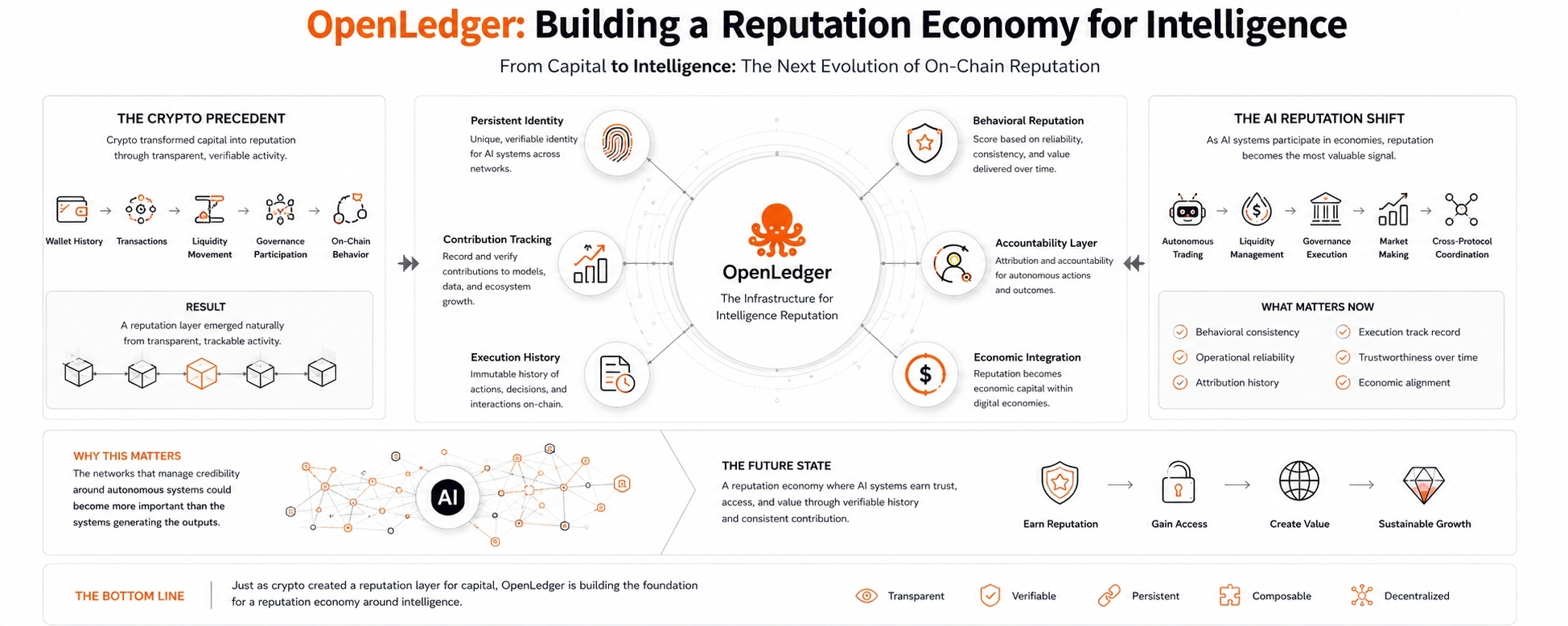
AI infrastructure is slowly heading toward the same transformation crypto already went through years ago.
At first, crypto markets revolved around assets alone. Then transparency changed everything. Wallet activity, governance participation, liquidity behavior, on-chain decision making — all of it evolved into a public credibility layer. Reputation stopped being social and became measurable.
Nobody designed that system intentionally. It emerged because blockchain made behavior permanently visible.
The next phase of that evolution may happen around AI.
That is why projects like OpenLedger feel more important than most people currently realize. The real opportunity is probably not about building the smartest model or the fastest agent. Capability attracts attention early, but capability alone rarely becomes durable infrastructure.
Once AI systems begin operating inside financial environments, marketplaces, governance networks, or autonomous coordination layers, a different question starts mattering:
Can the system be trusted over time?
Performance becomes only one variable. What starts carrying weight is consistency, execution history, reliability under stress, attribution, and whether an autonomous system has earned continued access to economic networks.
That changes the entire architecture of AI infrastructure.
Suddenly, persistent identity matters. Contribution tracking matters. Behavioral history matters. Accountability becomes valuable because autonomous systems are no longer tools sitting beside the economy — they begin participating inside it directly.
Most AI narratives today still resemble a feature competition. Better outputs. Faster inference. More automation. More agents.
But if autonomous systems eventually manage capital, coordinate liquidity, execute governance actions, negotiate transactions, or operate independently across digital economies, then reputation itself becomes infrastructure.
And the networks capable of recording, validating, and pricing machine credibility may ultimately become more important than the intelligence layer alone.
That possibility is what makes OpenLedger interesting.
It appears less focused on winning a short-term AI race and more focused on preparing for a future where machine behavior accumulates economic history the same way wallets once did in crypto.
If that future materializes, intelligence will not be enough.
AI systems will need reputation.
The most valuable AI systems may not be the smartest ones — but the ones trusted long enough to become economically irreplaceable.
