
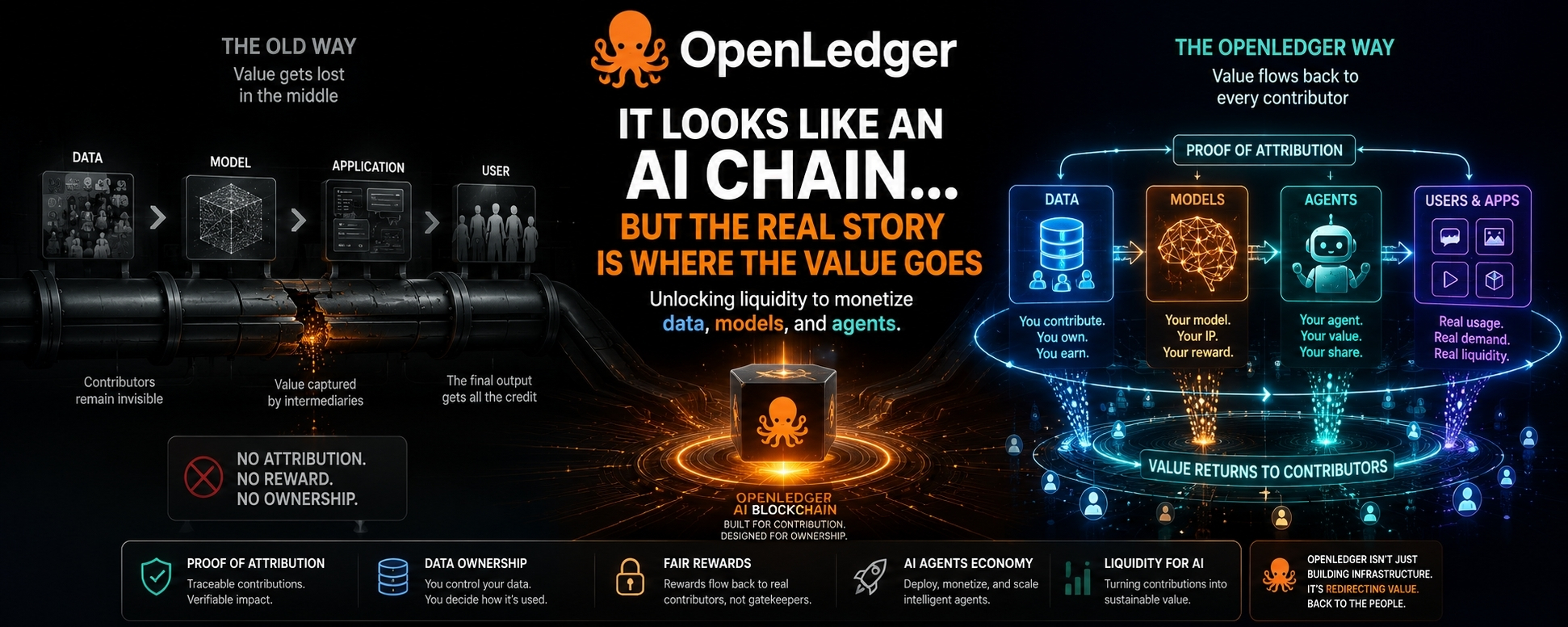
At first, OpenLedger felt like one of those projects that sounds impressive before you have really thought about it. AI blockchain. Data monetization. Models. Agents. The words are all there, and they fit together in a way that makes the idea feel complete almost immediately.
But after sitting with it a little longer, I stopped seeing it as just another AI infrastructure story. What started to stand out was something quieter: the way it seems to change where value lives, and who gets to stay connected to it.
That part feels more important than the big label on the front.
Most people probably look at a project like this and assume the value moves in a straight line. Data goes in, intelligence comes out, users benefit, and the chain captures the activity somewhere along the way. Simple enough. But OpenLedger seems to be built around a different idea. It does not just want to host AI activity. It wants to make the contribution behind that activity visible enough that it can be rewarded.
That sounds like a technical detail, but it is really a shift in behavior.
Once contribution becomes traceable, people begin to act differently. A dataset is no longer just a file sitting in the background. It becomes something that might still matter later. A model contribution is not only a piece of work completed in the moment. It becomes a possible claim on future value. Even an agent, which can feel abstract at first, starts to look like a thing that might keep producing measurable impact if the system continues to recognize it.
That is the part I keep coming back to. OpenLedger seems less interested in making AI louder and more interested in making its hidden inputs harder to ignore.
I think that is where the project gets interesting.
There is something almost natural about the idea. For a long time, people have been feeding value into digital systems without really seeing it come back. They label data, refine models, test outputs, and improve the thing without always being visible inside the thing. So a system that says, “your contribution can be tracked, and maybe rewarded,” immediately feels more fair. More honest. Maybe even overdue.
But once you look closely, the picture gets a little messier.
Because measurement and fairness are not the same thing.
That is the tension I keep noticing. A system like this can be more efficient at recognizing input, but that does not automatically mean it understands contribution in a fully fair way. Some work is easy to count. Some work is not. Some people create obvious value. Others do the slower, harder work that only becomes useful much later. A system can trace influence, but it still has to decide what counts as meaningful influence in the first place.
And that decision changes everything.
The more I think about OpenLedger, the more it feels like a system that quietly teaches people how to behave. Not with rules shouted from the top, but through incentives that reshape attention over time.
People become more careful about what they contribute. More aware of what can be recognized. More sensitive to whether their work remains attached to future value. Even collaboration starts to feel different when credit can be measured more directly. Suddenly, participation is not just participation. It is something that might leave a trail.
That trail matters.
Because in systems like this, value does not always show up in one big obvious moment. It accumulates through small things. A cleaner dataset. A better correction. A model that performs well in a narrow area. An agent that gets reused. A quiet improvement that nobody notices right away but that keeps paying off over time.
That is what makes OpenLedger feel less like a spectacle and more like a bookkeeping change in the background of AI. It is not trying to dazzle you. It is trying to decide where the credit should land, and whether that credit can stay connected to the work that made it possible.
That may sound simple, but I do not think it is.
Because the moment a system gets better at tracking value, it also gets better at shaping behavior around value. People adapt fast. They start optimizing for what is visible. They learn what the system notices. They give more attention to actions that are more likely to be rewarded. And over time, that can make the network stronger in some ways and narrower in others.
That is the tradeoff I cannot quite shake.
A more measurable system can feel more just. But it can also make everything feel a little more strategic, a little more calculated, a little less human. Not because anyone is forcing it, but because people naturally adjust to the incentives around them. Once the ledger becomes part of the relationship, the relationship changes.
So I end up seeing OpenLedger as something larger than a chain for AI. It feels like an attempt to reorganize the path value takes through a system, and maybe even the way people behave once they know that path can be seen.
That is a meaningful shift, even if it is not a dramatic one.
And maybe that is why it stays interesting. Not because it promises to fix everything, but because it asks a question that is easy to miss at first: if the work behind AI finally becomes visible, does that make the system more honest, or just more careful about what it chooses to reward?
