
Most AI projects right now feel like they’re trapped in this endless arms race.
Bigger models.
More GPUs.
More Nvidia chips duct-taped together with billion dollar funding rounds.
More flexing about parameter counts like anyone outside Silicon Valley even cares anymore.
And yeah, sure, the tech is insane. I am not pretending it isn’t. Watching AI evolve over the last two years has felt a little unreal tbh. One week it’s generating goofy images, next week it’s replacing entire workflows. Cool. Slightly terrifying. Standard timeline stuff.
But the deeper I go down the crypto x AI rabbit hole, the more I think the real opportunity isn’t just building smarter models.
It’s fixing who captures the value.
Because right now? AI is basically feeding on humanity at industrial scale.
People are constantly contributing to these systems without realizing it. Posting threads. Writing articles. Labeling datasets. Dropping alpha in Discords. Making memes. Answering questions. Training recommendation systems through behavior patterns alone.
All of that becomes fuel.
Then giant platforms vacuum it up quietly in the background and centralize the upside at the company layer. Same internet pattern. Different decade.
That’s the part where OpenLedger got my attention.
The first time I really understood what they were building, the whole thing clicked immediately:
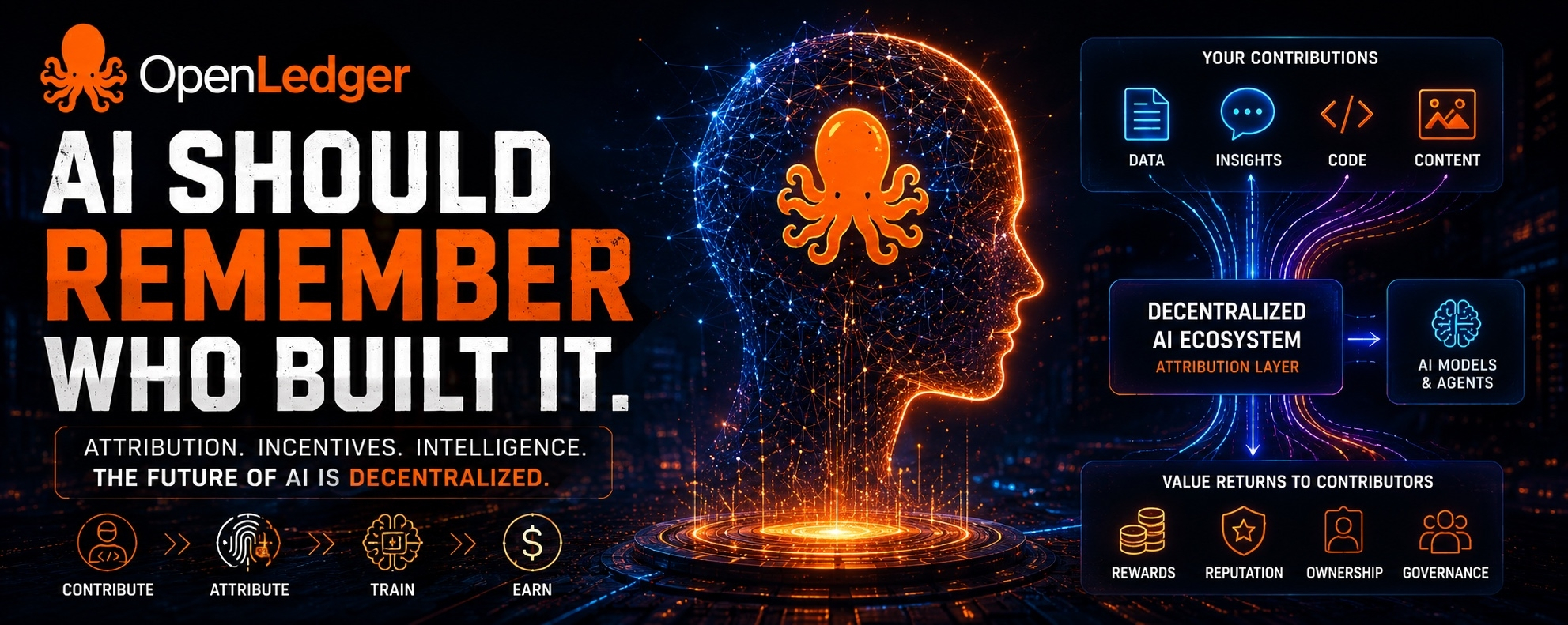
OpenLedger wants AI to remember who helped build it.
Not remember in some vague marketing slogan way either. Not those fake community badges projects hand out so everyone feels included while VCs own the cap table.
I mean actual attribution.
Who contributed the data.
Who improved outputs.
Who provided context.
Who trained niche intelligence.
Who made the model more useful over time.
And most importantly who should receive value back once those systems start generating revenue.
That changes the relationship between humans and AI completely.
Because current AI systems operate like giant black holes. They absorb knowledge, creativity, conversations, behavioral feedback, and collective intelligence from millions of people then all the economic value gets compressed upward into a handful of corporations.
OpenLedger is trying to build the opposite structure.
What they’re creating feels less like another AI protocol and more like a decentralized memory layer for machine intelligence.
That phrase sounded abstract to me at first too, ngl.
Then you think about the implications for five minutes and it starts getting kind of wild.
Datasets become traceable.
Contributions become attributable.
Outputs can route value back to contributors.
AI systems can preserve provenance instead of flattening everyone into anonymous training data sludge.
That’s huge.
Imagine a healthcare AI trained partially on specialized datasets contributed by researchers globally. Or a crypto trading model sharpened by thousands of onchain traders posting market insights over time. Or niche legal and biotech models curated by actual experts instead of scraped internet garbage from 2017 Reddit threads.
Normally those contributors vanish after the training phase. Gone. Invisible.
OpenLedger’s infrastructure is designed so contribution history actually matters.
The AI doesn’t just learn.
It remembers where the intelligence came from.
And honestly that feels way more aligned with the original spirit of crypto than most AI + blockchain projects I have seen lately.
Because crypto has always been about ownership of value creation.
BTC introduced ownership of money.
ETH expanded ownership into applications and digital assets.
OpenLedger is exploring ownership of intelligence itself.
That’s the real narrative here imo.
The architecture matters because they’re building decentralized AI coordination rails where
data can be verified
models can interact modularly
contributors can get rewarded
and AI systems can operate transparently instead of inside sealed corporate black boxes.
One thing I keep coming back to is their focus on specialized AI ecosystems.
Ngl i don’t think the future belongs to one omniscient mega model trying to know literally everything on earth. That feels inefficient and kind of dystopian anyway.
The future probably looks more fragmented.
Smaller domain specific models.
Finance models.
Medical models.
Gaming models.
Legal models.
Research models.
Creator economy models.
Basically networks of highly specialized intelligence tuned by actual communities with expertise.
And niche intelligence is often way more valuable than generalized intelligence.
A crypto native model trained by real onchain traders might absolutely outperform a massive general purpose AI when it comes to market structure or behavioral flows. Same with biotech datasets curated by researchers versus random internet scrape data polluted with SEO spam and AI-generated nonsense.
OpenLedger seems positioned around enabling those ecosystems while preserving attribution and incentive alignment.
That last part matters more than people realize.
Because the AI industry keeps obsessing over models while barely talking about the quality of data underneath them.
Bad data creates bad intelligence. Simple
OpenLedger treats data more like an asset class than disposable raw material.
Not just information
Structured intelligence input
Traceable
Attributable
Rewardable
And honestly in the long run, proprietary high quality data may end up more valuable than compute itself. Everyone’s fighting over chips right now, but eventually the real moat becomes unique intelligence sources.
The infrastructure layer matters too.
Instead of relying entirely on centralized AI monopolies, OpenLedger is building decentralized coordination systems for
datasets
model interaction
inference
attribution
and eventually value distribution itself.
That’s where crypto genuinely makes sense in AI.
Not the lazy put AI on blockchain narrative people spam for engagement farming.
Actual incentive coordination.
Because if AI becomes one of the largest economic layers on the planet and it probably will then contribution accounting becomes insanely important.
Who gets paid?
Who owns outputs?
Who controls training?
Who benefits from improvement loops?
These questions get political really fast once AI moves from experimental toy to global infrastructure layer.
And that transition is already happening.
AI isn’t just a novelty anymore. It’s becoming foundational infrastructure the same way cloud computing and mobile internet became foundational infrastructure.
Whenever infrastructure solidifies, power concentrates.
A handful of corporations controlling intelligence layers for the internet long term? Yeah I don’t think people are going to love that outcome forever.
Which is exactly why crypto-native coordination models suddenly feel much more relevant than they did even a year ago.
That’s also why OpenLedger feels bigger than just another protocol launch.Underneath all the technical architecture, the core idea is actually pretty simple
AI today has intelligence.
But it barely has accountability.
OpenLedger is trying to add memory to intelligence.
Memory of contribution.
Memory of provenance.
Memory of who helped create value in the first place.
And I genuinely think that could become one of the most important primitives in the entire AI economy.
Because the future probably won’t be decided only by which AI becomes smartest.It’ll be decided by which ecosystems people actually want to contribute to.