
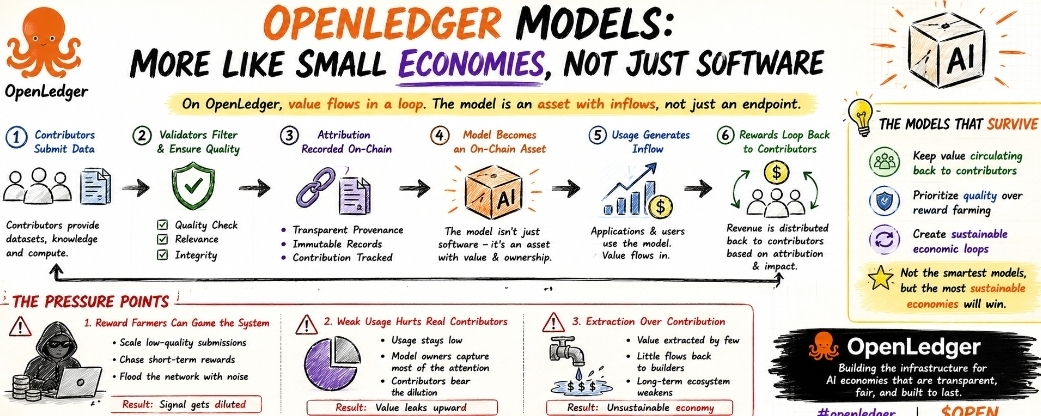
People still talk about AI models like they are simple software products. Train the model, deploy it, improve performance, repeat. But systems being built on OpenLedger are starting to look less like software and more like small digital economies.
Every model depends on participants. Contributors provide data, validators filter quality, attribution records activity on-chain, and rewards move back through actual usage. That changes the structure completely. The model is no longer just a technical endpoint. It becomes an economic system with incentives, capital flow, and competing interests.
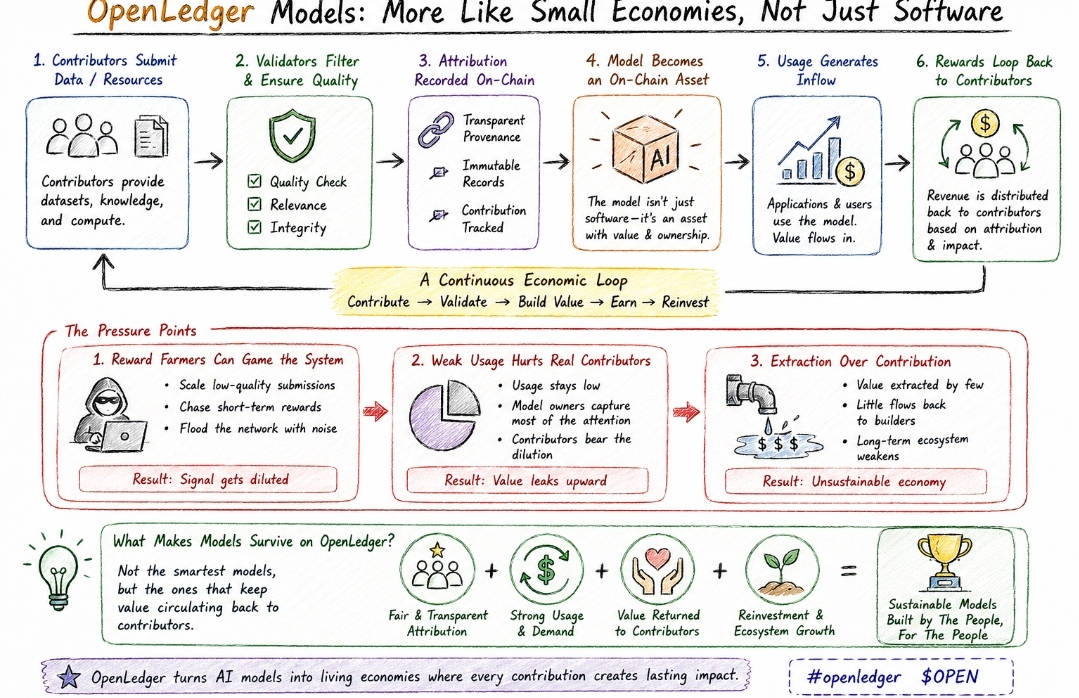
The challenge is that incentive systems can break very quickly if value distribution becomes unbalanced.
Low-quality reward farming is an obvious risk. Contributors chasing rewards can flood networks with weak data while genuine researchers and domain experts spend far more time producing meaningful signal. If the system rewards volume over usefulness, quality naturally starts collapsing.
There is also the issue of value leakage. A model can generate attention, speculation, and market activity while the underlying contributors slowly absorb dilution. In that scenario, ownership concentrates while the people improving the intelligence layer receive less over time.
That is why sustainability may become more important than raw model performance.
The strongest models on OpenLedger may not necessarily be the most advanced technically. They may be the ones that create durable economic loops where contributors continue benefiting as usage grows instead of being extracted from as the network scales.
