I’ll be honest I’ve become naturally skeptical whenever a crypto project starts talking about AI infrastructure now.
Not because AI isn’t important. Clearly it is. But after watching this space for a while, the language starts sounding strangely repetitive. Every few days there’s another project promising autonomous agents, decentralized intelligence, machine economies, self operating systems, or some new version of “the future of AI coordination.” The words get bigger every cycle, but underneath it all, a lot of the infrastructure still feels unfinished.
And eventually you notice something uncomfortable.
Most of these systems are still struggling with very basic problems.
Not futuristic problems. Not sci fi problems. Just practical coordination problems.
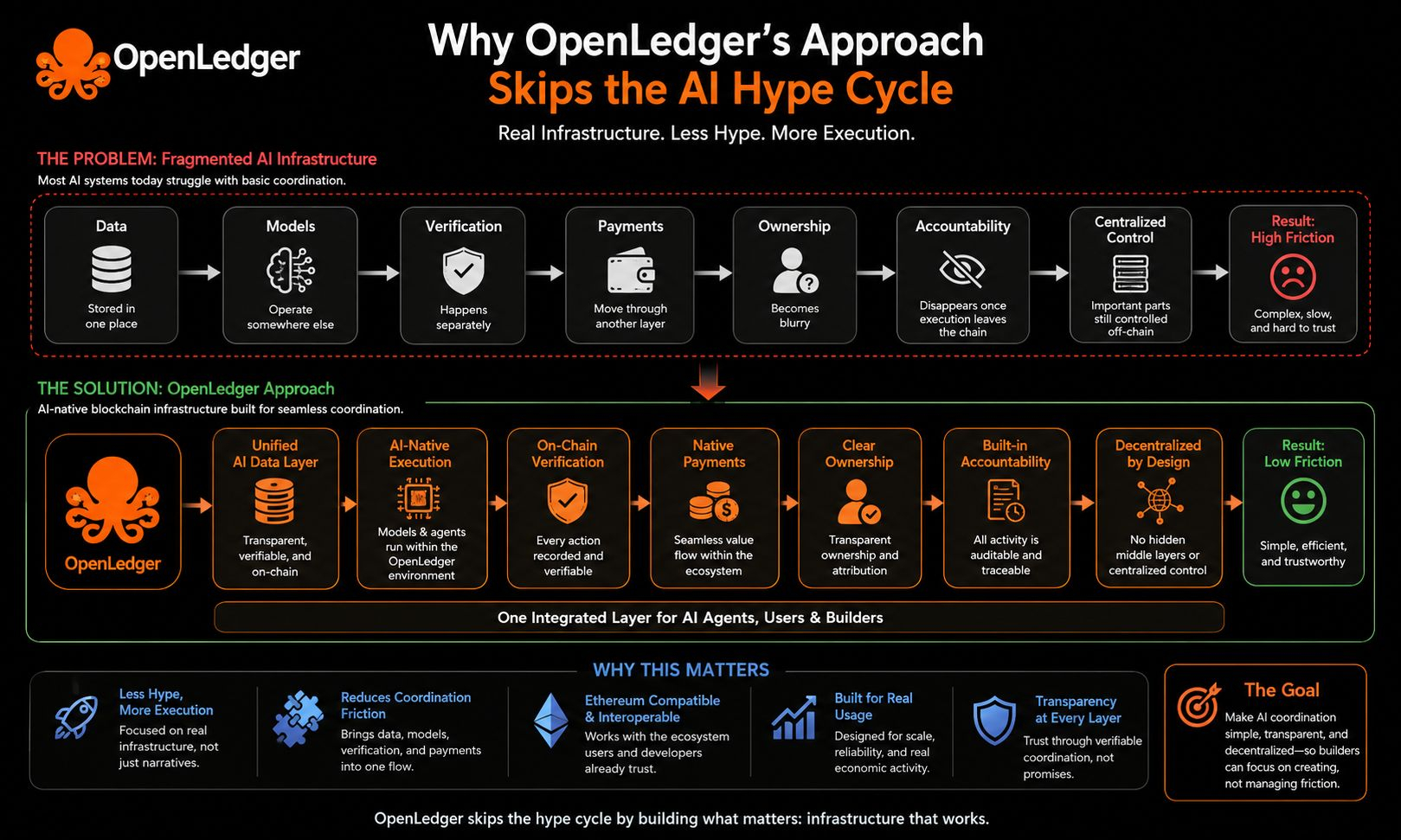
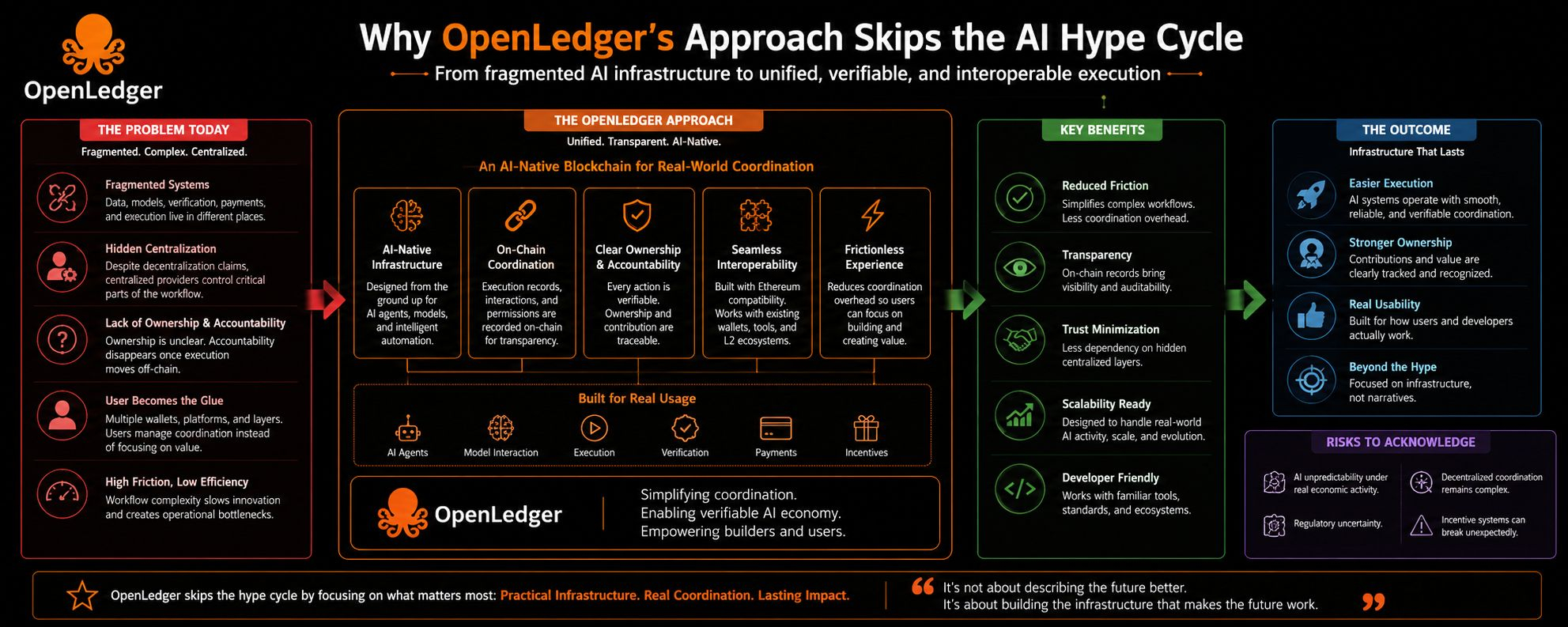
Data lives in one place. Models operate somewhere else. Verification happens separately. Payments move through another layer entirely. Ownership becomes blurry. Accountability disappears once execution leaves the chain. Then somewhere in the middle, despite all the decentralization talk, there’s usually still a centralized provider quietly controlling an important part of the workflow.
That was honestly the mindset I had before spending time looking into OpenLedger.
At first glance, I expected the same thing I’ve come to expect from most AI related crypto narratives lately: polished branding, ambitious language, dramatic promises about the future, and not much substance once you looked past the surface.
Even the phrase “AI blockchain” immediately triggers skepticism for me now because the industry has gotten incredibly good at packaging narratives before proving utility.
But the interesting thing was that the deeper I went into OpenLedger, the less it felt like a narrative driven project and the more it felt like infrastructure trying to solve actual operational friction.
That difference became more noticeable the longer I sat with it.
What caught my attention wasn’t really the marketing side. It was the architecture philosophy underneath everything.
Most AI systems today still feel fragmented in ways people don’t talk about enough. Everyone focuses on model intelligence while quietly ignoring how messy the surrounding infrastructure still is. Workflows move across disconnected environments that weren’t really designed to coordinate with each other cleanly. Users end up becoming the coordination layer themselves.
And honestly, that’s exhausting.
You connect one wallet here. Another platform there. One system handles execution. Another handles permissions. Another handles payments. Verification happens elsewhere. AI activity occurs off chain, while trust still depends on centralized infrastructure sitting somewhere behind the scenes.
The more advanced the systems become, the more fragmented everything strangely starts to feel.
That’s part of why OpenLedger started standing out to me.
The project seems less obsessed with selling futuristic AI fantasies and more focused on reducing coordination friction between systems that already exist today. And personally, I think that’s a much more realistic way to approach infrastructure building.
Because right now the biggest bottleneck isn’t imagination.
It’s execution.
What I found interesting about OpenLedger is that blockchain doesn’t appear to be treated like some external payment rail attached afterward. The infrastructure itself seems designed around AI native participation from the beginning. AI agents, model interaction, execution records, and coordination mechanisms appear integrated directly into the environment instead of existing completely outside of it.
That changes things conceptually.
When AI systems operate through infrastructure that maintains transparent on chain coordination, ownership and participation become easier to track. Activity becomes more verifiable. Interactions become easier to audit. The system starts reducing dependency on invisible middle layers that usually control access behind closed doors.
And honestly, that matters more to me than hearing another project promise “the future of intelligence.”
At this point, I care far more about whether infrastructure removes friction than whether it sounds futuristic on social media.
That’s probably why OpenLedger kept feeling more grounded the deeper I looked.
Another thing I genuinely appreciated was the interoperability approach.
A lot of crypto infrastructure still behaves like isolated ecosystems competing for attention instead of networks trying to integrate into real usage patterns. New chains constantly ask users to abandon familiar tooling, move assets into unfamiliar environments, learn new systems, and rebuild workflows from scratch.
But most actual blockchain activity still revolves around Ethereum standards in one way or another. Wallet infrastructure, smart contracts, developer tooling, Layer 2 ecosystems Ethereum compatibility still matters because that’s where users already are.
OpenLedger building around that reality instead of pretending it doesn’t exist feels practical.
And practicality is underrated in crypto.
People underestimate how important friction reduction actually is. Everyone talks about innovation, but sometimes the projects that survive aren’t the ones introducing the most complexity. They’re the ones quietly simplifying coordination so users stop feeling like infrastructure managers every time they interact with a system.
That’s the feeling I kept coming back to while researching OpenLedger.
It doesn’t feel designed purely for attention cycles.
It feels designed around workflow coordination.
Now obviously, none of this guarantees success.
I think it’s important to stay realistic about that.
AI systems become unpredictable very quickly once real economic activity enters the picture. Infrastructure that looks smooth during controlled demos can become chaotic under scale, pressure, and adversarial behavior. Regulation is still uncertain. Decentralized coordination remains difficult. Incentive systems can break in unexpected ways. And AI itself is evolving faster than most infrastructure can comfortably adapt to.
Those risks are real.
But I still think OpenLedger feels directionally more convincing than a lot of the AI narratives currently moving through crypto.
Mostly because it seems focused on operational design instead of emotional hype.
And over time, I’ve started believing that the projects which survive long-term are usually the ones doing quiet infrastructure work while everyone else competes for visibility. Attention creates momentum temporarily. But usability is what keeps systems alive after the excitement fades.
That’s why I’m less interested in listening to polished promotional language now and more interested in observing behavior.
How does the infrastructure perform once people actually start building on it?
How smooth are integrations?
How reliable is coordination between systems?
How difficult is deployment?
How much friction exists once real users enter the environment?
Because eventually every AI infrastructure project reaches the same moment where the narrative stops mattering.
And the only thing left is the experience itself.
Does the system actually make execution easier?
Or does it simply describe the future better than everyone else?