
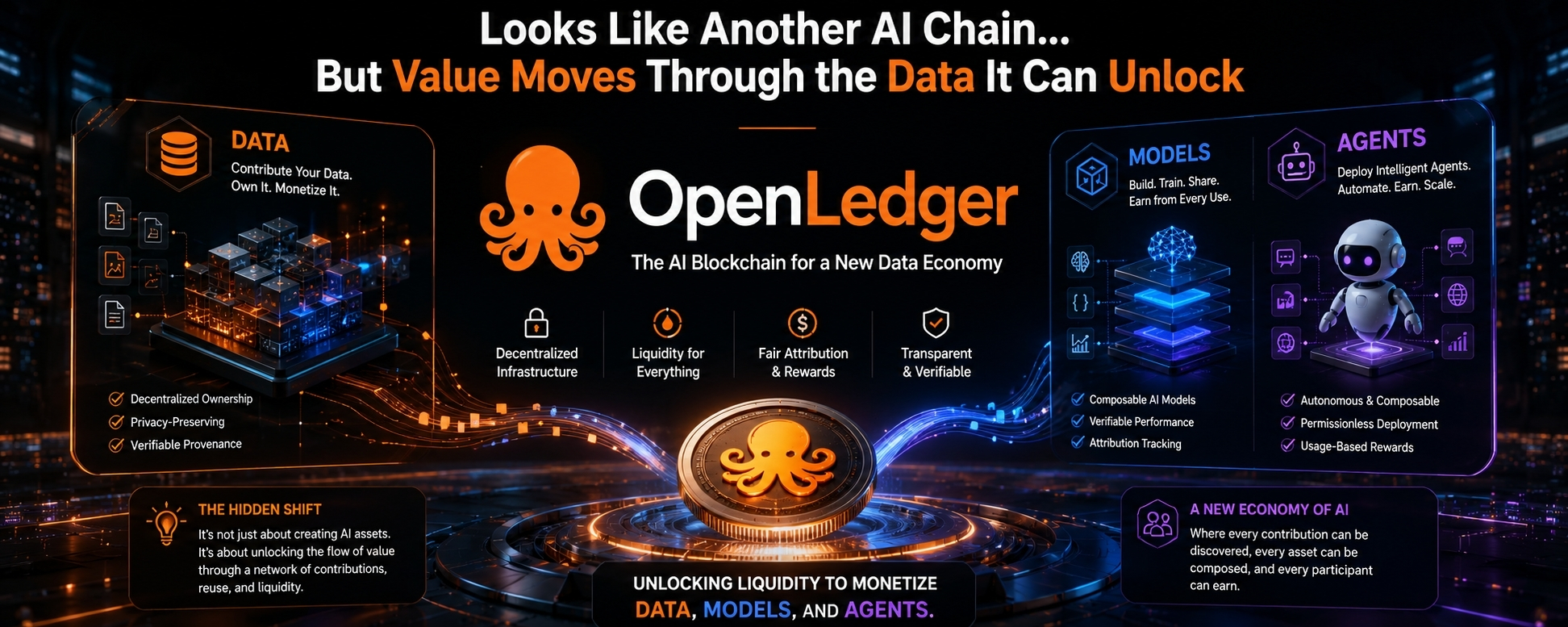
Looks Like Another AI Chain… But Value Moves Through the Data It Can Unlock
At first glance, OpenLedger (OPEN) feels like one more project trying to sit at the intersection of AI and crypto, which is already a crowded place. That was my first reaction, anyway. The surface story is easy to recognize: data, models, agents, liquidity, monetization. It sounds polished in the way a lot of crypto narratives do when they are still trying to find their footing. I almost dismissed it as another attempt to give old words a newer wrapper.
But the longer I sat with it, the more I started noticing that the real story may not be about AI at all. Or at least, not only about AI. The more interesting part is the way value seems to move underneath the obvious activity. People usually look at projects like this and assume the token follows the product, as if the token is just a label attached to whatever the network does. But with something like OpenLedger, it feels more like the token is sitting closer to the flow itself. Not the headline. The plumbing.
That changes the whole mood of the thing.
When people talk about monetizing data, models, and agents, the first instinct is to picture obvious transactions. Someone contributes something, someone else uses it, and value gets exchanged in a direct line. Clean. Easy. Almost too easy. But systems like this rarely work in such a neat way. The value does not just move once. It moves in layers. It gets discovered slowly, routed through participation, and then assigned meaning by repeated use rather than by a single event.
That is the part I keep coming back to. Value here does not feel static. It feels conversational.
A dataset that looks small on day one may become more useful once other contributors build around it. A model that seems ordinary may become more valuable if it is repeatedly reused, adapted, or paired with better agents. An agent that performs a simple task might quietly become part of a larger workflow that nobody fully mapped in advance. The market usually loves the visible endpoint, but systems like this seem to depend more on the invisible chain that comes before it.
And that is where the hidden shift appears. What users think is happening is probably straightforward: they are uploading, training, interacting, earning, or routing liquidity through a new kind of AI infrastructure. What may actually be happening is that each action is becoming part of a larger pattern of value discovery. The system is not just rewarding output. It is shaping what kind of output becomes economically legible in the first place.
That subtle difference matters.
Because once value is tied to data, models, and agents in a networked way, the meaning of contribution changes. It is no longer just about producing something useful. It becomes about producing something that can keep moving. Something that can be reused, recomposed, indexed, or built upon. In other words, the asset is not only the object itself, but the path it creates for future activity.
That is where OpenLedger starts to feel less like a single product and more like a mechanism for turning participation into residual value. I do not mean that in a grand or promotional sense. I mean it in the simple, almost uncomfortable way that good systems often work: small advantages can compound quietly, and not everyone compounds at the same speed.
That is another thing worth noticing. Progress is probably uneven here. Some users will contribute things that matter immediately. Others will add pieces whose value does not show up right away, if ever. Some models or agents may attract attention quickly because they solve visible problems. Others may only become valuable once the network matures enough to understand why they matter. That unevenness is not a bug. It is part of the structure. But it also creates tension.
Efficiency versus fairness is one obvious tension. A system that rewards liquidity and reuse may naturally favor what can already move well. But what about the quieter contributors? The people or systems whose work is useful, but not obviously monetizable at first glance? If the network becomes too efficient, it can start to feel selective in a way that looks neutral on the surface and harsh in practice.
There is also the question of behavior. Whenever tokens are close to the value flow, people do not just participate differently; they think differently. They start timing actions, optimizing contributions, and paying attention to what the system rewards most reliably. That can be healthy when it aligns incentives. It can also become pressure. If every action has economic weight, the network may attract not just builders, but extractors. And then the whole thing changes shape.
That is why I find the long-term uncertainty more interesting than the marketing claims. The real question is not whether a project like this can describe a compelling future. It is whether the behavior it encourages will stay productive once the easy narratives wear off. Will contributors keep showing up if the returns are uneven? Will the liquidity actually improve access, or will it concentrate attention around whatever is already working? Will the value flow remain open, or gradually become more scripted by the largest participants?
I think those questions matter more than the surface story. Because the surface story is almost too easy to tell. AI, blockchain, monetization, liquidity—these are all words that already know how to sound important. But the quieter mechanism underneath is more revealing. OpenLedger seems interesting not because it promises to make data valuable, but because it suggests that value can be made to move differently, and that movement itself can become the product.
Maybe that is what separates an ordinary narrative from a system worth watching. Not the promise of output, but the way it rearranges the path to output. Not the token itself, but the behaviors it nudges into existence. Not the headline, but the flow beneath it.
And if that flow keeps deepening, the real question may not be whether OpenLedger can monetize data, models, and agents. The question might be whether it can do so without quietly changing what people are willing to create in the first place.