
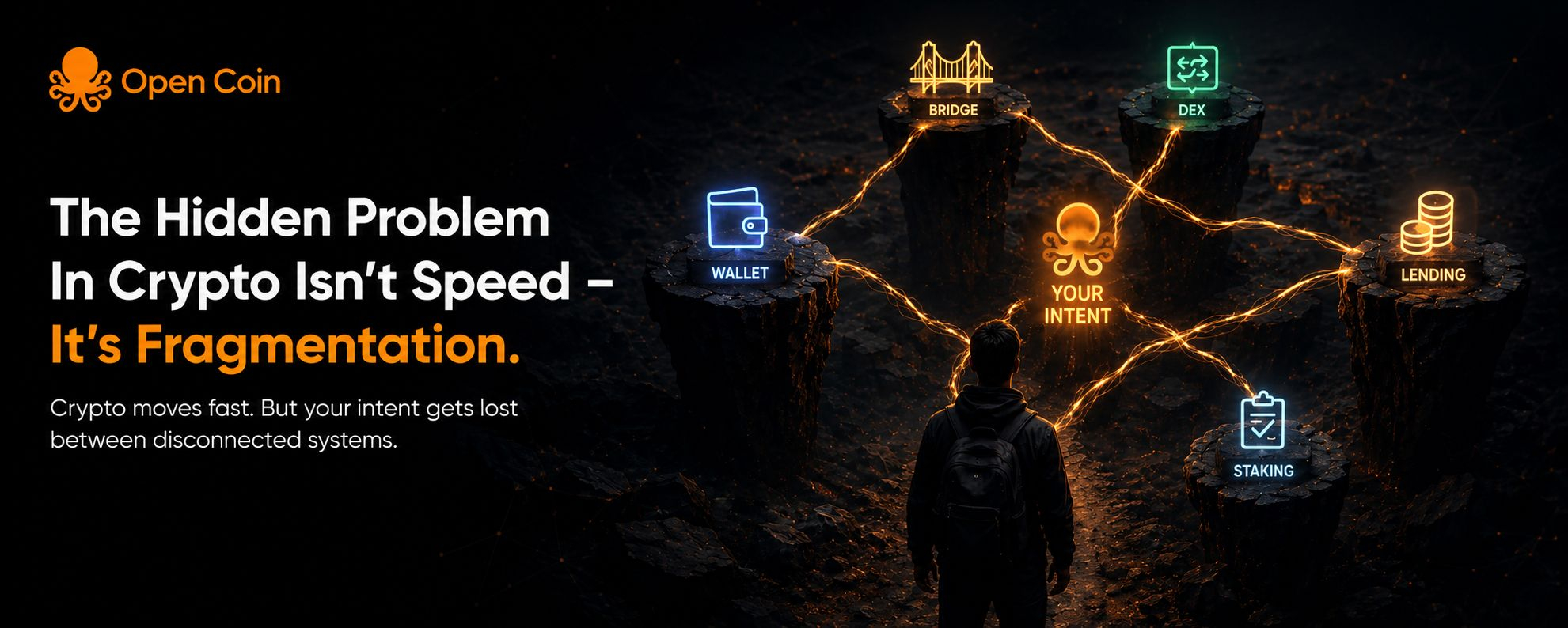
Speed is usually the first thing people notice in crypto.
Faster chains. Faster confirmations. Faster finality. Everything feels tuned for movement, almost like the system is trying to convince you that time was the only real bottleneck.
And for a while, that story made sense.
Traditional finance isn’t slow in a simple way — it’s slow in a procedural way. Too many checkpoints, too many invisible delays, too many moments where you’re just waiting because that’s how the system is designed. So crypto came in and removed the waiting.
At least, that was the idea.
But after spending enough time actually using these systems — not just reading about them or tracking metrics — something starts to feel slightly off in that framing.
Speed stopped being the real constraint earlier than most people admit.
What stayed behind is quieter. Harder to point at.
Fragmentation.
Not just across chains or liquidity, but in how intent actually moves through systems that were never really designed to behave like one environment.
Most crypto interactions don’t feel like a single flow. They feel like switching between separate tools that just happen to be loosely connected.
A wallet to sign.
A bridge to move.
A DEX to swap.
A lending app that assumes a completely different mental model.
Each step works. Individually, nothing is broken.
But the experience doesn’t feel continuous.
And I’ve noticed something personally here — even after you understand how everything works, the friction doesn’t disappear. It just becomes familiar. You stop reacting to it.
You start normalizing jumps that should probably feel strange.
You don’t really “use crypto” as one system. You assemble it, hold the pieces together long enough to finish what you need, and then mentally let it all dissolve again.
Next time, you rebuild the map. Even if it’s the same path.
That part is more exhausting than it sounds, but it’s subtle. You only notice it when you step away for a bit and come back.
People adapt to this quietly.
Experienced users don’t really complain about it anymore. I’ve caught myself doing this too — just bookmarking routes, avoiding certain chains, sticking to flows that feel predictable. Not because they’re perfect, but because they reduce thinking.
That’s not really resolution. It’s just familiarity covering up friction.
New users don’t have that layer yet, so they see everything at once. Every extra step feels unnecessary. Every interface change feels like a break in logic. Every moment where something technically works but doesn’t feel connected stands out immediately.
And that difference is important in a way the industry still underestimates.
Because that’s usually where adoption quietly slows down — not at the level of access, but at the level of comfort with repetition.
Over time, you can see behavior naturally narrow.
Most people don’t explore crypto ecosystems freely. They settle into small, stable paths that feel safe. Known DEXs. Known bridges. Known chains.
Not because everything else is bad, but because switching context has a cost that builds up in the background.
Even if no one explicitly calculates it.
That’s fragmentation showing up as behavior, not just infrastructure.
And it’s sticky. It doesn’t announce itself.
A lot of early infrastructure thinking still focuses on improving individual pieces — faster chains, cheaper fees, better bridges, cleaner interfaces.
But improving parts doesn’t automatically fix what happens between those parts.
Sometimes it even makes the gaps more visible.
Because the real friction was never inside the components. It was always in the transitions.
This is where AI makes things feel slightly different to me.
AI systems don’t experience “platforms” the way humans do. They don’t build habits or tolerance for inconsistency. They just try to execute intent.
And when they hit crypto systems today, what they see isn’t one environment — it’s a collection of partially aligned endpoints.
Different assumptions.
Different data formats.
Different definitions of the same action.
Humans smooth that over with memory and habit. Machines don’t. They just fail more directly.
And I think that matters more than it seems right now.
Because we’re slowly moving toward a world where a lot of interaction won’t be manual anymore. It’ll be agents trying to move across systems continuously, executing intent without pausing at every interface boundary.
And coordination breaks faster than speed ever did.
That part keeps sitting in my head — not as a prediction, more like an unfinished thought.
Because coordination assumes a level of shared structure that doesn’t really exist yet. We have connectivity. We don’t really have consistency.
So intent becomes fragile.
It gets translated slightly at each step. Sometimes it survives. Sometimes it partially lands. Sometimes it just disappears into “something went wrong” without a clear reason why.
People rarely describe it that way though.
They just say it didn’t work. Or it felt confusing. Or they don’t try again.
Simple reactions to something more structural.
And over time, the response is predictable.
People don’t expand their usage infinitely. They narrow it. They find the few paths that consistently work and stay there.
I’ve done this myself more than I’d like to admit.
Which creates this strange contradiction.
The system becomes more capable every year, but most users experience a smaller slice of it in practice.
More infrastructure. Less felt simplicity.
More possibility. Less everyday movement.
And adoption metrics don’t always capture that tension, because access is not the same thing as continuity.
You can give someone access to everything and still end up with them only trusting a small corner of it.
If I step back and look at it honestly, it feels like crypto didn’t just build financial infrastructure.
It built a set of high-performance systems that still don’t fully agree on how to behave like one environment.
Bridges, aggregators, wrappers, middleware — each one solving something real, but also adding another seam in the experience.
None of this is “wrong.” It’s just what early systems look like when growth outpaces standardization.
But the cost of that structure doesn’t show up evenly.
It shows up quietly.
In hesitation before trying something new.
In defaulting to familiar routes even when better ones exist.
In slowly narrowing what people are willing to touch without even realizing it.
And maybe that’s the part I keep coming back to.
Not that crypto is slow.
But that it still doesn’t feel continuous in the one place that actually matters — the moment intent turns into action, and action either feels like one clean movement… or a series of disconnected steps stitched together just well enough to pass.
