
@OpenLedger The deeper I looked into OpenLedger, the more I found myself thinking about something completely outside the world of AI and crypto: franchise businesses.
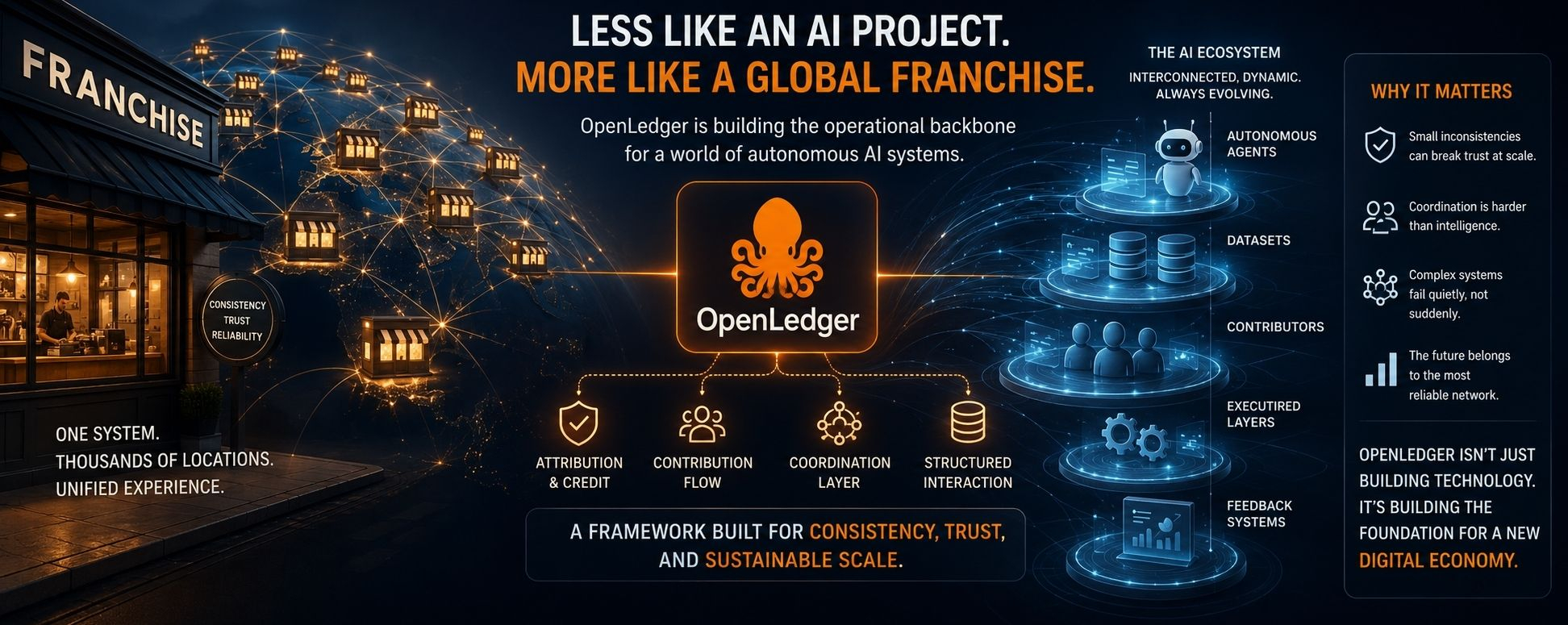
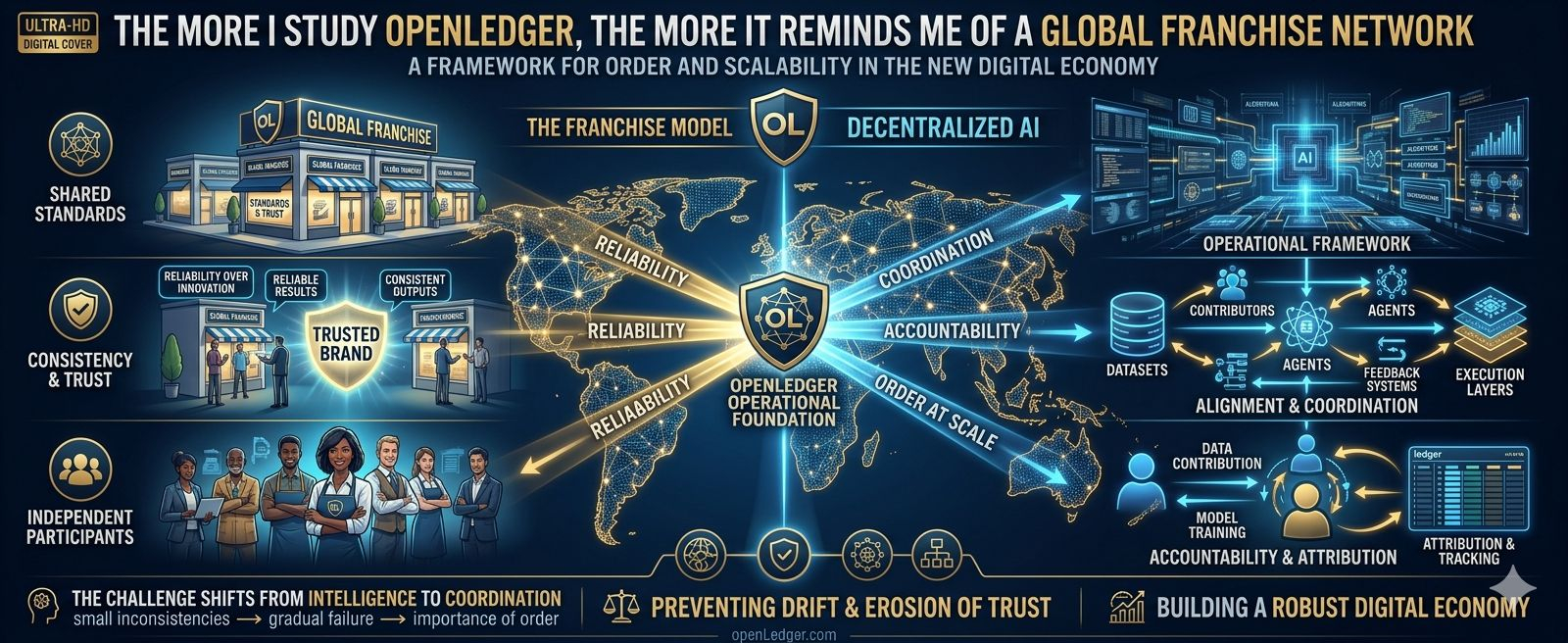
At first, it sounds like an odd comparison. But the connection became hard to ignore. The most successful franchise networks in the world are not built on a single great location. They are built on a system that allows thousands of independent participants to operate under shared standards while still producing reliable results. Customers trust the brand because they know what to expect regardless of where they interact with it. That consistency is what creates long-term value.
As I spent more time understanding OpenLedger, I started seeing a similar philosophy beneath the surface.
Today, most people focus on AI through the lens of outputs. They look at what a model can generate, how fast it responds, or how impressive the results appear. But as AI systems become more integrated into daily life, the real challenge shifts away from intelligence alone. The difficult part becomes coordination. Modern AI is no longer a single model running in isolation. It is becoming an interconnected environment made up of datasets, contributors, autonomous agents, execution layers, feedback systems, and countless moving pieces that constantly influence one another.
Keeping all of those components aligned over time is far more difficult than creating a powerful model in the first place.
That is where OpenLedger continues to stand out to me. Instead of focusing solely on what users see on the front end, the project appears increasingly focused on the operational framework underneath. Attribution systems, contribution tracking, coordination mechanisms, and structured interaction between participants all seem designed around a simple but important idea: large-scale AI networks need order if they are going to remain useful as they grow.
The interesting thing about complex systems is that they rarely fail all at once. Most of the time, problems begin quietly. Small inconsistencies emerge. Data quality starts drifting. Coordination becomes weaker. Outputs become slightly less reliable. Trust erodes gradually, almost invisibly, until people eventually realize the system no longer feels dependable. By that point, the damage has often been building for much longer than anyone noticed.
As AI ecosystems continue expanding, these challenges will only become more important. The future may not belong to the project with the flashiest demonstrations or the loudest marketing campaigns. It may belong to the platform capable of maintaining stability while thousands of independent participants contribute, interact, and build on top of one another simultaneously.
That is ultimately why OpenLedger remains on my radar. What interests me is not simply the technology itself, but the structure supporting it. The project feels less focused on creating a temporary wave of excitement and more focused on building the kind of operational foundation that can support a much larger ecosystem over time.
If AI is moving toward a future where autonomous systems operate continuously beneath the surface of everyday life, then reliability, coordination, and accountability may become more valuable than raw intelligence alone. And from that perspective, OpenLedger starts looking less like another AI project and more like an attempt to build the framework that allows an entire digital economy to function at scale.