
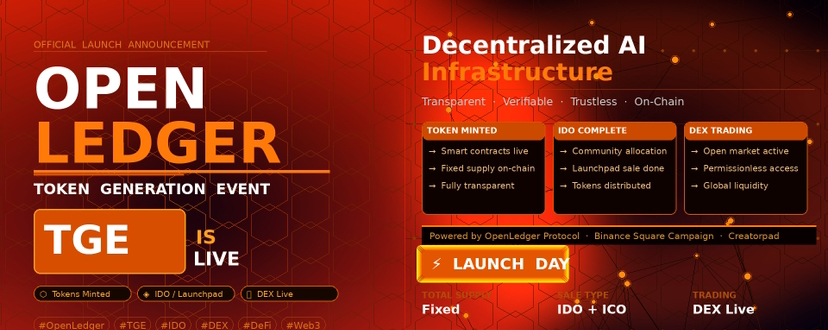
Moment Has Finally Arrived
There are rare moments in the world of blockchain and decentralized technology where you look back years later and say,
“I was there when it happened.”
OpenLedger Token Generation Event is one of those moments.
This is not just another token launch. This is not another project making promises on a white-paper and disappearing six months later.
OpenLedger is a fully built, deeply thought-out infrastructure project that sits at the intersection of two of the most powerful forces reshaping the world today — Artificial Intelligence and Blockchain Technology.
And now, with the TGE live, the tokens minted, the IDO and launchpad sale underway, and DEX trading officially enabled — the OpenLedger ecosystem is open for the world.
If you’ve been following this project from early days, this moment feels earned. If you’re just discovering OpenLedger today, you couldn’t have picked a better time to pay attention.
Let me walk you through everything — what OpenLedger actually is, why the TGE matters, how the token launch unfolded, what DEX trading means for you, and most importantly, why this project carries real substance behind it.
First, Let’s Talk About Problem OpenLedger Is Solving
Before you understand why the TGE is significant, you need to understand what OpenLedger was built to fix.
Artificial Intelligence is no longer a future technology. It is here. It is being used across industries — in healthcare, in finance, in education, in logistics, in content creation, in cybersecurity, and in dozens of other sectors. AI models are being trained, deployed, and relied upon at a scale that would have seemed impossible just five years ago.
But here’s the uncomfortable truth that most people don’t talk about.
AI industry runs on broken foundation:
Right now, the majority of AI development is centralized. A small number of powerful companies control the data pipelines, the computing resources, the model training, and ultimately the outputs that billions of people interact with every day. There is no transparency. There is no accountability. There is no way for the average person — or even most institutions — to verify what goes into the AI models they rely on.
Who owns data that trained model you just used?
Who verified that data was accurate, ethical & unbiased?
Who benefits when that AI model generates value?
Who gets paid when your data contributes to a training dataset?
Honest answer to all four questions is:
you have no idea
This is problem OpenLedger was built to solve.
OpenLedger is decentralised AI infrastructure protocol — foundational layer that brings transparency, accountability, and verifiability to how AI models are built, trained, evaluated, and deployed. It creates an open ecosystem where data contributors, model developers, validators, and end users all operate on a shared, trustless infrastructure governed by cryptographic proofs and on-chain coordination.
Put simply:
OpenLedger makes AI development honest.
What OpenLedger Actually Does
Let’s break down the core mechanics of what OpenLedger is building, because it’s important to understand this before we get to the token.
1. Decentralized Data Contribution
OpenLedger enables data contributors from around the world to supply training data to AI models in a transparent, trackable way. Every contribution is recorded on-chain. There is a clear, auditable trail of what data went into any given AI model — who contributed it, when, under what conditions, and what it was used for.
This solves one of most significant trust problems in AI today. When you know exactly what data model was trained on, you can evaluate whether model is biased, incomplete or un-reliable.
2. On-Chain Model Verification:
Every AI model built on OpenLedger goes through an on-chain verification process. This creates what team refers to as “verifiable AI” standard, where training process, data inputs & model outputs are all trace-able & provable.
Think about what this means for high-stakes applications.
Medical AI model that recommends treatment plans.
Legal AI system that analyzes contracts.
Financial AI tool that evaluates investment risk
In all of these cases, being able to verify model’s foundation is not just desirable, it’s essential.
3. Incentivized Ecosystem Participation:
OpenLedger creates real economic incentives for every participant in the AI development lifecycle. Data contributors are rewarded. Validators are rewarded. Developers are rewarded. This creates self-sustaining fly-wheel where more people participate honestly, more value ecosystem generates for everyone.
4. Open Infrastructure for AI Builders:
Companies can be built directly on OpenLedger’s infrastructure. Instead of paying massive fees to centralized cloud providers or relying on closed-source data pipelines, they get access to an open, competitive market-place for data & computation, governed by transparent rules & enforced by smart contracts.
This is what OpenLedger has been building. And this is what the TGE now unlocks at scale.
Token Generation Event — What Just Happened
TGE is the formal moment when OpenLedger’s native token is created, distributed, and made available to the public. It is the transition from a closed development phase to a fully open, public ecosystem.
Here is exactly what happened, step by step.
Tokens Are Minted:
First act of any TGE is the minting of tokens. In OpenLedger’s case, this means the smart contracts that define the total supply, the distribution schedule, the vesting mechanisms, and the utility of the token were deployed and executed on-chain.
Every token in existence is accounted for from the moment of minting. The smart contract is public. The logic is transparent. There is no hidden supply. There are no backdoor mint functions. The total supply is fixed, and the allocation is publicly verifiable.
This is important because it establishes baseline of trust for everything that follows. Investors, users & broader community can see exactly how many tokens exist, where they are allocated & when they will become available.
For OpenLedger, token minting wasn’t just a technical act — it was a public commitment. The protocol is now fully on-chain. The tokenomics are live. The game has officially started.
IDO and Launchpad Sale:
Following mint, OpenLedger conducted its Initial DEX Offering (IDO) through selected launchpad partners, giving early supporters & community participants opportunity to acquire tokens before open market trading began.
Launchpad process in OpenLedger campaign was structured to prioritize community participation. Projects on launchpad platforms typically have tiered system, participants with higher platform stakes or longer participation history get priority allocation. This is designed to reward genuine long-term community members rather than bots and large capital players who simply want to flip tokens on launch day.
The IDO process for OpenLedger followed this principle. Allocations were distributed. Tokens were claimable. And the community that had been following and supporting OpenLedger’s development finally had a real stake in the protocol.
For many participants, this was the culmination of months — in some cases, over a year — of following the project’s progress. The launchpad sale brought those early believers into the ecosystem with real ownership.
An ICO component, for institutional and strategic participants, also ran parallel to the IDO, allowing select investors who had been following the project’s development to participate at a larger scale. This added a layer of institutional credibility to the launch while keeping the primary community-facing distribution through the decentralized launchpad.
DEX Trading Goes Live:
This is the part that most people in the crypto community were watching closely.
Once the IDO concluded and tokens were distributed to launchpad participants, OpenLedger’s token was listed on decentralized exchanges — enabling open, permissionless trading for anyone in the world.
DEX trading going live is the true public debut of any token. It is the moment where market price discovery begins. It is the moment where anyone — regardless of whether they participated in the IDO — can buy and sell the token freely.
For OpenLedger, this represented a massive shift in accessibility. The protocol, which had previously been accessible only to technical users building on the infrastructure or early community participants, was now open to the entire global crypto community.
The liquidity pools were seeded. Trading pairs went live. The price discovery process began. And the OpenLedger ecosystem was officially, irrevocably, in the hands of its community.
Why Token Matters — Not Just as Price, But as Infrastructure
Here is where I want to slow down and make something very clear, because it’s easy in the excitement of a TGE to reduce everything to price speculation.
OpenLedger token is not just a trading instrument.
It is the functional backbone of the entire OpenLedger ecosystem. Without understanding the token’s utility, you don’t understand what you’re holding or why it has long-term value.
Governance:
Holders of tokens can take part in the governance of the protocol. This entails taking part in the decision-making process regarding issues that define the course of development of OpenLedger, such as modifications of the protocol, addition of features to the protocol, allocations of the treasury and funds to the ecosystem.
It is important to note that by doing this, you get the opportunity to contribute to decisions that will define an entire industry. It is because we are dealing with a protocol that will form the basis of a decentralized AI system.
Staking and Validation:
As a validator for the OpenLedger network, you will be expected to stake your tokens. The staked tokens provide a good way of aligning your interest with those of the token. A validator who behaves honestly earns staking rewards. A validator who acts maliciously loses their stake.
This is the classic proof-of-stake security model, applied to an AI infrastructure context. It is elegant, battle-tested, and directly ties token value to network security.
Data Contribution Rewards:
Data providers that provide training data to AI models on OpenLedger get incentivized in the native token of the platform. It forms an infinite demand cycle, whereby as more and more AI models get developed using the OpenLedger ecosystem, more data becomes available for consumption, leading to rewards being generated.
Developer and Builder Incentives:
Developers working on applications and AI models on the OpenLedger network interact with tokens as part of their operation model. Protocol fees are paid in the token. Grants from the ecosystem treasury are denominated in the token. Marketplace transactions settle in the token.
Every layer of usage creates demand.
Fly-wheel:
When you put all of this together, you see a carefully designed economic flywheel. More development → more demand → more rewards → more participation → better quality → more adoption → more development.
Token is thconnective tissue that makes this flywheel work. It is not just asset, it is economic engine of real ecosystem.
OpenLedger’s Position in Broader Market
Let’s step back and look at where OpenLedger sits in the broader landscape of both crypto and AI.
The intersection of AI and blockchain is one of the hottest narratives in the technology world right now — and for good reason. The problems of centralized AI are becoming harder to ignore as AI systems become more powerful and more deeply embedded in critical infrastructure.
Regulatory bodies around the world are beginning to ask hard questions about AI accountability. Governments are looking at legislation that would require transparency in AI training data. Enterprise buyers are becoming more sophisticated and demanding explainability and verifiability from AI vendors.
OpenLedger is positioned at exactly the right place at exactly the right time.
But let’s be honest — the AI x blockchain space has attracted a lot of projects that are long on vision and short on execution. Whitepapers are cheap. Promises are cheap. What matters is whether a project has actually built something.
OpenLedger has. The infrastructure is not theoretical. The protocol is live. The data contribution mechanisms are functional. The validation framework is operational. The developer tools exist and are being used.
This is a meaningful distinction. When you look at a project that has a working product at the time of its TGE, you are looking at a fundamentally different risk profile than a project that is launching tokens to fund future development.
OpenLedger did work first. TGE is reward, not gamble.
Community Behind OpenLedger
A project is only as strong as the community that believes in it. And in OpenLedger’s case, the community is one of the most compelling parts of the story.
OpenLedger community is not a collection of airdrop hunters looking for the next quick flip. It is a genuinely engaged group of people who understand the problem the protocol is solving and who have taken the time to learn how it works.
You’ll find data scientists who understand why on-chain data provenance matters. You’ll find AI developers who are frustrated with the limitations of centralized infrastructure and see OpenLedger as the alternative they’ve been waiting for. You’ll find blockchain enthusiasts who appreciate the technical sophistication of the protocol’s design. And you’ll find everyday crypto users who simply believe in building a more transparent and equitable internet.
This community diversity is a strength. It means that the conversations happening in OpenLedger’s Discord, Telegram, and forum channels are substantive. People are asking real questions, providing real feedback & contributing real ideas.
Team has been responsive to this community throughout development process. Feedback from community testing rounds has shaped product decisions. Community validators have been among the most active and reliable in the network. Community-produced content has educated thousands of new users about the protocol.
When the TGE launched, this community showed up. The energy was genuine. The participation was real & ownership that came with token distribution felt earned rather than simply purchased.
What Launchpad Experience Was Like
For those who participated in OpenLedger IDO through launchpad, experience was worth re-counting.
Process began weeks before actual TGE, with launch-pad partner announcing upcoming sale & opening registration window. Participants who wanted allocation signed up, completed any necessary KYC or staking requirements, and entered into the lottery or tiered allocation system.
On launch day, the energy in the community was electric. Social media channels lit up. Discord servers saw activity levels they hadn’t experienced before. Everyone was watching the countdown.
When the sale went live, allocations were distributed quickly and cleanly. The smart contract functioned exactly as expected. There were no technical failures, no surprise delays, no confusing processes. For a launch that was this anticipated, that level of execution is more notable than it sounds — many high-profile launches in crypto have been marred by technical problems under the load of simultaneous demand.
Token claiming was smooth. Users who participated in the IDO received their tokens directly to their connected wallets. The moment of seeing those tokens arrive was, for many participants, a real milestone.
When DEX trading went live shortly after, the liquidity pools were active and functioning. Price discovery happened in real time, visible to anyone watching. The market was making its first assessments of OpenLedger’s value.
For launchpad participants who had been in the project since its early days, seeing that price discovery happen — seeing the market begin to reflect the value of what the team had built — was genuinely rewarding.
Binance Square and Why This Campaign Matters
OpenLedger’s Binance Square campaign represents something important: the project’s first major public exposure to the broadest possible audience in the crypto space.
Binance Square is not just a social media platform. It is the content hub of the world’s largest cryptocurrency ecosystem. When a project runs a campaign on Binance Square, it is placing itself in front of millions of crypto users who are active, engaged, and looking for their next meaningful investment and participation opportunity.
For OpenLedger, this is the right moment for that exposure.
TGE is live. The token is trade-able. The ecosystem is open. Bringing new users into the OpenLedger community right now — at the moment when the protocol is fully launched and the token is actively distributed — means those users are joining at the beginning of the next chapter, not arriving late to a party that’s already winding down.
Binance Square campaign is designed to educate. Too many crypto campaigns are purely hype-driven — full of price predictions, moon emojis, and vague promises. OpenLedger’s campaign is different. It is focused on helping people understand what the project actually does, why the TGE matters, and what the token’s real utility is.
That approach is refreshing. It respects the intelligence of the audience. And it builds the kind of community that stays engaged long after the initial launch excitement fades.
If you’re reading this as part of discovering OpenLedger through Binance Square — welcome. You’re in the right place at the right time.
What Happens After TGE?
TGE is the beginning, not the end. Understanding what comes next is important for anyone who wants to think about OpenLedger’s trajectory beyond the immediate launch window.
Ecosystem Expansion:
With the token now live and distributed, OpenLedger can begin accelerating its ecosystem development programs. Grants from ecosystem treasury become available to developers building on protocol. New data pipelines can be established through contributor reward system. New validator nodes can be on-boarded as more participants stake tokens & join network.
TGE essentially multiplies the protocol’s resources and its ability to grow. What was constrained during private development phases is now open to the full power of a decentralized community.
Developer Adoption:
One of most important metrics to watch over coming months is developer adoption. How many AI projects are choosing to build on OpenLedger’s infrastructure? How many data pipelines are being established? How many models are trained & verified on-chain?
These numbers will tell the real story of whether OpenLedger’s vision is translating into tangible ecosystem growth. And given the quality of the infrastructure and the clear market need it addresses, there is strong reason for optimism here.
Protocol Governance Going Live:
As token distribution stabilizes & community finds its foots in post-TGE period, formal mechanisms will become increasingly active. Token holders will begin voting on proposals. Treasury allocation decisions will be made on-chain. Community will start exercising governance power that token represents.
This is when OpenLedger truly transitions from team-led project to community-governed protocol. That transition is one of most important milestones in any decentralized project’s life-cycle & typically marks significant maturation of ecosystem.
Exchange Listings and Liquidity Depth:
Following the initial DEX trading launch, the team will continue working on additional exchange listings to deepen liquidity and broaden access. Centralized exchange listings, when they come, typically bring a new wave of users who are more comfortable with CEX trading interfaces. Each new listing expands address-able market for token & increases number of people who can participate in ecosystem.
Product Road-map Execution:
OpenLedger team has detailed product road-map that extends well beyond TGE. New features, new tools, new integrations & new partnerships are all on horizon. TGE isn’t destination, it’s fuel that powers next phase of building.
A Note on Risk and Responsibility
Any honest discussion of a token launch must include an honest discussion of risk.
Crypto markets are volatile. Token prices fluctuate, sometimes dramatically, in response to market conditions that have nothing to do with the underlying project’s quality. Even excellent projects with working products and strong communities experience significant price volatility, especially in the period immediately following a TGE.
OpenLedger is not immune to these market dynamics.
If you are considering participating in the OpenLedger ecosystem — whether by acquiring tokens, contributing data, building on the protocol, or becoming a validator — you should do so with a clear-eyed understanding of the risks involved.
Do your own research. Understand the tokenomics. Understand the vesting schedules. Understand the competitive landscape. Understand what you own and why you own it.
The purpose of this article is not to tell you what to do with your money. It is to give you the information and context you need to make an informed decision. The project is real. The team is credible. The problem it’s solving is genuine. But the market is always uncertain, and responsible participation means knowing that going in.
Why I’m Genuinely Excited About OpenLedger
Let me be direct here, because I think this is more useful than false objectivity.
I’ve been following the AI x blockchain space for a long time. I’ve seen a lot of projects come and go. I’ve seen whitepapers that looked brilliant turn into nothing. I’ve seen teams with impressive credentials fail to execute. I’ve seen genuinely innovative protocols get buried under poor tokenomics and worse community management.
OpenLedger stands out to me for a specific reason: the problem they’re solving is going to matter more, not less, as time goes on.
The question of AI accountability and transparency is not going away. If anything, it is becoming more urgent with every passing month. As AI systems become more powerful, as they make more consequential decisions, as they become more embedded in the infrastructure of modern life — the question of where did this model come from and can we trust it is going to become one of the defining questions of our time.
OpenLedger is building the answer to that question at the infrastructure level. They’re not building a product that sits on top of the problem — they’re building the foundation that the entire AI industry will eventually need.
That’s a big swing. It takes conviction to build at that level. It takes deep technical expertise to execute it properly. And it takes the right kind of community to sustain it over the long term.
OpenLedger has all three.
TGE is the moment where that vision becomes a public asset — something that belongs to everyone who believes in it, not just the team and early investors.
How to Get Involved
If you’ve read this far and you want to do more than just read about OpenLedger — here’s how to actually get involved.
1. Explore Protocol:
Start with the documentation. OpenLedger’s technical documentation is genuinely well-written and designed for both developers and non-technical users. Understanding what the protocol does at a functional level is the best foundation for any other form of participation.
2. Join Community:
Discord & Telegram communities are active. These are places where you’ll get real-time updates, connect with other participants, ask questions directly to team members & community experts & understand direction project is heading.
3. Acquire Tokens:
With DEX trading now live, you can acquire OpenLedger tokens through any supported decentralized exchange. Make sure you’re using correct contract address from official OpenLedger documentation, crypto space is full of scammers who create fake tokens with similar names. Always verify contract address from official sources before making any transaction.
4. Consider Contributing:
If you have relevant data, development skills or capacity to run validator node, consider contributing to network. Active participation, beyond simply holding tokens, is where real long-term value gets built. It’s also how you develop the deepest understanding of what OpenLedger is and where it’s going.
5. Follow Campaign:
Keep following this Binance Square campaign as it progresses. The campaign will continue producing educational content, updates, and community activities. Staying engaged with the campaign is one of the best ways to stay informed about what’s happening in the OpenLedger ecosystem in real time.
Bigger Picture
Zoom out for a moment.
We are living through a period of profound technological transformation. Artificial intelligence is not a trend. It is fundamental shift in how human society processes information, makes decisions & creates value.
Every major technological shift in history has had a corresponding shift in its underlying infrastructure. The internet needed protocols. Commerce needed payment rails. Finance needed clearing houses. The AI revolution needs its own infrastructure layer — one that is transparent, accountable, decentralized, and trustworthy.
That infrastructure layer does not exist in any meaningful form today. The companies that currently dominate AI are centralized, opaque, and answerable primarily to their shareholders rather than to the broader public that depends on their systems.
OpenLedger is one of the most serious attempts I’ve seen to build that infrastructure layer in a way that actually works — technically, economically, and socially.
The TGE is the moment where that attempt becomes a real public asset. The tokens are minted. They’re distributed. They’re trading. The community owns a piece of this.
Whether OpenLedger succeeds in its mission depends on many things — continued execution by the team, adoption by developers, growth of the data contributor community, market conditions, regulatory environment, and the collective decisions of thousands of token holders making governance choices over years and decades.
None of that is guaranteed. Nothing in technology is guaranteed.
But the foundation is right. The problem is real. The building has begun. And with the TGE now behind us and the full launch of the ecosystem ahead, OpenLedger enters its most important chapter yet.
Final Thoughts
OpenLedger TGE is not a finish line. It is a starting gun.
Everything the team built — the protocol, the data infrastructure, the verification mechanisms, the governance framework, the tokenomics — was preparation for this moment. The moment when the doors open, the community takes ownership, and the real work of growing a decentralized AI ecosystem begins.
If you believe, as I do, that the future of AI must be transparent, verifiable, and accountable — then OpenLedger is building exactly what the world needs.
Tokens are live. Trading is open. Ecosystem is ready.
Only question is whether you want to be part of it.
⚠️ Purely informational & educational content only, not financial or investment advice.
#OpenLedger #BinanceSquare #creatorpad
