
Most people still think the AI race is mainly about intelligence.
Bigger models.
Faster inference.
Better reasoning.
Lower latency.
And to be fair, that’s the most visible part of the market right now. Every few weeks there’s another benchmark, another launch, another wave of claims about which system is now “ahead.”
But the longer I watch this space, the less convinced I am that raw intelligence will be the thing that ultimately defines the next AI economy.
I think the harder problem is something quieter.
Attribution.
Not in the superficial sense of credits or citations, but in the deeper economic sense: who contributed value, how that value gets measured, and whether the system distributing rewards can actually see the invisible layers underneath an output.
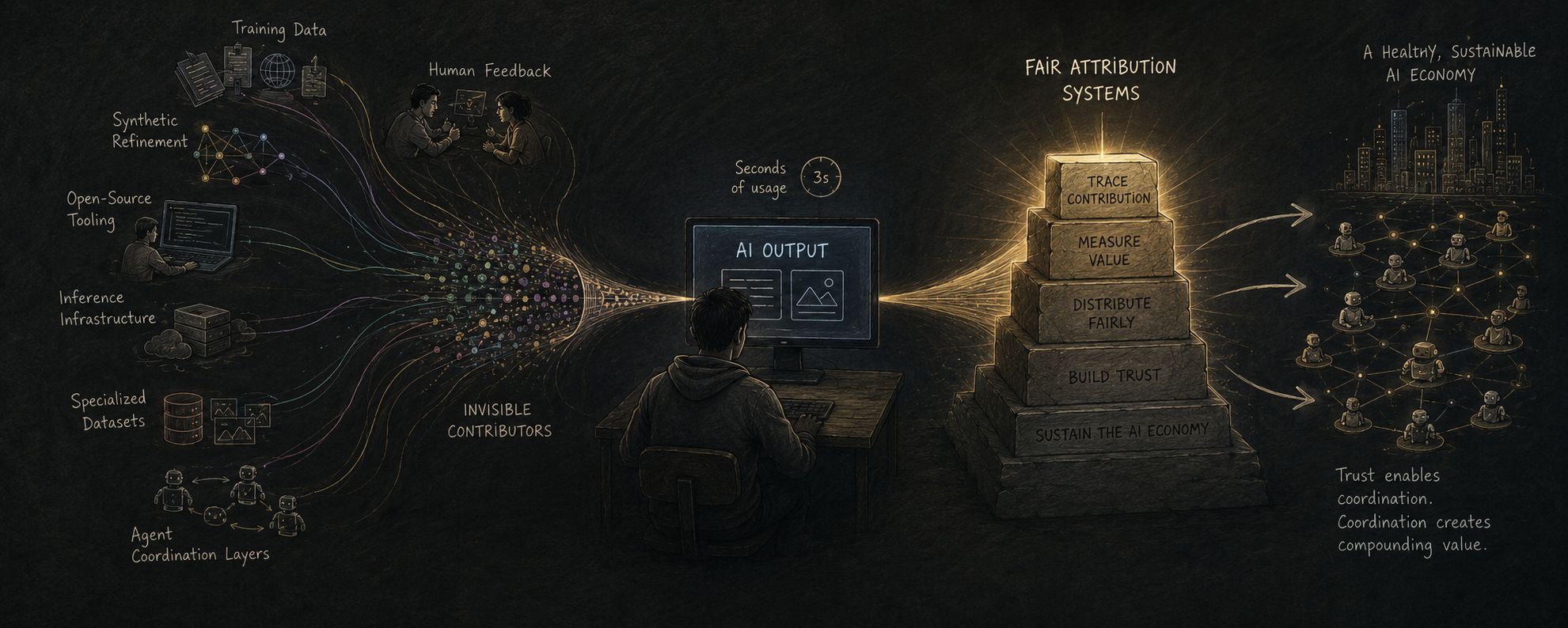
Because modern AI outputs already come from thousands of fragmented inputs stacked together in ways most people barely notice anymore.
Training data.
Human feedback.
Synthetic refinement.
Open-source tooling.
Inference infrastructure.
Specialized datasets.
Agent coordination layers.
An answer generated in three seconds may carry the weight of millions of invisible contributions behind it.
And right now, most systems are surprisingly bad at recognizing that complexity fairly.
That becomes uncomfortable once real economic value starts flowing through AI systems at scale.
The internet already went through a softer version of this problem years ago.
Platforms became extraordinarily good at extracting contribution while becoming increasingly vague about attribution. Content moved faster than recognition did. Algorithms amplified engagement without necessarily preserving origin.
And over time, people adapted to a strange environment where visibility and value became loosely connected.
You can already feel similar tensions starting to appear around AI.
People contribute data without knowing where it ends up.
Models learn patterns without transparent lineage.
Communities improve systems collectively while ownership remains concentrated in a few visible layers at the top.
For now, most users tolerate this because AI still feels novel enough that capability overshadows structure.
But that usually changes once ecosystems mature.
Early infrastructure phases are often misunderstood because users evaluate them emotionally before they evaluate them economically.
People notice outputs first.
The invisible incentive systems underneath come later.
Crypto actually taught this lesson earlier than AI did.
Most crypto experiments weren’t really about tokens in the long run. They were experiments in coordination — attempts to figure out how distributed systems reward participation without relying entirely on centralized trust.
Some failed because incentives were badly designed.
Some failed because extraction became easier than contribution.
Some quietly succeeded because they aligned behavior more carefully than people realized at the time.
That’s why I think the next meaningful AI shift may not come from models becoming dramatically smarter.
It may come from systems becoming dramatically better at tracing contribution.
Because intelligence scales differently once attribution becomes measurable.
Right now, there’s still an assumption floating around that better AI simply means larger centralized systems with more compute and more data.
Maybe that remains true. I’m not fully sure.
But I also think people underestimate how unstable ecosystems become when contributors stop believing the system can recognize their role fairly.
And contribution in AI is becoming increasingly fragmented.
A researcher contributes architecture.
A community contributes refinement data.
A user contributes behavioral feedback without realizing it.
An open-source developer solves a critical optimization issue.
A data provider contributes domain-specific information that improves outcomes later downstream.
Who actually created the value?
The answer gets blurry very quickly.
And blurry attribution systems tend to create behavioral distortions over time.
People either stop contributing openly, or they start optimizing for visibility instead of usefulness.
You can already see traces of this online.
A lot of modern internet behavior quietly revolves around gaming attention because attention became easier to measure than actual contribution quality.
That creates shallow ecosystems eventually.
The thing that interests me about the intersection of crypto and AI is that both industries are now colliding directly into the same coordination problem from different directions.
AI needs trustworthy contribution systems.
Crypto needs real utility layers beyond speculation.
Somewhere in the middle, attribution infrastructure starts becoming economically important rather than philosophically interesting.
And honestly, I don’t think most people find infrastructure compelling while it’s being built.
They notice applications.
They notice interfaces.
They notice products that feel magical.
They rarely notice the accounting systems underneath until those systems fail.
But attribution is basically economic memory.
It determines whether systems can track who added value across increasingly complex networks of interaction.
That becomes even more important once AI agents start interacting with each other autonomously.
Because agents won’t just consume information. They’ll generate outputs, trigger actions, coordinate services, exchange data, and potentially transact economically across systems.
Once that happens, attribution stops being about social recognition.
It becomes settlement infrastructure.
Who contributed what?
Which data improved the outcome?
Which agent initiated the useful action?
Which model generated measurable value versus noise?
Without reliable attribution layers, AI economies risk becoming structurally extractive very quickly.
And extractive systems usually scale faster than sustainable ones at first.
That’s part of what makes this transition hard to read in real time.
The market often rewards visible acceleration before it rewards healthy coordination.
I’ve noticed this personally even when using AI tools casually.
The systems that feel most impressive initially are not always the ones that feel trustworthy after prolonged use.
Sometimes the issue isn’t intelligence at all. Sometimes it’s opacity.
You start wondering where outputs came from.
What trained the behavior.
Whether contributors were acknowledged.
Whether the system itself can distinguish signal from recycled noise.
Those questions sound philosophical right now, but I suspect they become operational later.
Especially once AI-generated content begins recursively training future systems at scale.
At that point, attribution isn’t just about fairness anymore.
It’s about maintaining informational integrity.
And that changes the role of infrastructure entirely.
Because the systems that survive long term may not simply be the systems with the smartest outputs.
They may be the systems capable of sustaining trust between contributors, agents, users, and economic participants over long periods of time.
That’s a much harder problem than improving benchmarks.
Benchmarks are isolated measurements.
Coordination is continuous maintenance.
One scales computationally.
The other scales socially.
And social systems are usually where complexity becomes real.
Maybe that’s why this transition feels easy to underestimate right now.
Attribution infrastructure looks boring compared to model launches. Quiet systems usually do.
But historically, the invisible accounting layers underneath economies end up mattering more than people expect.
Not immediately.
Later.
Usually once enough value starts moving through the system that everyone suddenly realizes trust itself needed infrastructure too.
