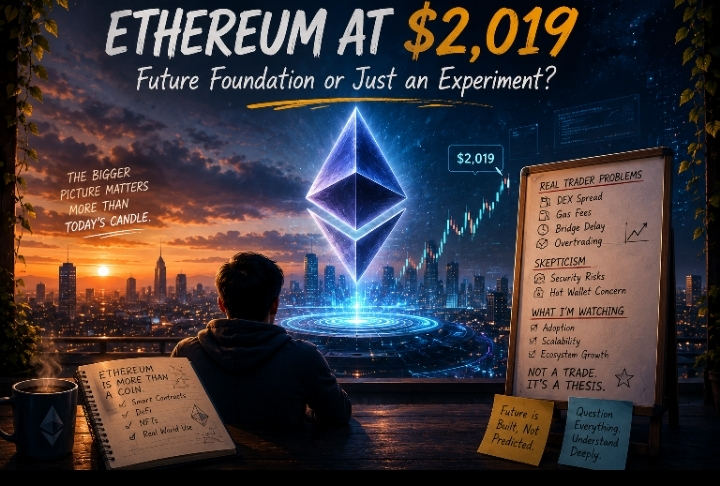
I’ll be honest I wasn’t looking for a deep investment idea when I opened the chart today. I was just checking the market like thousands of other crypto traders do every day. $ETH was sitting around $2,019, moving quietly between buyers and sellers, printing candles that most people would probably forget within a few hours.
But the longer I stared at the chart, the more I realized something interesting. Most of us spend so much time watching price movements that we rarely stop and think about what’s actually being built underneath them.
That made me revisit #Ethereum with fresh eyes, almost as if I had discovered it for the first time.
When people first hear about @Ethereum , they usually think of it as just another cryptocurrency. But Ethereum was never really designed to be only a coin. Its bigger idea was to create a blockchain where developers could build applications, financial tools, and entire digital economies without relying on traditional intermediaries.
That vision changed everything.
Instead of simply transferring value, Ethereum introduced smart contracts pieces of code that execute automatically when certain conditions are met. It sounds technical, but the result is surprisingly simple. Developers gained the ability to create lending platforms, decentralized exchanges, NFT marketplaces, blockchain games, and countless other applications that operate directly on-chain.
Today, a huge part of the crypto ecosystem still runs on Ethereum or technologies built around it. In many ways, Ethereum became the foundation upon which much of modern crypto was constructed.
But theory and reality are often very different things.
Anyone who has spent real time trading on-chain knows that crypto can be frustrating. Decentralized exchanges offer freedom, but DEX spreads can quietly eat into profits. Sometimes the price you expect is not the price you receive. Then there are gas fees. Ethereum has improved significantly over the years, yet many traders still remember paying far more than they wanted just to execute simple transactions.
Bridge delays create another layer of friction. Moving assets between different chains is often marketed as seamless, but in practice it can feel slow and inconvenient when market conditions change quickly. And then there's overtrading a problem that rarely gets discussed enough. Crypto markets never sleep, which means opportunities seem endless. Unfortunately, that also means emotional decisions become incredibly easy to make.
I've seen traders spend hours chasing tiny price movements only to realize later that fees, slippage, and impulsive decisions consumed most of their gains.
That's why I think understanding Ethereum requires looking beyond the marketing narratives.
There is also a healthy amount of skepticism that every investor should maintain.
The crypto industry has matured, but security risks remain very real. Smart contract exploits still happen. Wallet-draining scams continue to evolve. One wrong click can sometimes lead to devastating consequences. Even something as simple as using a hot wallet raises important questions about security versus convenience.
These concerns don't necessarily invalidate Ethereum's vision, but they do remind us that blockchain technology is still developing. Adoption is growing, yet the user experience often remains more complicated than many enthusiasts would like to admit.
Personally, I don't view skepticism as negativity.
In fact, I think skepticism is one of the healthiest qualities an investor can have. The people who ask difficult questions are often the ones who survive long enough to benefit from long-term trends.
Ethereum has spent years trying to address many of its limitations. Layer-2 scaling solutions have emerged to reduce costs and improve transaction speeds. Developers continue working on upgrades designed to increase efficiency and accessibility. The ecosystem keeps evolving because it has to.
Competition certainly isn't standing still. Newer blockchains arrive every year promising faster transactions, lower fees, and smoother user experiences. Some will succeed. Many will disappear. That's simply how innovation works.
Here's my take: Ethereum's greatest strength isn't just its technology. It's the ecosystem that has formed around it. Developers, liquidity, infrastructure providers, institutions, and users have collectively created a network effect that is incredibly difficult to replicate.
Technology can be copied.
Communities, trust, and ecosystems are much harder to rebuild from scratch.
What I'm watching now isn't whether Ethereum doubles next month or falls next week. Short-term price predictions have never interested me as much as long-term adoption trends. Are developers still building? Are users still finding value? Are real-world applications becoming more useful?
Those questions matter far more than a single candle on a chart.
That's why I don't see Ethereum as a trade for next week. I see it as a thesis a long-term bet on the possibility that blockchain-based infrastructure becomes a meaningful part of the future global economy.
Of course, every thesis carries risk. Regulatory uncertainty remains a challenge. Security concerns aren't disappearing overnight. User onboarding still needs improvement. And competition is becoming more intense every year.
Yet despite all those challenges, Ethereum continues moving forward.
As I looked at that $2,019 price level today, I realized the chart itself might be the least interesting part of the story. The real question is much bigger: are we watching the early foundation of a new digital financial system, or are we witnessing one of the most ambitious technological experiments ever created?
The answer may not become clear for years but that's exactly what makes Ethereum so fascinating to watch.