
@OpenLedger The more I study OpenLedger, the more I feel that people are focusing on the wrong thing.
Most discussions start with AI models, blockchain infrastructure, tokenomics, or scalability. But when I look at OpenLedger, none of those feel like the real story. The real story feels much deeper.
It starts with a simple question:
If data is becoming the fuel of artificial intelligence, then who should own the value that comes from it?
For years, the internet trained us to give away information for free. Every search, every post, every interaction became part of a system that generated enormous value somewhere else. AI accelerated that process even further. Models became smarter because of massive amounts of human-created data, yet the people behind that data rarely participated in the upside.
This is where OpenLedger caught my attention.
The project isn't simply trying to build another blockchain. It is trying to build an economic layer around intelligence itself. A structure where data is treated as a productive asset rather than something that disappears into the background once a model is trained.
That idea sounds straightforward at first.
But the moment you think about it seriously, it becomes far more complicated.
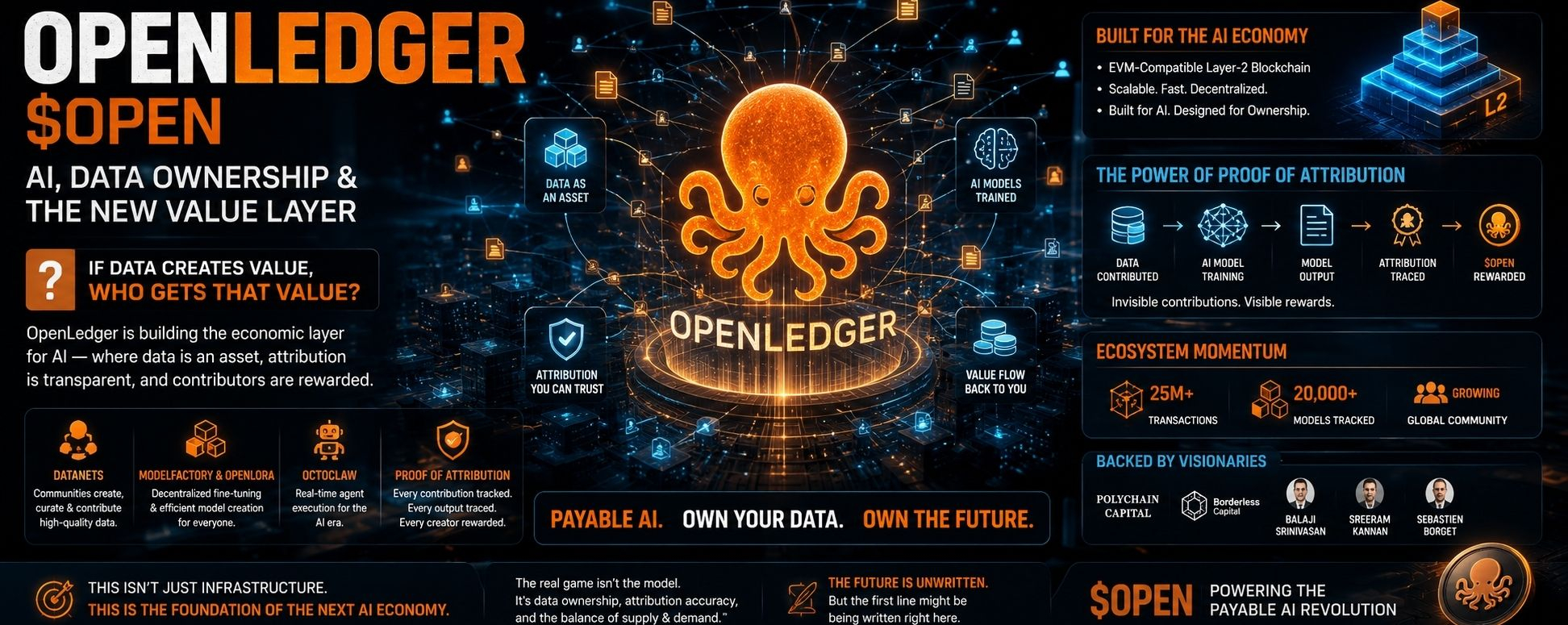
OpenLedger introduces the concept of Datanets, where communities can contribute, organize, and curate specialized datasets that eventually become part of AI training systems. Instead of viewing data as static information, the network treats it like an active component of value creation.
And honestly, that's where things become interesting.
Because participation and value are not always the same thing.
People will contribute when incentives exist. Every network attracts activity when rewards are involved. But the bigger question is whether those contributions remain meaningful after the excitement fades. Can incentive-driven participation evolve into a sustainable ecosystem of genuinely useful data?
I think that question sits at the center of the entire experiment.
Then there is the technical side of OpenLedger.
ModelFactory, OpenLoRA, decentralized fine-tuning, efficient deployment, specialized AI models — all of it points toward a future where building AI becomes more accessible and less dependent on centralized infrastructure.
The vision is ambitious.
Instead of a world where only a handful of companies can afford to build and monetize advanced AI systems, OpenLedger imagines an environment where communities, developers, researchers, and contributors can all participate in the creation process.
But every time I read about these systems, another thought appears in my mind.
Are we looking at infrastructure that is truly ready for large-scale adoption?
Or are we still witnessing the early optimism that often surrounds emerging technology before reality begins testing its limits?
Because building technology is one challenge.
Building behavior around technology is another.
And history has shown that adoption often becomes the hardest problem to solve.
What really separates OpenLedger from most AI projects, however, is something called Proof of Attribution.
This might be the most important part of the entire ecosystem.
Traditional AI operates like a black box. Data goes in, intelligence comes out, and somewhere in between the connection becomes invisible.
Most contributors never know how their information was used.
Most users never know where an answer came from.
OpenLedger is attempting to change that.
The goal is to create a system where AI outputs can be linked back to the data that influenced them, allowing contributors to receive rewards whenever their contributions help generate value.
In theory, it sounds incredibly powerful.
Almost like giving the internet a memory of where intelligence came from.
But this is also where the hardest questions begin.
How accurately can attribution really be measured when modern AI systems learn from countless layers of information?
How do you determine the exact influence of one dataset when models operate through billions of interconnected parameters?
And as systems become more complex, does attribution become easier to verify or harder to prove?
These aren't small questions.
They're fundamental questions.
Because the entire concept of a payable AI economy depends on attribution being trustworthy enough for people to believe in it.
Another part that keeps pulling my attention is how OpenLedger seems to be moving beyond simple AI training and into AI execution.
With systems like OctoClaw and agent-focused infrastructure, the conversation slowly shifts away from models generating responses and toward models taking actions.
That transition feels significant.
The future of AI may not be defined by who creates the smartest model.
It may be defined by who creates the most useful autonomous systems.
And if that future arrives, ownership, accountability, attribution, and governance become even more important than they are today.
Looking at the broader ecosystem, OpenLedger clearly has momentum.
Funding, partnerships, community growth, transaction activity, model development — all the metrics people usually point toward when discussing potential.
And to be fair, those signals matter.
Strong backers bring credibility.
Strong communities bring visibility.
Strong narratives attract builders.
But momentum and adoption have never been the same thing.
Crypto has taught that lesson many times.
Projects can generate enormous attention long before they prove long-term usefulness.
The real test comes later.
When incentives become smaller.
When markets become quieter.
When speculation disappears.
That's when you discover whether people were using something because they believed in it or because they were being rewarded for it.
The token economy creates another layer of uncertainty.
Like every ambitious ecosystem, OpenLedger eventually has to balance vision with economics.
Supply unlocks, market liquidity, user demand, contributor rewards, developer incentives — all of these forces move together whether a project wants them to or not.
A network can have brilliant technology and still struggle if the economic structure fails to create lasting equilibrium.
And that's why I think the future of OpenLedger won't be decided solely by technology.
It will be decided by whether value creation grows at the same pace as value distribution.
Because if those two sides drift too far apart, pressure begins building beneath the surface.
Still, despite all the uncertainty, I keep coming back to the same conclusion.
OpenLedger is asking a question that feels much larger than crypto.
Maybe the next era of AI won't be defined by who owns the biggest model.
Maybe it will be defined by who owns the data, who receives attribution, and who participates in the value being created.
And honestly, I don't think anyone knows the answer yet.
That's what makes this space so fascinating.
It feels early.
It feels unfinished.
It feels uncertain.
But sometimes the most important technological shifts look exactly like that in the beginning.
Maybe OpenLedger becomes a major piece of the future AI economy.
Maybe it becomes a stepping stone that helps the industry discover a better model later.
Either way, one thing feels increasingly clear.
The conversation around AI is slowly moving beyond intelligence itself.
The real conversation is becoming about ownership, attribution, incentives, and where the value generated by AI eventually settles.
And that question may end up being far more important than the models themselves.