
I've been noticing something about crypto that becomes harder to ignore the longer you stay around it. Every cycle seems to arrive carrying a new promise strong enough to convince people that this time things will be different. One year the future belongs to DeFi, then NFTs take over every conversation, later the metaverse becomes impossible to avoid, and now AI sits at the center of attention. The pattern rarely changes. Narratives appear fast, confidence grows even faster, and somewhere down the road many of those stories quietly lose their energy. Maybe that’s simply how this market works nowalways searching for the next direction before the previous one has fully settled.
That’s probably why OpenLedger (OPEN) landed on my radar with more curiosity than excitement.
At first, I treated it like another protocol trying to find its place inside the AI wave. Crypto has trained people to be careful with enthusiasm. Too many projects arrive wrapped in polished language and oversized expectations, promising to reshape industries or unlock entirely new systems, only to struggle once the attention fades and real execution begins.
But after spending some time reading about OpenLedger, I found myself thinking about the idea a little longer than usual.
What caught my attention wasn’t some dramatic promise about changing the world overnight. It was the problem sitting underneath the project.
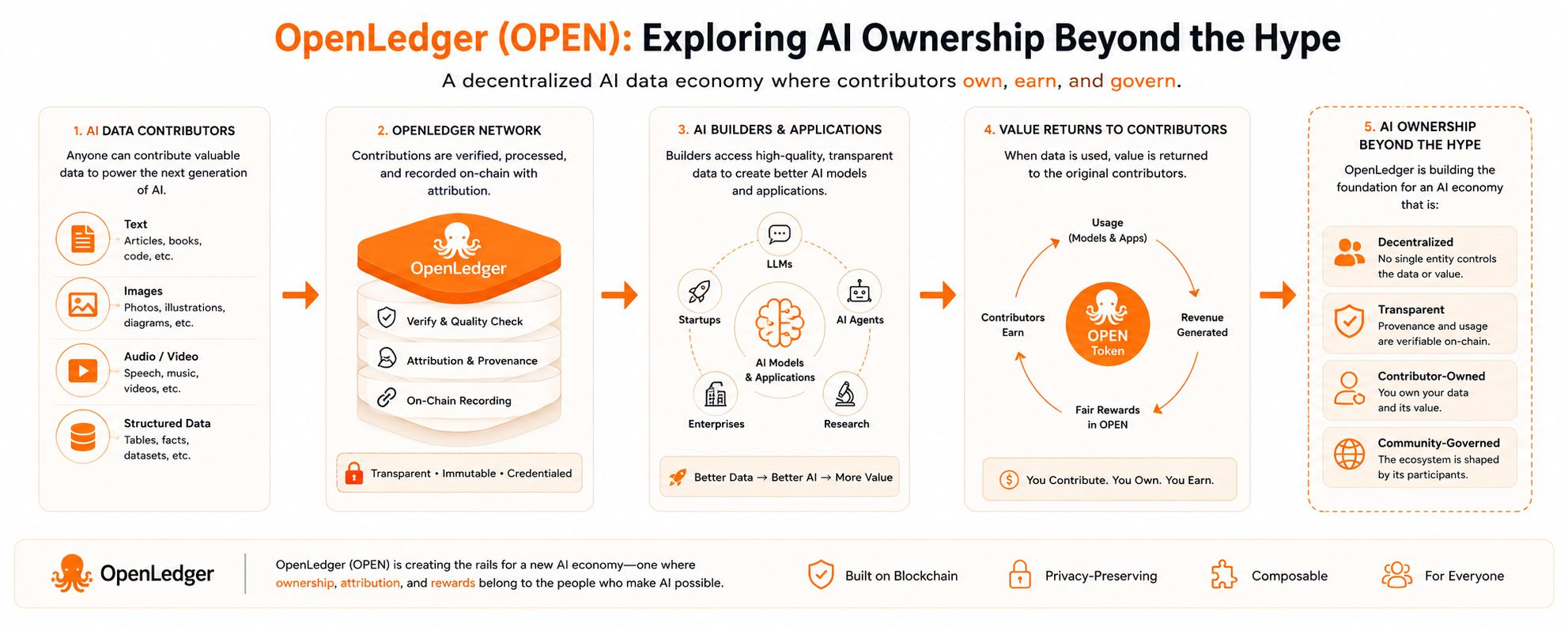
AI is growing quickly, maybe faster than most people expected, but behind every model or intelligent system there is something valuable feeding it—data, trained models, and increasingly agents that perform tasks or produce outputs. Yet the people or systems contributing those resources don’t always have a clear way to benefit from the value being created. OpenLedger seems to focus on that gap.
In simple terms, the idea feels like an attempt to create liquidity around AI resources—making data, models, and agents something that can be tracked, valued, and potentially monetized more openly through blockchain systems.
That sounds interesting in theory.
But theory has never been crypto’s biggest problem.
The industry is full of smart ideas. The difficult part usually starts when those ideas leave online discussions and run into the slower pace of the real world. Traditional industries don’t move with crypto speed. Companies guard their data carefully. Institutions think in terms of regulation, liability, and long-term risk, while crypto often moves through experimentation and momentum. Those two cultures don’t naturally operate on the same timeline.
That’s where I still find myself asking questions about OpenLedger.
The concept makes sense on paper, but adoption rarely follows logic alone. Building infrastructure is one thing. Getting businesses, developers, and real users to trust and rely on it is something entirely different. Crypto sometimes assumes that if technology exists, adoption will automatically follow, but history keeps reminding us that reality is more complicated than that.
At the same time, I can understand why projects like this continue to attract attention.
AI is no longer some distant conversation. It’s becoming part of how people work, create, and make decisions, and that naturally raises questions about ownership and value. Who benefits from the data being used? Who earns from the systems being trained? How should that value move? OpenLedger appears to be stepping into those questions rather than simply attaching itself to a trend.
Whether it succeeds is another matter entirely.
After watching enough crypto cycles, I’ve learned to separate interesting ideas from guaranteed outcomes. A good narrative can travel quickly, but lasting systems usually take much longer to prove themselves. OpenLedger may eventually build something meaningful around AI and digital ownership, or it may discover that the distance between concept and real-world adoption is larger than expected.
For now, I see it as one of those projects worth observing without rushing toward conclusions. Maybe it works, maybe it doesn’t, but at least it seems to be trying to solve something real in a market that often produces more noise than substance.