
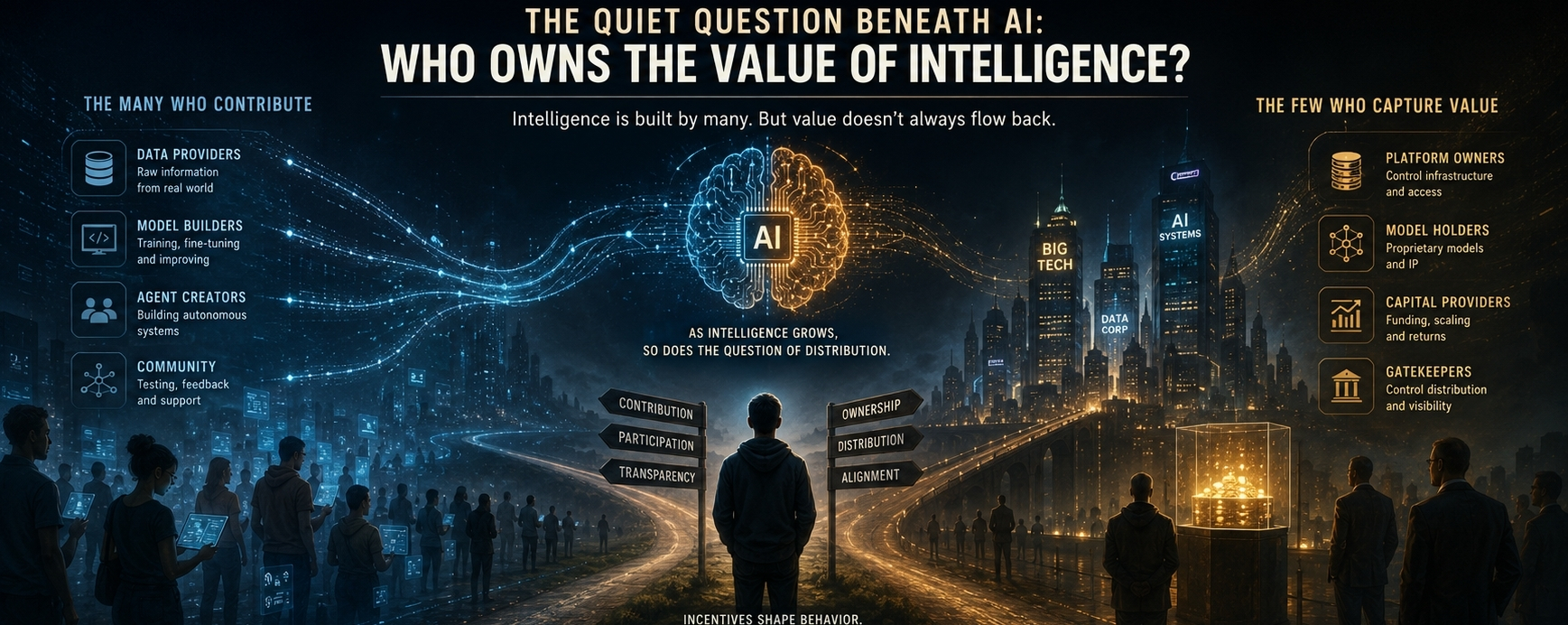
There is a tendency in technology to focus on what is being built while paying less attention to what is being rewarded.
The architecture of a system matters, of course. The models matter. The infrastructure matters. Yet over time I have become increasingly interested in something that sits beneath all of those things: incentives. Not because incentives explain everything, but because they often explain what survives after the initial excitement fades.
When I look at the development of artificial intelligence, I sometimes wonder whether the most important questions are no longer technical. The systems are becoming more capable each year, but capability alone does not determine how value moves through a network. It does not determine who benefits, who participates, or who ultimately has leverage.
That is partly why projects like OpenLedger catch my attention.
Not because they offer certainty, and not because they claim to solve a problem once and for all. What interests me is the question they seem to be exploring. If intelligence increasingly depends on data, models, and distributed contributions from many participants, how should the economic value generated by that intelligence be distributed?
The question sounds straightforward at first. The reality feels less clear.
Historically, large systems tend to concentrate value even when they begin with decentralized ambitions. Scale creates efficiencies. Efficiencies attract capital. Capital attracts coordination. Eventually coordination can begin to resemble concentration. Not always intentionally. Sometimes simply because complexity pushes systems in that direction.
This pattern appears repeatedly.
The internet expanded access to information, yet influence accumulated around a relatively small number of platforms. Open networks encouraged participation, yet participation and ownership often became separate things. Many people contributed. Fewer people captured most of the value.
Perhaps AI will follow a similar path. Perhaps it already is.
At the same time, there is another possibility worth considering. If data, models, and agents become increasingly important economic assets, then new mechanisms may emerge that allow contributors to participate more directly in the systems they help create. Not because fairness suddenly becomes the dominant force in technology, but because alignment of incentives can sometimes produce outcomes that resemble fairness.
The distinction feels important.
People often speak about technology as though it develops independently from human behavior. Yet every system eventually encounters the realities of incentives, competition, reputation, and economic pressure. What appears sustainable at small scale can behave very differently once large amounts of value begin moving through it.
That is where my uncertainty begins.
A network designed to reward contributions sounds compelling in theory. But measuring contribution is rarely simple. Data differs in quality. Models differ in usefulness. Agents differ in effectiveness. Once rewards exist, participants naturally adapt their behavior to maximize them. Sometimes that improves the system. Sometimes it changes the meaning of contribution itself.
The metric becomes the target.
And when the metric becomes the target, something subtle often shifts.
People are still participating in the same system, but they may no longer be participating for the same reasons.
I find myself thinking about this more often than I expected. Not because I distrust incentive structures, but because incentive structures are powerful. They shape behavior quietly. Gradually. Often invisibly. A community can feel unchanged while the underlying motivations are already evolving.
That evolution is not necessarily good or bad.
It is simply what systems do.
Perhaps the future of AI will involve increasingly sophisticated markets around data, models, and autonomous agents. Perhaps liquidity will unlock forms of participation that were previously impossible. Perhaps ownership itself will become more distributed than it has been in earlier technological eras.
Or perhaps the same forces that shaped previous generations of technology will reappear in new forms.
I do not know.
What I do know is that the conversation feels larger than any individual project. It touches something deeper about how intelligence, value, and ownership interact as digital systems become more capable and more economically significant.
The visible story is often about innovation.
The quieter story is about distribution.
Who contributes. Who benefits. Who accumulates influence. Who remains dependent on systems they helped create.
Those questions tend to emerge slowly. Sometimes years after the technology itself arrives.
And as AI continues to evolve, I suspect those questions may become increasingly difficult to ignore.
For now, I find myself observing more than concluding. Watching how different experiments attempt to connect contribution with ownership. Watching how incentives reshape behavior once scale enters the picture. Watching whether new structures genuinely distribute value differently or simply reorganize familiar patterns under new names.
The answers remain unclear.
But sometimes uncertainty is where the most important questions begin.